
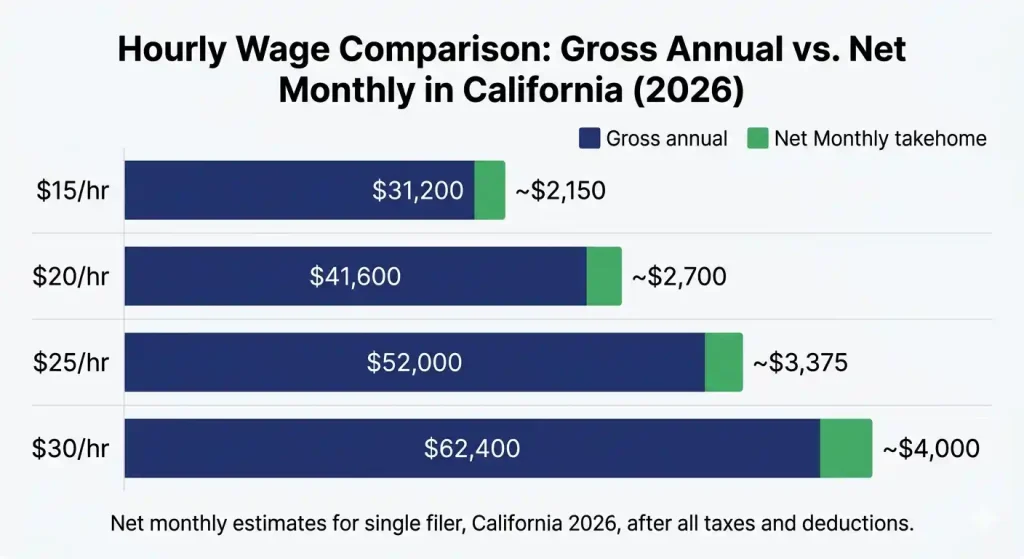
Here is the short answer first. If you work a standard 40-hour week for all 52 weeks in a year, $20 an hour comes out to $41,600 in gross annual income. That breaks down to roughly $3,467 per month, $1,600 every two weeks, or $800 per week before any deductions. Those are clean, round numbers. But your real take-home pay after taxes will be noticeably lower, and whether that net income is enough to live comfortably depends almost entirely on where you live and how you manage your money.
In this guide, we are going to walk through every angle of earning 20 dollars an hour. You will see the exact yearly, monthly, and weekly breakdowns. You will learn what happens to your paycheck after federal and state taxes. We will compare this wage against the national cost of living in different states, look at dozens of jobs that pay this rate with and without a degree, and lay out a practical budget you can start using today. If you have been offered a position at this rate or you are simply trying to figure out whether your current pay is keeping up, everything you need is right here.
How to Convert a 20$ an Hour Salary Into Yearly, Monthly, and Weekly Pay
Before you can plan a budget, negotiate a raise, or compare two job offers, you need to know exactly what your hourly wage translates to across every pay period. The formula is simple, but a surprising number of people get it wrong because they forget about variables like unpaid time off and inconsistent schedules.
The Basic Math Behind 20 an Hour to Salary
The standard calculation assumes full-time work with no unpaid breaks throughout the year. Multiply $20 by 40 hours per week, then multiply that result by 52 weeks in a year. The answer is $41,600 in gross annual pay. From there, you can slice it into smaller time frames. Your monthly gross income would be approximately $3,467. If your employer pays biweekly, which most do, you will receive 26 paychecks of $1,600 each before deductions. Your weekly gross is $800, and for a single eight-hour shift, you earn $160.
One thing worth noting is that two of those 26 biweekly paychecks are essentially “bonus” checks in months that happen to have three pay periods instead of two. Plenty of people budget around two paychecks per month and then treat those extra checks as a windfall for savings or debt payoff. It is a small mental trick, but it works.
What Changes When You Work Fewer Than 40 Hours
Not everyone works a full 40-hour schedule, and if you are hourly rather than salaried, every missed shift hits your bottom line directly. At 35 hours per week, your annual gross drops to $36,400. Cut it down to 30 hours and you are looking at $31,200 per year. At 25 hours a week, the total falls to just $26,000.
The difference between these numbers is not trivial. A single missed week at $20 per hour costs you $800 in gross income, and unlike salaried positions, there is no built-in safety net for sick days, slow seasons, or schedule reductions. This is why financial advisors consistently recommend that hourly workers build their budgets around their realistic average weekly hours, not their best-case scenario. If you typically work 37 or 38 hours rather than a full 40, your annual income could be $2,000 to $3,000 less than the $41,600 figure you see quoted everywhere. That gap matters when rent is due.
Yearly Salary for 20 Dollars an Hour After Taxes
Gross pay is only half the story. What actually lands in your bank account each month is what you can spend, save, and live on. Understanding your after-tax income is the single most important step in building a realistic budget around a 20 an hour salary.
Federal Tax, Social Security, and Medicare Deductions
For a single filer in 2026, the standard deduction is approximately $14,600. That means if your gross income is $41,600, your federal taxable income drops to about $27,000. At that level, you fall squarely into the 12 percent federal income tax bracket, which results in roughly $3,200 to $3,300 in federal income tax for the year.
On top of that, every worker pays FICA taxes, which fund Social Security and Medicare. The employee share of FICA is 7.65 percent of gross wages, broken into 6.2 percent for Social Security and 1.45 percent for Medicare. On $41,600, that works out to approximately $3,182. When you combine federal income tax and FICA, you are looking at total federal deductions in the range of $6,000 to $6,500 per year. That leaves you with roughly $35,100 to $35,600 in after-federal-tax income, or around $2,925 to $2,967 per month.
How State Income Tax Shifts Your Take-Home Pay
Your state of residence can make a meaningful difference in how much of your paycheck you keep. Seven states charge zero state income tax: Texas, Florida, Nevada, Wyoming, Tennessee, Washington, and South Dakota. If you live in one of these states and earn $20 an hour, your take-home pay stays at that $35,100 to $35,600 range after federal taxes only.
Compare that to California, where state income tax at this income level runs between 4 and 6 percent, or New York, where you can expect to lose another 4 to 5 percent. That translates to an extra $1,600 to $2,500 per year coming out of your paycheck. Over a decade, that gap adds up to tens of thousands of dollars. The practical takeaway is that the yearly salary for 20 dollars an hour ranges from roughly $33,000 to $35,600 in net income depending almost entirely on your zip code. Two workers earning the exact same hourly rate can have very different financial lives simply because one of them lives in Houston and the other lives in Los Angeles.
Is a 20 an Hour Salary Enough to Live On in 2026?
This is the question that really matters, and the honest answer is that it depends. Not on luck or wishful thinking, but on measurable factors like your location, your household size, and how deliberately you handle your money.
How $20 Per Hour Compares to National Averages
The median individual income in the United States currently sits in the range of 41,600 to $45,000 per year, which means a 20 an hour salary puts you right around the national midpoint. You are earning roughly what the typical American worker brings home. The federal minimum wage, by contrast, is still $7.25 per hour, so at $20 you are earning nearly three times that floor. Many states have pushed their minimum wages higher, with some reaching $15 to $17 per hour in 2026, but $20 still sits comfortably above those benchmarks.
That said, the average individual income in the United States is closer to $65,000 when you factor in high earners in technology, finance, and medicine. That average is pulled upward by outliers, so it is not the best comparison for most workers, but it does highlight that $20 an hour is solidly middle-of-the-road rather than high-earning territory. For dual-income households where both partners earn this rate, the combined gross of $83,200 exceeds the median household income and opens the door to significantly more breathing room in a monthly budget.
Cost of Living — Where 20 Dollars an Hour Goes the Furthest
Geography is the wildcard that turns a 20$ an hour salary into either a comfortable living or a constant struggle. In states like Oklahoma, where the cost of living runs roughly 17.8 percent below the national average, or Arkansas, where it is 22.5 percent below average, $20 an hour stretches much further than most people expect. States like Iowa, Mississippi, Kansas, Wisconsin, and North Dakota also offer significantly lower housing, grocery, and transportation costs. A one-bedroom apartment in these markets often rents for under $700 per month, leaving plenty of room in the budget for savings and discretionary spending.
On the other end of the spectrum, high-cost metro areas make this wage genuinely difficult. In California, average one-bedroom rent in cities like Los Angeles, San Francisco, and San Jose regularly exceeds $1,800 per month. New York City, Boston, Seattle, and Honolulu present similar challenges. The widely recommended 30 percent rule says your housing costs should not exceed 30 percent of your after-tax income. At approximately $2,925 per month in net pay, that cap is around $878. You can find apartments in that range in cities like Columbus, Indianapolis, San Antonio, and the suburbs of Raleigh. But in coastal metros, $878 will barely cover a shared room, let alone a full apartment.
The bottom line is that location is the single biggest factor in whether this pay rate feels stable or stressful. If you have the flexibility to choose where you live, that choice alone could be worth thousands of dollars per year in effective purchasing power.
Jobs That Pay a 20$ an Hour Salary With and Without a Degree
One of the most encouraging things about the $20 per hour mark is that you do not necessarily need a four-year college degree to reach it. There are dozens of roles across multiple industries that pay this rate or higher to candidates with certifications, trade training, or relevant experience instead of a bachelor’s diploma.
Entry-Level and No-Degree Roles at $20 Per Hour
Customer service representatives are among the most accessible positions at this pay level, and the rise of remote work has expanded these opportunities significantly. Many companies now offer $20 or more per hour for phone- and chat-based support roles that you can do from home. Medical assistants and dental hygienists also commonly start at this rate, requiring a certification or associate degree rather than a full four-year program. Delivery and truck drivers are another strong option. A commercial driver’s license is required, but not a college degree, and entry-level regional drivers typically earn between $18 and $22 per hour with experienced long-haul drivers exceeding $30.
Warehouse supervisors, logistics coordinators, and administrative assistants round out the no-degree category. Patient care coordinators, for example, earn between $20 and $23 per hour in many healthcare settings. On the freelance side, virtual assistants, freelance writers, and social media managers frequently charge $20 or more per hour once they build a modest client base.
Skilled Trades and Career-Track Positions
If you are willing to invest in trade school or an apprenticeship, the earning potential at the $20 per hour starting point climbs steeply over time. Electricians, plumbers, and HVAC technicians often begin their apprenticeships near $20 an hour and can reach $30 to $52 per hour within a few years of earning their full licenses. Solar panel installers represent one of the fastest-growing trades in the country, with the Bureau of Labor Statistics projecting over 20 percent job growth through the next decade. Starting wages in solar installation typically range from $18 to $25 per hour.
Licensed practical nurses, physical therapy assistants, IT help-desk technicians, paralegals, and medical coders all fall in or near the 20 an hour salary range at the entry level. The critical point here is that most of these roles treat $20 per hour as a launchpad, not a ceiling. With experience, additional certifications, and consistent performance, workers in these fields regularly move into the $25 to $35 range within two to four years.
Smart Budgeting When You Earn 20 an Hour
Earning a decent wage only matters if you have a plan for where the money goes. Without a budget, even $20 an hour can disappear into a cycle of paycheck-to-paycheck living. With one, this income can cover your essentials, build a safety net, and still leave room for the things you enjoy.
A Realistic Monthly Budget on Roughly $2,925 Net Income
Here is a practical starting framework that works for most single adults earning 20 dollars an hour in a mid-cost area.
Housing should take up no more than 30 percent of your net income, which caps your rent or mortgage payment at about $878. In mid-size cities, this comfortably covers a one-bedroom apartment. With a roommate, it becomes even easier, and you free up $300 to $500 per month for other priorities.
Transportation typically runs around 15 percent, or approximately $440 per month. That covers a modest car payment in the $200 to $300 range, plus insurance and gas. If you live in a city with reliable public transit, this category can shrink considerably. Groceries and food should land between 10 and 12 percent of your budget, roughly $290 to $350 per month. Meal planning and cooking at home make this number very achievable. Eating out frequently, on the other hand, can blow past it quickly.
Utilities, phone, and internet together typically cost between $150 and $200 per month. If you are carrying debt, setting aside $150 to $250 for monthly payments keeps you moving in the right direction without suffocating your cash flow. Savings should be treated as a non-negotiable expense, not an afterthought. Even 10 percent, which is about $290 per month, builds a $10,000 emergency fund in roughly three years. That kind of cushion turns minor financial surprises into minor inconveniences instead of full-blown crises.
Whatever remains, usually between $200 and $400, covers personal spending, entertainment, clothing, and anything else that makes life enjoyable. The key is to assign a purpose to every dollar before you spend it.
Tips to Stretch Every Dollar Further
Small habits create large results over time. Tracking your spending with a budgeting app often reveals patterns you would never notice otherwise. Many people discover they are spending $100 to $200 per month on convenience store runs, vending machines, and subscriptions they forgot they signed up for. If you contribute to a retirement account, you may qualify for the Saver’s Credit, which is worth up to $1,000 as a direct reduction on your tax bill. Workers with qualifying children may also be eligible for the Earned Income Tax Credit, which can put several thousand dollars back in your pocket at tax time.
Negotiating recurring bills at least once a year — especially insurance, internet, and phone plans — typically saves $30 to $60 per month with a single phone call. Cooking in batches, buying store-brand groceries, and using cashback apps can shave 15 to 20 percent off your food costs without any real sacrifice in quality.
How to Move Beyond a 20$ an Hour Salary
A 20$ an hour salary is a solid foundation, but it does not have to be your permanent ceiling. Even modest increases in your hourly rate create surprisingly large improvements in your annual income. A $5 per hour raise, for example, adds over $10,000 per year to your gross pay. That is not pocket change — it is a vacation fund, a faster path to homeownership, or a fully funded retirement contribution.
Upskilling and Certifications That Boost Hourly Pay
The fastest way to move past the $20 mark is to acquire a credential that makes you measurably more valuable to employers. In the IT field, a CompTIA A+ or Network+ certification can push your hourly rate into the $25 to $30 range. A commercial driver’s license opens the door to trucking roles that pay $30 or more. HVAC licensing, phlebotomy certification, medical coding credentials through the AAPC, and project management certifications like the CAPM or PMP all carry strong returns on a relatively small investment of time and money.
Skilled trades apprenticeships deserve special mention because they allow you to earn while you learn. An electrician or plumber who enters an apprenticeship near $20 per hour can realistically reach $30 to $35 per hour within two to three years of completing their program. Many of these paths are available through community colleges, trade schools, or online platforms and can be completed in under six months.
Negotiation, Side Income, and Long-Term Strategy
One of the most underused tools for increasing your pay is simply asking. A surprising number of workers never request a raise, and the worst thing that can happen is hearing “not right now.” The best approach is to document your contributions before the conversation. Write down the problems you have solved, the money you have saved the company, and the responsibilities you have taken on beyond your original job description. Present those results when you sit down with your manager.
Beyond your primary job, a side income stream can accelerate your financial progress significantly. Freelancing, gig delivery work, tutoring, selling photography online, and digital marketing consulting are all realistic options that can add $500 to $1,500 per month depending on the time you invest. Think beyond the hourly rate itself as well. Benefits like an employer-matched 401(k), company-paid health insurance, and tuition reimbursement programs can add thousands of dollars in annual value that do not show up on your paycheck stub but absolutely improve your financial position.
Frequently Asked Questions About Earning 20 Dollars an Hour
1. How much is a 20$ an hour salary per year before taxes? A full-time worker earning $20 an hour makes $41,600 per year before any deductions. This assumes a standard 40-hour workweek across all 52 weeks of the year, totaling 2,080 paid hours annually.
2. How much is $20 an hour per month? At $20 per hour with full-time hours, your gross monthly income is approximately $3,467. This is calculated by dividing the annual salary of $41,600 by 12 months, though actual monthly paychecks may vary slightly depending on the number of working days in each month.
3. What is the biweekly paycheck for $20 an hour? Your gross biweekly pay at $20 per hour is $1,600, based on 80 hours across two standard workweeks. Most employers use 26 biweekly pay periods per year, which means two months out of each year will include three paychecks instead of two.
4. How much does $20 an hour equal per week and per day? At 40 hours per week, $20 an hour equals $800 per week before taxes. For a single eight-hour shift, that comes to $160 per day. These are gross figures and do not reflect tax withholdings or benefit deductions.
5. How much does a 20$ an hour salary add up to if you only work part-time? Part-time income varies by hours worked. At 30 hours per week, $20 an hour equals $31,200 per year. At 25 hours, it drops to $26,000, and at 20 hours, the annual total is just $20,800 before taxes.
6. How much is $20 an hour after taxes? After federal income tax and FICA deductions, most single filers earning $20 an hour take home between $33,000 and $35,600 per year. The exact amount depends on filing status, state income tax, and any pre-tax deductions like a 401(k) or health insurance.
7. What is the monthly take-home pay on a 20$ an hour salary? After federal taxes and FICA, a single filer working full-time at $20 per hour typically takes home approximately $2,925 to $2,967 per month. Workers in states with income tax, such as California or New York, will see even lower monthly deposits.
8. How much tax do you pay on $20 an hour? On a gross annual income of $41,600, a single filer pays roughly $3,200 to $3,300 in federal income tax and about $3,182 in FICA taxes (Social Security and Medicare combined). Total federal deductions typically fall in the $6,000 to $6,500 range, though state taxes can add $1,600 to $2,500 more.
9. Does $20 an hour pay more in states with no income tax? Yes, significantly. Workers in zero-tax states like Texas, Florida, Nevada, and Wyoming keep $1,600 to $2,500 more per year than workers at the same wage in states like California or New York. Over a full career, that difference compounds into tens of thousands of dollars in additional savings.
10. What is the hourly take-home rate on a 20 an hour salary after taxes? After federal taxes and payroll deductions, most full-time workers earning $20 per hour effectively take home about $15 to $17 per hour. Contractors typically keep even less because they must pay self-employment taxes and cover their own benefits, bringing effective take-home closer to $13 to $15 per hour.
11. Is a 20$ an hour salary considered good in 2026? It falls near the U.S. median individual income of roughly $41,600 to $45,000 per year. In affordable states like Oklahoma, Arkansas, and Mississippi, it provides a comfortable lifestyle for a single adult. In high-cost metros like San Francisco, New York City, or Los Angeles, it can feel tight without a second income or roommates.
12. Can you live on your own making $20 an hour? In mid-cost and low-cost cities, yes. A net income of roughly $2,925 per month can cover a one-bedroom apartment, transportation, groceries, and modest savings. In high-cost coastal metros, living alone on this wage without supplemental income is very difficult because rent alone often exceeds the recommended 30 percent budget cap.
13. How much rent can you afford on $20 an hour? Using the widely recommended 30 percent rule, a worker earning $20 an hour can afford up to $878 to $1,040 per month in rent, depending on whether you calculate from net or gross income. This budget fits one-bedroom apartments in cities like Columbus, Indianapolis, San Antonio, and Raleigh suburbs, but falls short in most coastal metros.
14. Can you support a family on a 20 dollars an hour salary? Supporting a family on $20 an hour as the sole income is challenging in most parts of the country. For a single-income household, the $41,600 gross salary often falls below what researchers like the MIT Living Wage Calculator estimate as a livable wage for families. A dual-income household where both partners earn $20 an hour, however, reaches a combined $83,200 and gains significantly more financial flexibility.
15. What states can you live comfortably on $20 an hour? States with a cost of living well below the national average offer the most comfort at this wage. Oklahoma (17.8 percent below average), Arkansas (22.5 percent below), Mississippi, Iowa, Kansas, West Virginia, and Wisconsin are among the most affordable. Workers in these states benefit from lower housing costs, cheaper groceries, and in some cases no state income tax.
16. What jobs pay a 20$ an hour salary without a college degree? Dozens of roles pay $20 an hour or more without requiring a four-year degree. Common examples include customer service representatives, truck drivers, medical assistants, warehouse supervisors, dental hygienists, delivery drivers, administrative assistants, freelance writers, and virtual assistants. Many of these are available as remote positions in 2026.
17. What skilled trades start at $20 an hour? Electrician, plumber, and HVAC technician apprenticeships commonly start near $20 per hour, with fully licensed tradespeople reaching $30 to $52 per hour within a few years. Solar panel installer roles also start in the $18 to $25 range and are growing at over 20 percent through the next decade, according to the Bureau of Labor Statistics.
18. Is $20 an hour above minimum wage? Yes, by a wide margin. The federal minimum wage is $7.25 per hour, making $20 nearly three times that floor. Even in states with higher minimum wages, which range from $10 to $17 per hour depending on the state, $20 still sits comfortably above the legal minimum in every U.S. jurisdiction.
19. How should you budget on a 20 an hour salary? A practical starting budget at roughly $2,925 per month in net income allocates 30 percent to housing (about $878), 15 percent to transportation ($440), 10 to 12 percent to groceries ($290 to $350), 5 to 7 percent to utilities ($150 to $200), and 10 percent to savings ($290). The remainder covers debt repayment, personal spending, and discretionary expenses.
20. Can you buy a house on $20 an hour? It is challenging as a solo buyer in most U.S. housing markets, but not impossible in affordable regions. Lenders typically look at your gross monthly income of $3,467 to determine mortgage qualification. In areas where median home prices fall below $200,000, a single earner at this wage may qualify, especially with a strong credit score and a modest down payment saved.
21. How much can you save per month earning $20 an hour? Setting aside 10 percent of your after-tax income puts roughly $290 per month into savings. At that rate, you could build a $10,000 emergency fund in about three years. Workers who qualify for the Saver’s Credit (up to $1,000) or the Earned Income Tax Credit can accelerate their savings further at tax time.
22. What is time and a half for $20 an hour? Time and a half at $20 per hour is $30 per hour. Under the Fair Labor Standards Act, non-exempt employees must be paid at least 1.5 times their regular hourly rate for every hour worked beyond 40 in a single workweek. If you work 10 overtime hours in a week, that adds $300 in gross pay on top of your regular $800 weekly earnings, bringing your total to $1,100 for that week.
23. How can you increase your pay beyond a 20$ an hour salary? The most effective strategies include earning industry-recognized certifications (CompTIA, CDL, HVAC licensing, medical coding), completing a skilled trades apprenticeship, negotiating a raise based on documented contributions, and developing a side income through freelancing or gig work. Even a $5 per hour raise adds over $10,000 per year to your gross income.
24. How does a 20$ an hour salary compare to the national average income? A 20$ an hour salary of $41,600 per year falls close to the U.S. median individual income but sits well below the national average income of approximately $63,000 to $65,000, which is pulled upward by high earners in fields like technology, finance, and medicine. For a dual-income household where both partners earn $20 an hour, the combined $83,200 exceeds the median household income and puts the family in a solid financial position in most parts of the country.
Final Thoughts
A 20$ an hour salary translates to $41,600 per year before taxes and roughly $33,000 to $35,600 after deductions depending on where you live and how you file. Those numbers put you near the center of the American income spectrum — above minimum wage by a wide margin, but below the averages that high earners pull upward.
Whether this wage feels comfortable or limiting comes down to three things: your location, your budget, and your willingness to grow. In an affordable state with disciplined spending habits, $20 per hour covers your essentials, builds an emergency fund, and leaves room for a life you actually enjoy. In a high-cost metro without a plan, it can feel like running on a treadmill.
The good news is that $20 an hour does not have to be your destination. It is a starting point. With the right certifications, negotiation skills, and a commitment to improving your financial habits, this rate can serve as the foundation for earning $25, $30, or well beyond. The people who move past this mark are not always the most talented or the luckiest. They are the ones who understood their numbers, made a plan, and followed through.
Use the breakdowns, budgeting framework, and career strategies in this guide as your starting point. Know exactly what you earn, know exactly where it goes, and take one deliberate step each month toward the next level. That is how a 20 an hour salary stops being a ceiling and starts being a launchpad.