
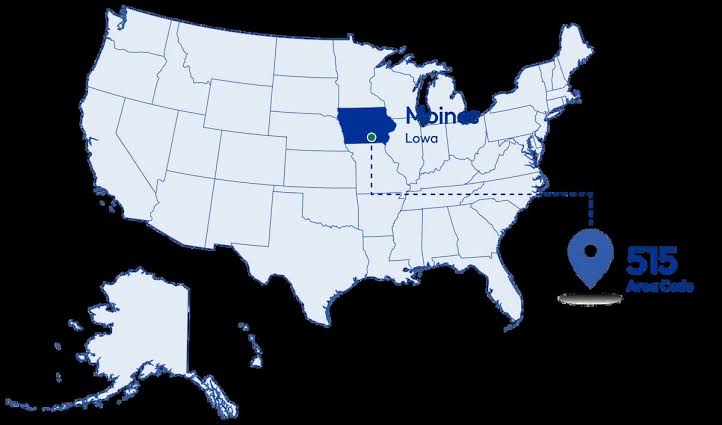
You glance at your phone and see a missed call from an unfamiliar number. The first three digits read 515, and your mind starts running through possibilities. Is it a client from Des Moines? A university admissions office in Ames? Or just another robocall trying to steal your personal information? If that scenario sounds familiar, you are not alone. Millions of people across the United States encounter this number every day, whether on their caller ID, on a street address sign, or in the branding of a local business.
At its core, 515 is a telephone area code that has served central Iowa since 1947, making it one of the oldest and most recognized prefixes in the country. But its significance goes well beyond phone lines. The number appears in commercial addresses tied to established financial firms, in social media handles celebrating Des Moines culture, and in everyday conversations among Iowans who consider it a badge of regional pride. One notable example outside of Iowa is Allentown Lending at 515 Hamilton Street in Allentown, PA, a lending service that has built its presence at a well-known downtown address in Pennsylvania’s Lehigh Valley.
This article serves as your complete guide. Whether you are tracing a missed call, researching a local business, trying to get a virtual phone number for your company, or simply curious about why this particular code keeps showing up, the information here will give you everything you need. We will walk through the geographic coverage, the fascinating history behind the code, its role in business and community identity, the scam risks you should watch out for, and what the future holds for central Iowa’s telecommunications landscape.
What Is the 515 Area Code and Where Is It Located?
The 515 area code is the telephone prefix assigned to the central region of Iowa, a stretch of the Midwest that includes the state capital and several thriving suburban and university communities. It covers 21 counties, more than 70 individual cities, and serves an estimated population of over 620,000 residents. The geographic footprint is anchored by Polk County, the most populous county in the state, and fans out north and west through a mix of urban centers, agricultural land, and growing bedroom communities.
Major Cities and Counties Within the Region
Des Moines sits at the center of this area code and is the largest city by far, with a metropolitan population approaching 474,000. It serves as the economic, political, and cultural capital of Iowa. North of Des Moines, the city of Ames is home to Iowa State University and a population of roughly 68,000. West Des Moines and Ankeny have emerged as two of the fastest-growing suburbs in the state, attracting young professionals and families drawn by strong school districts and affordable housing. Other notable cities within the coverage zone include Urbandale, Waukee, Fort Dodge, Altoona, Indianola, and Grimes. The key counties include Polk, Story, Dallas, Warren, Webster, Jasper, Marion, Boone, Hardin, and Clay.
Time Zone and Dialing Instructions
The entire region falls within the Central Time Zone. During standard time, that is UTC minus six hours. When daylight saving time kicks in between March and November, it shifts to UTC minus five. If you are calling from within the United States, the format is straightforward: dial 1, then the area code, then the seven-digit local number. International callers need to dial their country’s exit code followed by the US country code (+1), the area code, and the local number. It is worth noting that 10-digit dialing is now standard throughout the region, so even local calls require you to include the three-digit prefix before the seven-digit number.
The History Behind 515 — From 1947 to Today
Few area codes in the country can claim a history stretching back nearly eight decades, but this one can. It was established in 1947 as part of the original batch of 86 area codes created under the North American Numbering Plan. At the time, it covered the entire state of Iowa. Every telephone in the state, from rural farmhouses in the northwest to riverfront offices in the southeast, carried the same three-digit prefix.
That changed in 2000. As the population grew and the number of phone lines multiplied with the rise of cell phones, fax machines, and internet dial-up connections, the original code could no longer support the demand for new numbers. The eastern and southern portions of its territory were split off to form area code 641, leaving the original prefix to serve a tighter but far more densely populated region centered on Des Moines and Ames.
There is an interesting historical footnote that most people overlook. Back in the era of rotary phones, the number of pulses required to dial a code mattered a great deal. Dialing 5-1-5 required only 11 pulses on a rotary phone, compared to an average of about 14 pulses for other codes created around the same time. Lower-pulse codes were intentionally assigned to more populated areas because they were faster to dial, reducing strain on the telephone network. So even from the very beginning, this particular code was reserved for Iowa’s most important region.
More recently, the 357 overlay was introduced to serve the same geographic territory. An overlay does not change any existing phone numbers. It simply means that newly assigned numbers in the area might carry a different three-digit prefix, ensuring there are enough numbers to go around as demand continues to rise.
Why This Number Shows Up Beyond Phone Lines
Numbers gain a kind of cultural gravity when they appear across enough different contexts. Think about how “212” instantly evokes Manhattan, or how “90210” conjures images of Beverly Hills even for people who have never watched the television show. Something similar happens with certain numbers that appear not just as area codes but as street addresses, building names, and community shorthand.
This is exactly what has happened with the number we are discussing. In Iowa, it has become a symbol of Des Moines identity. You will find it printed on t-shirts, stitched into baseball caps, used as social media handles, and referenced in local business names. Restaurants, breweries, and clothing brands across the metro area incorporate it into their marketing because it instantly signals a connection to the central Iowa community. It functions the same way “312” does for Chicago or “ATX” does for Austin — a shorthand that says, “We are from here, and we are proud of it.”
A Street Address with Its Own Story — The Case of Allentown Lending
Outside of Iowa, this same number appears in one of the more well-known commercial addresses in downtown Allentown, Pennsylvania. The building at 515 Hamilton Street sits in the heart of Allentown’s financial district and houses a range of professional services. Allentown Lending operates out of Suite 307 in that building and can be reached at (610) 550-8188. The firm provides lending services in a market that has been experiencing steady growth over the past several years.
Allentown’s Lehigh Valley region has become one of the more closely watched real estate markets in the northeastern United States. The city’s Neighborhood Improvement Zone, a tax incentive program designed to revitalize downtown, has attracted new development and spurred commercial investment. As of early 2026, the median listing price for homes in the Allentown area has climbed to approximately $304,000, reflecting a four percent year-over-year increase. First-time buyers have been particularly active, many of them using FHA loan programs to enter the market.
The building at Allentown Lending 515 Hamilton Street Allentown PA is shared with other financial services firms, including a Morgan Stanley wealth management branch and multiple settlement services companies. That concentration of financial businesses at a single address speaks to the building’s reputation as a trusted commercial hub. For anyone searching for Allentown Lending 515 Hamilton Street Allentown PA (610) 550-8188, the firm is situated in a well-established professional environment with easy access to downtown parking and public transit.
How Area Code 515 Supports Local Businesses
For small and mid-sized businesses, a phone number is more than a way to receive calls. It is a piece of branding. When a customer in Des Moines sees a local prefix on their caller ID, they are far more likely to pick up than if the call comes from an unfamiliar or out-of-state number. That dynamic makes having a recognizable local prefix a genuine competitive advantage.
According to surveys conducted by the Iowa Telecommunications Association, more than 70 percent of businesses in the region consider their phone number to be an essential part of their brand identity. That figure makes sense when you consider how deeply the code is woven into the local culture. Customers equate a local number with a local presence, and a local presence translates into trust.
Benefits for Companies in Central Iowa
The advantages go beyond simple recognition. A local number improves answer rates on outbound sales and customer service calls. It strengthens marketing campaigns by embedding a regional identity directly into the contact information. And with the rise of VoIP and virtual phone number services, even businesses that are physically located outside of Iowa can obtain a Des Moines-area number to establish a foothold in the market without needing a brick-and-mortar office.
Key Industries Anchored by This Area Code
Central Iowa’s economy is surprisingly diverse for a region often stereotyped as purely agricultural. The insurance and financial services sector is massive, with Principal Financial Group headquartered in Des Moines and dozens of smaller firms clustered around the metro. Higher education is another major pillar, driven by Iowa State University in Ames. Agriculture and agribusiness remain critically important, but they share the stage with healthcare institutions like UnityPoint Health, a growing technology sector, and significant investments in renewable energy. All of these industries rely on local telecommunications infrastructure, and the area code that ties them together is a recognizable part of doing business in the region.
Protecting Yourself from Scam Calls Using a Familiar Area Code
No discussion of any area code in 2026 would be complete without addressing the scam problem. The unfortunate reality is that fraudsters deliberately spoof local numbers because people are more likely to answer a call that appears to come from their own community. This tactic, known as “neighbor spoofing,” has turned every recognizable area code into a potential vehicle for fraud.
The central Iowa prefix is no exception. According to FTC complaint data, Des Moines alone accounts for roughly 15 percent of all spam complaints associated with this particular code. Ankeny, West Des Moines, Adel, and Ames round out the top five cities for reported unwanted calls. Prerecorded voice messages make up more than 56 percent of those reports, which tells you that the majority of scam activity is automated and high-volume.
Common Scams Reported from These Numbers
The most frequently reported scam involves robocalls claiming that the recipient’s Social Security number has been compromised or linked to criminal activity, sometimes referencing a supposed crime in “South Texas.” The caller ID may even display “SSI” to look official. Other common scams include fake Medicare and health insurance pitches, where callers vaguely identify themselves as “your health insurance provider” and try to sell unnecessary medical products. Employment verification fraud is another growing concern. Scammers call businesses posing as representatives from Equifax or a mortgage company, asking for employee information that they then use for identity theft. Political robocalls and extended auto-warranty offers also make up a significant share of complaints.
How to Verify a Legitimate Call
The most important rule is also the simplest: never share personal or financial information with someone who calls you out of the blue, no matter what their caller ID says. If someone claims to be from the Social Security Administration, the IRS, your bank, or any other institution, hang up and call that organization back using a number you find independently. The Social Security Administration and the IRS do not call people to threaten arrest. They do not demand payment over the phone. Any call that creates a sense of panic or urgency is almost certainly a scam.
Beyond that, consider installing a reputable call-blocking app that maintains an updated database of known scam numbers. Report suspicious calls to the Federal Trade Commission so that the data can be used to track and shut down fraudulent operations. And if you receive a call asking, “Can you hear me?” — hang up immediately. Scammers record your “yes” response and use it to authorize fraudulent charges.
The Future of 515 — Overlays, Number Demand, and What Comes Next
As of mid-2026, the North American Numbering Plan Administrator reports that there is no immediate threat of number exhaustion in the central Iowa region. The 357 overlay that was introduced to supplement the existing supply has provided enough additional capacity to meet current demand. That means newly assigned phone numbers in the same geographic area might carry the 357 prefix, but existing numbers remain completely unchanged.
Looking ahead, several factors will continue to drive demand for new numbers. The Des Moines metropolitan area is one of the faster-growing regions in the Midwest, attracting new residents with its affordable cost of living, strong job market, and quality of life. The expansion of mobile devices shows no sign of slowing down. And the rise of Internet of Things devices — smart thermostats, connected appliances, wearable technology — means that more and more gadgets require their own unique identifiers on the telecommunications network.
Despite these pressures, the original prefix is not going anywhere. It carries too much cultural and economic weight. Businesses have built their brands around it. Residents identify with it. And as long as central Iowa continues to grow and thrive, that three-digit code will remain one of the most recognized markers of the region.
Quick-Reference Guide — 515 at a Glance
Here is a fast summary of the essential details you might need:
State Served: Iowa
Primary City: Des Moines
Other Major Cities: Ames, West Des Moines, Ankeny, Urbandale, Waukee, Fort Dodge
Counties Covered: 21, including Polk, Story, Dallas, Warren, and Webster
Time Zone: Central (UTC−6 standard, UTC−5 daylight saving)
Year Established: 1947
Overlay Code: 357
Domestic Dial Format: 1-515-XXX-XXXX
International Dial Format: +1 followed by the area code and local number
Estimated Population Served: Over 620,000
Notable Use as a Street Address: 515 Hamilton Street, Allentown, PA, home to financial services firms including Allentown Lending
Conclusion
What makes this particular number worth an entire article is the sheer breadth of contexts in which it appears. It is a telecom prefix with a history stretching back to 1947, a geographic marker covering 21 counties and more than 70 cities, a branding tool that Iowa businesses wear with pride, and a street address number associated with established financial firms in places as far away as eastern Pennsylvania. Understanding it in all of these dimensions puts you in a stronger position, whether you are deciding whether to answer a phone call, evaluating a company’s local presence, or simply satisfying your curiosity about how the American telecommunications system works.
The practical takeaways are clear. Know how to dial the number correctly when calling domestically or internationally. Stay alert to scam calls that spoof local prefixes to gain your trust. Recognize that a local area code still matters deeply for business credibility in 2026, even in a world dominated by digital communication. And understand that the 357 overlay does not replace the original code — it simply adds capacity alongside it.
Central Iowa is growing. Its economy is diversifying. Its communities are attracting new residents and new investment. And through all of that change, the three digits that have represented the region since Harry Truman was in the White House remain as relevant as ever.
1. What state does area code 515 belong to? It belongs to the state of Iowa and specifically covers the central part of the state. Des Moines, the state capital and largest city, sits at the center of its coverage zone.
2. What cities are covered by this area code? The major cities include Des Moines, Ames, West Des Moines, Ankeny, Urbandale, Waukee, Fort Dodge, Altoona, Indianola, and Grimes. In total, the code serves more than 70 cities across 21 Iowa counties.
3. Is this a toll-free number? No, it is not a toll-free number. It is a standard geographic area code, so standard calling rates from your carrier apply. Toll-free numbers in the United States use prefixes like 800, 888, 877, and 855.
4. Was this one of the original area codes in the United States? Yes, it was created in 1947 as part of the first batch of 86 area codes under the North American Numbering Plan. It originally covered the entire state of Iowa before being split in 2000.
5. Why was the original Iowa area code split in 2000? The growing demand for phone numbers driven by cell phones, fax machines, and internet dial-up connections exhausted the available supply. The eastern and southern portions were split off to create area code 641, leaving the original code to serve central Iowa.
6. What is the 357 overlay, and does it affect existing phone numbers? The 357 overlay is a supplementary code that covers the same geographic area. It was introduced to provide additional phone numbers as demand increased. Existing numbers remain completely unchanged — only newly assigned numbers may carry the 357 prefix.
7. What time zone does this area code fall in? The entire region falls within the Central Time Zone. That means UTC minus six hours during standard time, and UTC minus five hours when daylight saving time is observed between March and November.
8. How do I call a 515 number from outside the United States? Dial your country’s international exit code, then the US country code (+1), followed by the three-digit area code and the seven-digit local number. Most smartphones handle this automatically when you save the contact with the full number.
9. Do I need to dial all 10 digits for local calls within central Iowa? Yes. Ten-digit dialing is now mandatory in the region, even for calls within the same area. This change was implemented as part of a federal rule tied to the national 988 suicide prevention hotline.
10. Is a call from this area code always legitimate? Not necessarily. While it is a real and legitimate code, scammers frequently spoof local numbers through a technique called neighbor spoofing. Always verify the identity of any unexpected caller before sharing personal information.
11. What is neighbor spoofing and why does it involve local area codes? Neighbor spoofing is when a scammer fakes their caller ID to display a local or familiar number. They target recognized prefixes like this one because people are far more likely to answer a call that appears to come from their own community.
12. What are the most common scams reported from this area code? The most reported scams include Social Security suspension threats, fake Medicare and health insurance offers, employment verification fraud, extended auto-warranty pitches, and political robocalls. Prerecorded voice messages account for over 56 percent of all complaints.
13. Should I call back an unknown number from this area code? It is generally not recommended. Calling back unknown spam numbers can confirm that your phone number is active, which may lead to even more unwanted calls. If the call was important, the caller will typically leave a voicemail or try again.
14. How can I block scam calls from this area code? Use a reputable call-blocking app that maintains an updated database of known scam numbers. Most smartphones also have built-in features that let you block individual numbers or silence calls from unknown callers. Report suspicious numbers to the FTC at donotcall.gov.
15. What is Allentown Lending at 515 Hamilton Street in Allentown, PA? Allentown Lending is a financial services firm located in Suite 307 of that Hamilton Street building in downtown Allentown, Pennsylvania. The firm operates alongside other financial companies, including Morgan Stanley, and can be reached at (610) 550-8188.
16. Why do local businesses in Iowa value having a local area code? A local phone number builds immediate trust with customers who recognize the prefix as belonging to their community. Surveys indicate that over 70 percent of businesses in the region consider their number an essential part of their brand identity.
17. Can I get a virtual phone number with this area code even if I live outside Iowa? Yes. Multiple VoIP and virtual phone number providers allow businesses and individuals to obtain a Des Moines-area number regardless of their physical location. This is a popular strategy for companies that want to establish a local presence in the central Iowa market.
18. Can I keep my existing number if I switch to a VoIP service? In most cases, yes. The process is called number porting, and it allows you to transfer your existing phone number to a new VoIP provider. Your old carrier may charge a small porting fee, but the number itself stays with you.
19. What major industries operate within the central Iowa region? The region supports a diverse economy anchored by insurance and financial services, higher education, agriculture, healthcare, technology, and renewable energy. Major employers include Principal Financial Group, Iowa State University, and UnityPoint Health.
20. What is the population served by this area code? The estimated population across all zip codes in the coverage area exceeds 620,000 residents. The Des Moines metro is one of the fastest-growing regions in the Midwest, with a recent annual growth rate of about 1.69 percent.
21. Is there a connection between the band Slipknot and this area code? Yes. The heavy metal band Slipknot, which formed in Des Moines, named a track “(515)” on their album Iowa as a direct reference to their hometown area code. It is one of the more well-known cultural nods to the number in popular music.
22. What other area codes are used in Iowa? Iowa currently has five area codes in total. Besides the central Iowa prefix, the other codes are 319 serving eastern Iowa, 563 covering the northeast, 641 handling north-central and southern regions, and 712 assigned to western Iowa.
23. Will this area code ever run out of available numbers? As of mid-2026, the North American Numbering Plan Administrator reports no immediate threat of number exhaustion. The 357 overlay already provides additional capacity, and any future growth will be handled through similar overlay strategies rather than replacing the original code.
24. Why does the number 515 carry cultural significance in Iowa? For many Iowans, this three-digit number is more than a phone prefix. It appears on local merchandise, social media handles, business names, and community branding. It functions as shorthand for Des Moines pride, similar to how 212 represents Manhattan or 312 represents Chicago.

