
We spend years chasing bigger goals, better titles, and busier schedules — and somewhere along the way, we forget the basics. The stuff that actually keeps us grounded. The stuff that helps us sleep at night and wake up without that familiar knot in the stomach.
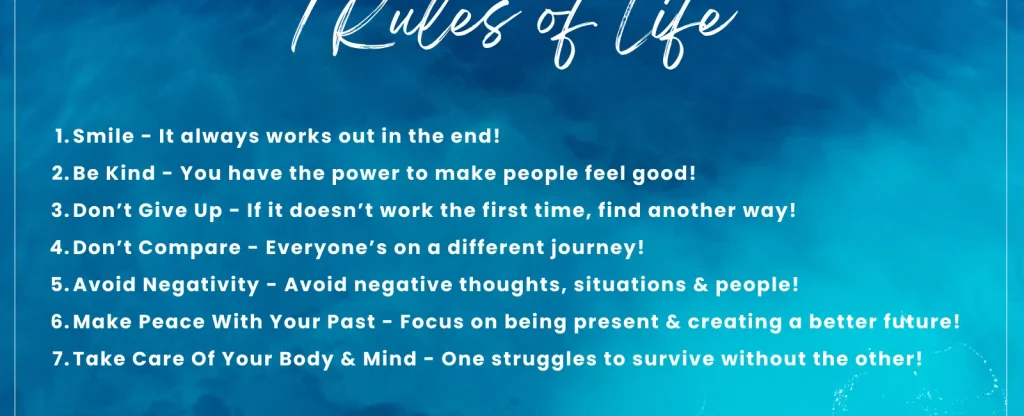
That is exactly why the 7 rules of life have struck such a deep chord with millions of people around the world. These are not complicated self-help theories. They are not tied to a single book or a famous guru. They are a simple set of principles — rooted in ancient wisdom, everyday psychology, and plain common sense — that remind us where to put our energy and where to stop wasting it. You have probably seen them on a poster in someone’s office, a wallpaper on a friend’s phone, or pinned on a classroom bulletin board. There is a reason these rules keep showing up in people’s lives, and it goes far beyond aesthetics.
This article is going to take you deeper than the usual motivational list. We will unpack each rule, explore the psychology behind it, and give you practical ways to actually live by it — not just nod along and forget it by tomorrow. Because the truth is, knowing the right thing and doing the right thing are two very different skills. And these seven principles bridge that gap better than almost anything else out there.
Where Did the 7 Rules of Life Come From?
Nobody owns these rules. That is part of their charm. They first gained widespread traction as a viral list shared across Pinterest boards, Instagram stories, and personal development blogs in the early 2010s. No single author has been credited, because the ideas themselves borrow from centuries of philosophical and spiritual tradition. You will find echoes of Stoicism in the rule about making peace with the past. Buddhist mindfulness runs through the rule about overthinking. And the rule about owning your own happiness sits comfortably alongside the core teachings of positive psychology.
What turned this list from a social media graphic into a cultural fixture was its commercial crossover. The 7 rules of life motivational poster became a bestselling product on Amazon, Etsy, and Redbubble. Printable wall art versions started appearing in therapy offices, school counseling rooms, and college dorm rooms. People even set them as phone and desktop wallpapers to keep the message front and center throughout the day. The rules resonated because they take ideas that psychologists write entire textbooks about and boil them down into language anyone can understand, remember, and repeat to themselves during a hard moment.
Now, let us walk through each rule, one at a time.
The Seven Principles — Explained, Backed by Science, and Made Practical
Rule 1: Make Peace With Your Past So It Doesn’t Ruin Your Present
Everyone carries baggage. A mistake you made ten years ago. A relationship that ended badly. Words you said or words you wish you had said. The weight of the past is real, and if you let it, it will follow you into every new chapter of your life like an uninvited guest who refuses to leave.
This rule is about choosing to set that weight down — not because the past did not matter, but because carrying it forward is costing you more than it is protecting you. Research from UC Berkeley’s Greater Good Science Center has shown that the practice of forgiveness, including forgiving yourself, strengthens emotional regulation, lowers anxiety, and creates psychological room for growth. A 2018 study published in PLOS ONE found that people who adopt a forward-moving mindset are significantly more inclined toward self-forgiveness, which in turn protects their overall well-being against the toxic effects of guilt and shame.
Think about the person who replays a failed business decision every time a new opportunity shows up. They are not learning from the past at that point — they are being imprisoned by it. There is a critical difference between reflecting on what happened and replaying it on a loop.
Here is what actually helps. Write a letter to your past self. You do not have to send it. Just get the words out. Replace every “I should have” in your vocabulary with “next time I will.” And if the past feels too heavy to carry alone, talk to a therapist or counselor — that is not weakness, that is wisdom. The past is useful as data. It was never meant to be a life sentence.
Rule 2: What Others Think of You Is None of Your Business
This one stings a little, does it not? We are wired for social approval. From childhood, we learn to read the room, adjust our behavior, and seek validation from the people around us. But there is a line between healthy social awareness and living your entire life according to other people’s scorecards.
Psychologist Carl Rogers described something called the “external locus of evaluation” — a state where your sense of worth depends almost entirely on how others see you. When you live this way, you lose contact with who you actually are. You make career decisions based on what impresses people at dinner parties. You hold back your real opinions because you are afraid of being judged. You shrink yourself to fit spaces that were never designed for you.
The fix is not arrogance. It is clarity. Ask yourself a simple question before any major decision: “Am I doing this for me, or for someone else’s comfort?” Limit the time you spend chasing validation on social media. Build a small circle of people whose opinions you genuinely trust and respect — and stop auditing everyone else’s. The reality is that you cannot control how people perceive you, no matter how hard you try. Some will misread your intentions. Some will project their own insecurities onto you. That is their business, not yours. Your only job is to stay true to what you believe and let the rest fall where it falls.
Rule 3: Time Heals Almost Everything — Give It Time
When you are in the middle of pain, this rule feels almost offensive. Someone tells you “give it time” when your heart is breaking, and you want to throw something at them. But here is the uncomfortable truth — they are usually right.
Psychologists refer to a concept called hedonic adaptation. In simple terms, human beings have a remarkable built-in ability to return to a baseline level of happiness after major life disruptions, whether positive or negative. Studies consistently show that most people, even after devastating events like job loss, divorce, or serious illness, gradually recalibrate and find stability again. That does not mean the pain was not real. It means the pain is not permanent.
The practical side of this rule is about patience and self-protection. When you are in a crisis, ask yourself one question: “Will this matter in five years?” Most of the time, the honest answer is no. Journal your feelings during difficult seasons, because six months from now you will look back and realize how far you have come. And above all, resist making permanent decisions when you are in a temporary emotional state. Do not quit the job, end the friendship, or send the angry email at 2 a.m. Give it time. Time is slow medicine, but it works.
Rule 4: No One Is in Charge of Your Happiness Except You
This is the rule most people agree with in theory and ignore in practice. We say “I will be happy when I get the promotion.” Or “I will be happy when I find the right partner.” Or “I will be happy when I move to a new city.” The goalpost keeps moving, and happiness stays somewhere just beyond reach.
Dr. Sonja Lyubomirsky, a leading researcher in positive psychology, has found that roughly 40 percent of our happiness is determined by intentional daily activities and our chosen mindset. That is not a small number. It means that nearly half of how you feel on any given day comes down to what you choose to think, do, and focus on — regardless of your circumstances.
This is one of the most empowering ideas within the 7 rules of life, because it shifts the power back to you. Start small. Begin a daily gratitude practice — three things every morning, written down, not just thought. Own your mornings by building a routine that energizes you instead of draining you. And stop handing the keys to your emotional state over to other people, your boss, the news cycle, or a social media algorithm. The moment you stop outsourcing your happiness to things you cannot control, you reclaim the most valuable thing you have — your emotional freedom.
Rule 5: Don’t Compare Your Life to Others — You Have No Idea What Their Journey Looks Like
Comparison is not a modern problem. Psychologist Leon Festinger identified it back in 1954 with his Social Comparison Theory, arguing that humans have a natural drive to evaluate themselves by looking at others. But what Festinger studied in small social groups has exploded into something far more destructive in the age of Instagram, TikTok, and LinkedIn.
The issue is not comparison itself — it is what we are comparing. We measure our behind-the-scenes against someone else’s highlight reel. We scroll through curated vacation photos and feel inadequate. We see a colleague’s promotion announcement and wonder what we are doing wrong. Research published in clinical psychology journals confirms that excessive social comparison erodes self-esteem, fuels chronic anxiety, and warps our sense of reality.
Here is the antidote. Curate your social media feed like your mental health depends on it — because it does. Unfollow accounts that consistently make you feel “less than.” Track your own progress instead of measuring it against strangers. Compare yourself today to who you were a year ago, not to who someone else appears to be right now. And when someone in your circle wins, celebrate them. Their success does not subtract from yours. The only fair race you are running is against the person you were yesterday.
Rule 6: Stop Overthinking — It’s Okay Not to Have All the Answers
Your brain is a brilliant tool, but it makes a terrible master. When you let it run on autopilot without interruption, it defaults to loops — replaying conversations, rehearsing worst-case scenarios, and generating anxiety about problems that do not exist yet. Psychologists call this rumination, and clinical research has linked it directly to increased risk of depression, impaired decision-making, and chronic stress.
We have all been there. You spend three weeks agonizing over a decision that needed 30 minutes of honest reflection. You rewrite the same email fourteen times. You lie awake at 1 a.m. running mental simulations of a conversation that may never happen. Overthinking disguises itself as productivity, but it is actually the opposite. It keeps you stuck.
The practical approach is surprisingly straightforward. Set a decision deadline for recurring dilemmas — give yourself a specific timeframe and then commit, even if the choice is not perfect. Practice the “good enough” principle, because eighty percent of decisions in life do not require perfection. And when you catch yourself spiraling, use your body to break the loop. Go for a walk. Do a five-minute breathing exercise. Move. Physical activity interrupts rumination faster than any mental trick. Clarity rarely comes from more thinking. It almost always comes from action.
Rule 7: Smile — You Don’t Own All the Problems in the World
This is the rule people tend to dismiss as too simple. But that is exactly the point. It is not asking you to fake happiness or plaster on a grin while your life falls apart. It is asking you to step back, breathe, and remember that you are carrying your share of life’s weight — not the entire world’s.
Facial feedback research in psychology suggests that the physical act of smiling can activate positive emotional circuits in the brain, even when you do not feel particularly happy. It is a small act with an outsized effect. And beyond the science, there is a deeper truth here about perspective. Whatever you are going through right now, it is real, and it matters. But it is also not everything. There is still good happening around you, even on the worst days. You just have to be willing to notice it.
Start your morning with something that makes you genuinely laugh — a podcast, a video, a memory. Practice naming one thing that is going right, even on a difficult day. And remind yourself, as often as necessary, that carrying the weight of the world was never your job description. A smile is not denial. It is a quiet act of choosing lightness when everything around you feels heavy.
Why the 7 Rules of Life Became a Global Phenomenon
It is worth asking — why these particular rules? The internet is flooded with motivational quotes, life advice, and self-help frameworks. So what is it about this specific set of principles that made them stick?
Part of the answer is simplicity. The 7 rules of life printable versions and motivational posters that sell thousands of copies on Etsy and Amazon every month work because they communicate complex emotional intelligence in everyday language. You do not need a psychology degree to understand “stop overthinking.” You do not need a philosophy course to grasp “make peace with your past.” The rules meet people where they are.
The other part of the answer is visual psychology. Research in behavioral science shows that environmental cues — what you see on your walls, your desk, your phone screen — directly influence your daily habits and emotional state. That is why so many people set these rules as their 7 rules of life wallpaper or buy a 7 rules of life motivational poster to hang above their workspace. It is not decoration. It is a daily reset. A constant, silent nudge toward intentional living in a world that is designed to distract you.
This trend has only grown stronger as the broader mental health conversation has opened up globally. People are tired of overcomplicated advice. They want something they can read at a glance, absorb in five seconds, and carry with them throughout the day. These seven principles deliver exactly that.
How to Actually Live by These Rules (Not Just Read Them)
Reading this article is the easy part. The hard part is tomorrow morning, when the alarm goes off and life starts throwing its usual curveballs. Most people read the 7 rules of life, nod in agreement, and change nothing. The gap between knowing the right principles and practicing them is where most people fall off. So here is a simple framework to close that gap.
Pick one rule per week. Do not try to overhaul your entire mindset at once. Choose one rule each Monday and focus on it for seven straight days. Week one might be “make peace with your past.” Week two might be “stop overthinking.” Give yourself the space to really sit with each one before moving on.
Create visual triggers. Print the rules and put them where you cannot ignore them. On your bathroom mirror. On your refrigerator. On a sticky note at your desk. This is exactly why the motivational poster trend works — it turns a passing idea into a persistent reminder.
Journal one sentence each evening. Before bed, write one line about how you applied that week’s rule — or how you struggled with it. Both are valuable. Progress is not always forward, and tracking the effort matters more than tracking perfection.
Find an accountability partner. Share the seven principles with a friend, a sibling, or a colleague. Check in once a week. Ask each other, “Which rule did you need the most this week?” You will be surprised how much that simple conversation changes things.
The most important thing to remember is this — these rules are a practice, not a performance. You will not get them right every day. Some weeks, you will nail one rule and completely forget the rest. That is fine. Growth is not about being perfect. It is about being consistent enough to notice the difference over time.
Conclusion
The 7 rules of life are not groundbreaking in the traditional sense. There is no secret formula here, no hidden hack that will transform everything overnight. And that is precisely what makes them powerful. They are honest. They are grounded. And they work — not because they tell you something you have never heard before, but because they remind you of what you already know and keep forgetting.
Simplicity is not the same as easy. Letting go of the past takes courage. Ignoring other people’s opinions takes confidence. Owning your happiness takes daily discipline. And smiling when life feels heavy takes a kind of strength most people underestimate.
You do not need a complete life overhaul. You need a handful of principles you actually believe in, posted somewhere you can see them, and practiced one imperfect day at a time. So pick the rule you need most right now. Write it down. Put it somewhere you will see it tomorrow morning. And start there. The 7 rules of life have helped millions of people find clarity during chaos — they can do the same for you.
Frequently Asked Questions
1. What are the 7 rules of life?
The 7 rules of life are a set of widely shared motivational principles that guide people toward inner peace and personal growth. They include making peace with your past, ignoring what others think of you, giving time its healing power, owning your happiness, avoiding comparison, stopping overthinking, and choosing to smile. These rules draw from ancient philosophical traditions like Stoicism and Buddhism, combined with modern positive psychology.
2. Who wrote the 7 rules of life?
There is no single credited author behind the 7 rules of life. They emerged organically through social media platforms, personal development blogs, and motivational communities during the early 2010s. Some sources attribute them to Stephen Covey, but the rules predate his version and have been adapted in many forms by different writers and creators over the years.
3. Are the 7 rules of life based on science?
Yes, several of these rules align closely with established psychological research. For example, the rule about avoiding comparison connects to Leon Festinger’s Social Comparison Theory from 1954, while the rule about owning your happiness is supported by Dr. Sonja Lyubomirsky’s research showing that roughly 40 percent of happiness comes from intentional mindset and daily choices.
4. What is the most important rule among the 7 rules of life?
That depends entirely on where you are in life right now. For someone struggling with regret, the first rule about making peace with the past will feel most urgent. For someone caught in the social media comparison trap, the fifth rule about not comparing your journey to others will resonate the most. The beauty of these principles is that they meet you exactly where you need them.
5. How can I apply the 7 rules of life in my daily routine?
The most effective approach is to focus on one rule per week instead of trying to practice all seven at once. Create visual reminders by printing them or setting them as your phone wallpaper, write one sentence each evening about how you applied that week’s rule, and find an accountability partner to keep yourself consistent over time.
6. Can the 7 rules of life help with anxiety and depression?
While they are not a replacement for professional therapy or medication, these principles closely align with techniques used in cognitive behavioral therapy and positive psychology. Letting go of the past, reducing overthinking, and taking ownership of your emotional state are evidence-based strategies that research has shown can reduce symptoms of anxiety and depression when applied consistently.
7. What does “make peace with your past” actually mean?
This rule means accepting what has already happened without letting it control your present life. It does not mean forgetting or excusing past hurt — it means forgiving yourself and others, learning the lesson, and choosing to move forward. Research from UC Berkeley’s Greater Good Science Center confirms that forgiveness strengthens emotional regulation and reduces anxiety.
8. Why do the 7 rules of life say what others think is none of your business?
This rule challenges the habit of people-pleasing and seeking external validation. Psychologist Carl Rogers described how depending on other people’s approval for self-worth disconnects you from your authentic identity. The rule encourages you to focus on your own values and decisions rather than wasting energy trying to control how others perceive you.
9. How does the rule about not comparing help with social media pressure?
Social media creates a distorted reality where you compare your everyday struggles to someone else’s curated highlights. Psychologist Leon Festinger’s research shows that excessive comparison erodes self-esteem and fuels anxiety. This rule encourages you to curate your feed, track your own progress, and measure yourself only against who you were yesterday — not against a stranger’s filtered snapshot.
10. Is it realistic to stop overthinking completely?
The goal is not to eliminate thinking but to break the habit of rumination — the unhelpful mental loop of replaying scenarios and worrying about things you cannot control. Clinical research links chronic overthinking directly to increased depression risk. Practical strategies include setting decision deadlines, practicing breathwork, and using physical activity to interrupt the cycle when it starts.
11. Can students benefit from the 7 rules of life?
Absolutely. Many school counselors, therapists, and educators already display these rules in classrooms and counseling offices. The principles around avoiding comparison, managing overthinking, and taking ownership of happiness are especially relevant for young people navigating exam pressure, peer judgment, and the emotional toll of social media during formative years.
12. Are the 7 rules of life the same as Jordan Peterson’s 12 Rules for Life?
No. These are entirely different frameworks. Jordan Peterson’s 12 Rules for Life is a 2018 published book rooted in clinical psychology, mythology, and personal responsibility. The 7 rules of life are an uncredited, viral motivational list focused specifically on emotional well-being, inner peace, and letting go — they are simpler in scope and more focused on day-to-day mindset.
13. Where can I find a 7 rules of life poster or printable?
Motivational posters and printable wall art versions are widely available on Amazon, Etsy, Redbubble, Walmart, and Teachers Pay Teachers. They come in sizes ranging from small desk prints to large framed posters, and many sellers offer instant digital downloads in high resolution that you can print at home or at a local print shop.
14. Why are 7 rules of life posters so popular for office and bedroom decor?
Behavioral science research shows that environmental cues — what you see on your walls, desk, and phone screen — directly influence your daily habits and emotional state. A motivational poster placed where you see it every morning acts as a constant, silent mindset reset. That is why these posters have become bestsellers for home offices, dorm rooms, therapy offices, and classrooms.
15. Can I use the 7 rules of life as a phone wallpaper?
Yes, and many people do. Setting these rules as your lock screen or home screen wallpaper keeps them visible throughout the day. Digital versions designed specifically for phone screens are available as free downloads on Pinterest and design platforms, and paid high-resolution versions are available on Etsy and similar marketplaces.
16. Are the 7 rules of life religious or spiritual?
The rules themselves are not tied to any specific religion or spiritual tradition. However, they do draw from philosophical and spiritual teachings found across Stoicism, Buddhism, Hinduism’s Bhagavad Gita, and Christian scripture. They are designed to be universally applicable regardless of a person’s faith background, worldview, or cultural identity.
17. How do the 7 rules of life help in the workplace?
These rules directly address common workplace stressors such as overthinking performance reviews, comparing yourself to colleagues, worrying about what your boss thinks, and carrying the weight of past professional mistakes. Practicing these principles can reduce burnout, improve decision-making speed, and help you maintain healthier boundaries between your work identity and your personal sense of worth.
18. What does “smile, you don’t own all the problems in the world” mean?
This rule is about perspective, not toxic positivity. It does not ask you to fake happiness or ignore your struggles. It reminds you that you are carrying your share of life’s challenges — not the entire world’s burden. Facial feedback research in psychology suggests that the physical act of smiling can trigger positive emotional responses in the brain, even during stressful times.
19. How long does it take to see results from following these rules?
There is no fixed timeline because these are lifelong practices, not a quick fix. However, many people report noticeable shifts in their emotional well-being within a few weeks of consciously applying even one or two rules. Consistency matters far more than perfection — small daily efforts compound into meaningful change over months.
20. Can the 7 rules of life improve relationships?
Yes. Several of these rules directly improve how you relate to others. Letting go of the past helps you stop punishing a partner for old mistakes. Releasing the need for others’ approval reduces codependency. Avoiding comparison eliminates jealousy and resentment. And owning your own happiness prevents you from placing unrealistic emotional burdens on the people closest to you.
21. What is the difference between the 7 rules of life and the 7 habits of highly effective people?
Stephen Covey’s 7 Habits of Highly Effective People is a structured personal and professional effectiveness framework published as a bestselling book in 1989. The 7 rules of life are an informal, uncredited motivational list focused primarily on emotional peace and mental well-being. Covey’s habits lean toward productivity and leadership, while these rules center on inner calm, self-acceptance, and letting go.
22. Can I create my own version of the 7 rules of life?
Absolutely. Many personal development experts encourage people to write their own set of life rules or guiding principles. The viral list serves as an excellent starting point, but your personal rules should reflect your own values, challenges, and goals. Writing them down and displaying them where you see them daily is what makes them stick.
23. Are there different versions of the 7 rules of life?
Yes. While the most common version includes rules about making peace with the past, ignoring others’ opinions, giving time its space, owning your happiness, avoiding comparison, stopping overthinking, and smiling — several alternate versions circulate online. Some emphasize kindness, gratitude, or perseverance instead. The core themes of self-acceptance and emotional resilience remain consistent across all versions.
24. How do I teach the 7 rules of life to my children?
Start by modeling the behavior yourself — children learn more from what they see than what they hear. Use age-appropriate language to explain each rule, focusing on practical examples they can relate to, such as not comparing grades with classmates or learning to let go when a friend says something unkind. Printable versions designed for kids are available on educational platforms like Teachers Pay Teachers and Mental Health Center Kids.