
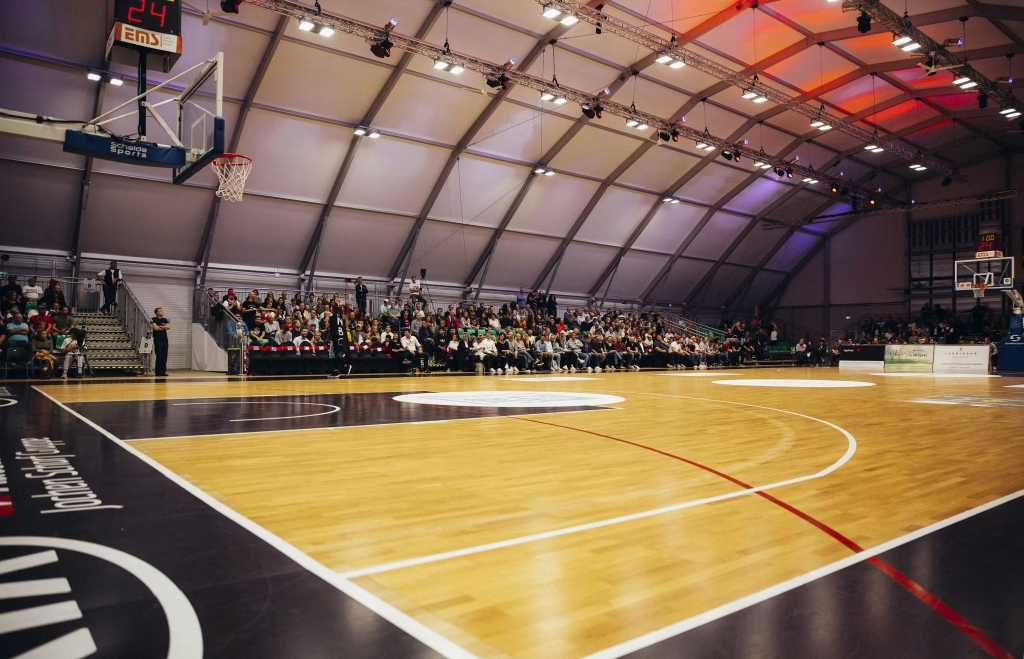
Picture this: it is a rainy Tuesday evening, you have been looking forward to shooting hoops all week, and the outdoor court down the street is completely soaked. Sound familiar? That frustration is something every basketball player knows too well. The weather does not care about your training schedule, and outdoor courts are always at its mercy.
That is exactly where an indoor basketball court changes everything. Whether you are a serious athlete chasing improvement, a parent looking for a safe space for the kids to stay active, or a facility owner wanting to serve your community better, an indoor setup removes every single barrier between you and the game.
This guide covers it all, from understanding why indoor play is genuinely superior for skill development, to finding free courts near you, choosing the right flooring, planning a build, and getting the most out of every session. By the time you finish reading, you will have a clear roadmap for wherever you are in your basketball journey.
What Makes an Indoor Basketball Court Different From an Outdoor One
At first glance, a basketball court is a basketball court, right? Not quite. The differences between an indoor and outdoor setup go far deeper than just having a roof over your head. They affect how you play, how quickly you improve, and even how your body holds up over time.
Consistent Conditions, Every Single Game
One of the biggest hidden advantages of playing indoors is consistency. Wind, rain, direct sunlight, and extreme heat all disappear the moment you step inside. Those environmental variables do more damage to your game than most players realize. When conditions change constantly, your brain spends energy adapting to the environment instead of focusing purely on your technique.
On an indoor basketball court, the conditions are identical today, tomorrow, and six months from now. That kind of predictability is what allows coaches to plan effective drills, and it is what allows players at every skill level to build real muscle memory. You stop guessing and start growing.
A Safer Surface for Your Body
Outdoor courts are often cracked, uneven, or slippery after light rain. That is a recipe for rolled ankles and hard falls. Indoor courts, by contrast, are built with surfaces that are smooth, well-maintained, and designed to absorb impact. The flooring reduces pressure on your knees, ankles, and hips during intense activities like jumping and sprinting.
That cushioning is not a luxury. For anyone playing several times a week, it is the difference between staying healthy and spending weeks on the sideline with an avoidable injury. Shock-absorbing surfaces also allow for faster cuts and sharper footwork, because players trust the grip beneath their feet.
Year-Round Access Without Compromise
Most athletes lose real momentum during the off-season, not because they want to stop, but because the outdoor options become unreliable. An indoor setup eliminates the off-season entirely. You can train through winter storms, summer heat waves, or anything in between, without adjusting your schedule or your goals.
This is particularly valuable for younger players who are still developing. Consistent repetition is the foundation of skill, and year-round access to a proper playing surface makes that repetition possible.
How to Find Indoor Basketball Courts Near Me: Free and Low-Cost Options
You do not need to own a private gym to get quality court time. There are more accessible options than most people realize, and many of them cost nothing at all. Here is how to track them down.
Start With Your Local Community Center
Community centers are the most overlooked resource for free court time. These facilities are typically funded by local taxes and grants, which means they are designed to serve residents, and basketball is almost always part of what they offer. Many run designated open gym hours where you can simply walk in and play.
The key is to be proactive. Do not assume they are closed or paid. Call ahead, check their website, or stop by in person and ask specifically about open court hours. You may be surprised by how much is available and how little it costs.
Public High Schools and College Gyms
Many public school gymnasiums are built with taxpayer money, and during evenings, weekends, or school holidays, they are sometimes opened to the community at no charge. Policies vary significantly by district, so it is worth contacting the athletic department directly and asking about open gym times or community night access.
College campuses are another option, especially for alumni or students. Some institutions offer guest passes or affordable day memberships. It is worth a quick inquiry before ruling it out.
YMCAs, Recreation Centers, and Fitness Clubs
YMCAs remain one of the best membership deals in the fitness world, especially for basketball players. Most locations include access to a full court as part of a standard membership, and many run organized leagues or open pickup game sessions throughout the week.
Some private fitness clubs also dedicate space to hardwood courts and schedule drop-in sessions. It is worth calling ahead to confirm availability, since courts are sometimes reserved for classes or leagues during peak hours.
Apps, Maps, and Online Resources
Technology has made finding courts much easier than it used to be. Court-finder platforms like Courts of the World offer interactive maps showing nearby basketball facilities, complete with details like lighting, court conditions, surface type, and whether pickup games are regularly held there.
Google Maps and Yelp can also surface gyms with basketball courts in your area. Searching for terms like basketball gym near me or recreation center with basketball court will return useful results. Local Facebook groups and neighborhood apps like Nextdoor are also solid sources, since community members often share access tips that never make it onto official websites.
One more option worth mentioning: your own social network. Ask around among friends, family, coworkers, and members of any clubs or faith communities you are part of. Private court access through personal connections is more common than people expect.
Indoor Basketball Court Dimensions: What the Numbers Actually Mean
Before building or booking court time, it helps to understand the size standards. Not all courts are created equal, and the differences between levels of play are more meaningful than most people think.
Official Size Standards by Level of Play
The NBA and NCAA use a regulation indoor basketball court measuring 94 feet long by 50 feet wide. FIBA uses a slightly smaller court at approximately 91.86 by 49.21 feet. High school courts are typically shorter at 84 by 50 feet, which affects player spacing and overall game pace.
For a private or residential court, you are rarely locked into regulation dimensions. A well-sized recreational court can deliver an excellent experience without needing to match pro-level specifications exactly.
Key Court Markings Every Player Should Know
The three-point line sits at 23.75 feet from the basket in the NBA, 22.15 feet in FIBA play, 20 feet 9 inches in college, and 19 feet 9 inches in high school. These differences change how players position themselves and how spacing works on offense.
Other key markings include the free-throw lane, often called the paint, the restricted area arc directly below the basket, and the center circle for tip-offs. If you are planning a training court, getting these markings right ensures your practice translates accurately to game situations.
Half-Court vs. Full-Court: Choosing the Right Setup
A half-court setup is cost-effective, space-efficient, and genuinely practical for the majority of players. It is ideal for individual skill work, small group training, and casual games. Full-court installations deliver the complete basketball experience and are better suited for teams, leagues, and families who host regular games.
If your budget or space is limited, starting with a half-court and building from there is a smart approach. Many great players have developed their games entirely on half-court setups.
Choosing the Right Floor for Your Basketball Court Indoor Space
The floor is the single most important physical component of any indoor basketball court. It affects ball bounce, player traction, joint health, and long-term maintenance costs. Here is a breakdown of your main options.
Maple Hardwood: The Gold Standard
Maple hardwood is what you see in every NBA arena and most collegiate gyms for good reason. It offers exceptional ball bounce, reliable traction, and a lifespan measured in decades when properly maintained. Its light natural color also makes it easier to see both the ball and court markings clearly.
Maple can be sanded and refinished multiple times over its life, which means a quality maple floor is a one-time investment that pays off for years. It is the premium choice for anyone who wants an authentic, professional-feel playing surface.
Vinyl, PVC, and Synthetic Tiles
Vinyl and PVC surfaces have improved dramatically in recent years. They now offer good traction, solid shock absorption, and excellent customization options including full-color logos, team branding, and a wide variety of surface designs. They are easier to clean and require less maintenance than hardwood.
Interlocking sport tiles made from polypropylene are a popular choice for garage conversions and basement courts. They are DIY-friendly, durable, and can be installed without professional help. The trade-off is that they do not deliver quite the same ball response or feel as maple.
Rubber and Polyurethane Surfaces
Rubber flooring is an underrated option for multi-use facilities and community gyms. It provides outstanding shock absorption, which reduces joint stress significantly, and its non-porous surface resists bacteria, making it a hygienic choice for high-traffic spaces. Rubber is also low-maintenance and highly durable.
Polyurethane coatings can be applied directly over existing concrete or older floors, making them a cost-effective way to upgrade a space without tearing out the current surface. They work well in facilities where budget is a key factor but quality still matters.
How to Build an Indoor Basketball Court: From Planning to First Tip-Off
Building your own court is a significant investment, but it is more achievable than most people think when you plan carefully. Here is how to approach the process from start to finish.
Assess Your Space First
Your first step is identifying the right space. Large basements, detached garages, converted warehouses, and dedicated outbuildings are all viable candidates. The most important considerations beyond floor area are ceiling height and structural clearance.
A regulation basketball hoop sits at 10 feet. You need a minimum of several feet of clearance above that to play safely, which means your ceiling should comfortably exceed 14 feet, with 16 to 20 feet being ideal for a fully functional experience.
Also consider who will be using the space and at what level. A competition-standard court must meet NCAA or high school federation requirements. A recreational or training court gives you far more flexibility.
Budgeting Realistically
Costs vary widely depending on court size, surface material, goal type, and your location. Here are the key factors to build your budget around:
- Surface material: Maple hardwood is the most expensive; vinyl tiles and polyurethane coatings offer more affordable alternatives.
- Permits and zoning: Most municipalities require permits, which typically add $200 to $1,000 or more depending on local regulations.
- Basketball goals: Wall-mount systems with tempered glass backboards are the premium indoor option; adjustable goals suit multi-age households.
- Lighting: LED systems range from $5,000 to $12,000 for indoor courts, but they pay for themselves over time through energy savings.
- Line markings: Professional court striping adds a polished feel; stencil kits are a budget-friendly DIY alternative.
It is always worth getting multiple contractor quotes. The difference in pricing between providers can be significant, and an experienced court builder will often identify cost-saving options you would not find on your own.
Lighting, Hoops, and the Finishing Details
LED lighting is now the clear choice for any indoor court. It delivers even coverage across the entire playing surface with no dark spots or shadows that affect visibility. LED systems use significantly less power than older fluorescent or metal halide fixtures and last 10 to 15 years before needing replacement. A typical court saves thousands in annual energy costs after switching.
For the backboard, tempered glass offers the best shot rebounding and the most realistic playing feel. Acrylic is a solid mid-range option that looks similar at a lower price point. A regulation backboard width is 72 inches, which is worth matching if you are serious about practice accuracy.
Climate control, a sound system, custom court logos, and padded wall protectors all add comfort and safety. They are optional for a home court but worth serious consideration for any facility or community space.
Construction Timeline
A full indoor basketball court build, including site preparation, concrete slab, subfloor installation, surface laying, and final markings, typically takes four to eight weeks. Custom features like LED systems, sound, and HVAC can extend the timeline depending on contractor availability. Planning well in advance of when you need the court ready is always the safer approach.
The Real Health Benefits of Playing on an Indoor Basketball Court
Basketball is one of the most complete physical workouts available. The combination of sprinting, jumping, cutting, reaching, and throwing engages nearly every muscle group simultaneously. Add in the competitive and social elements, and you have one of the few activities that keeps people coming back willingly, consistently, and enthusiastically.
A Full-Body Workout You Actually Enjoy
Basketball improves cardiovascular endurance, builds strength, sharpens coordination, and burns significant calories. The demands of the game, from dribbling and passing to shooting and defending, require the upper body, lower body, and core to work together constantly. Unlike gym machines that isolate individual muscles, basketball trains your entire body to function as a unit.
The sport also develops agility and reaction time. Playing on a well-maintained indoor court, with consistent traction and lighting, means you can push yourself harder and move more freely without holding back out of concern for the surface.
Mental Health, Focus, and Stress Relief
The mental benefits of basketball are just as real as the physical ones. The game demands concentration, quick decision-making, and spatial awareness. That level of focus acts as a powerful reset for a stressed mind. It is very difficult to dwell on work problems when you are reading a defense and deciding whether to drive or kick it out to the corner.
Basketball also builds camaraderie and social connection, both of which are proven contributors to long-term mental wellbeing. A regular pickup game or weekly league gives players something to look forward to, a group to belong to, and an outlet for competitive energy that otherwise has nowhere to go.
Benefits for Families and Young Players
For families, having access to an indoor court creates a shared activity that pulls everyone off screens and into the same space. Kids who might struggle to stay engaged in traditional exercise find basketball far more appealing because it feels like play, not a workout.
For younger players specifically, the controlled, safe environment of an indoor basketball court supports faster development. Consistent surfaces, proper lighting, and regulation equipment all reinforce good habits from an early stage. The competitive habits formed in a well-equipped facility tend to stick.
How Indoor Basketball Courts Add Long-Term Value to Facilities
For business owners, school administrators, and community organizations, an indoor basketball court is not just an amenity. It is a strategic asset that generates measurable value across multiple dimensions.
Revenue Streams for Facility Owners
A well-run indoor court facility can generate income through several channels simultaneously:
- Year-round basketball leagues for youth and adult players
- Weekend tournaments that bring in visiting teams and drive concession revenue
- Private court rentals for coaches, trainers, and teams running camps or practice sessions
- Fitness classes and multi-sport programming during off-peak hours
The key advantage of an indoor facility is reliability. When it rains, outdoor competitors lose their revenue. An indoor court stays open and keeps generating income regardless of what the weather is doing outside.
Multi-Sport Versatility
A well-designed indoor basketball court does not have to serve a single sport. The same space can accommodate volleyball, pickleball, badminton, yoga, circuit training, and general fitness programming. Installing removable boundary lines and adjustable net systems allows one court to serve multiple purposes throughout the day.
This versatility makes the court useful to a broader range of community members, including older adults who might not play basketball but who benefit greatly from low-impact indoor sports like pickleball. Serving more people means generating more revenue and creating more community goodwill.
Property Value and Community Appeal
For homeowners, a private indoor court is a distinctive selling point in the real estate market. Properties with unique recreational features stand out from comparable listings and appeal specifically to buyers who prioritize active family lifestyles. It is a feature that buyers remember and talk about.
At the community level, access to quality indoor facilities directly influences where families choose to live. A neighborhood recreation center with a proper basketball setup is a meaningful quality-of-life factor, not a small detail.
Your Next Step Toward the Perfect Indoor Basketball Court
Whether you are looking to find a free court in your neighborhood, understand what makes a great playing surface, or plan a full build from the ground up, the path forward is clearer than it might seem.
An indoor basketball court is not just a place to play. It is a place where skill gets built repetition by repetition, where families connect over something they genuinely enjoy, and where communities come together around a shared activity. The physical and mental health benefits are real, the versatility is unmatched, and the long-term value, whether for a homeowner or a facility operator, is hard to argue with.
Start simple. Look up your local community center this week and ask about open gym hours. If you are further along in your planning, use the guidance in this article to make confident decisions about flooring, dimensions, lighting, and equipment. And if you are ready to build, get those contractor quotes in hand and start comparing.
Every great game starts somewhere. Your indoor basketball court could be exactly where yours begins.
FAQ 1: What is the standard size of an indoor basketball court?
The standard size of an NBA and NCAA indoor basketball court is 94 feet long by 50 feet wide. FIBA courts used in international competition measure approximately 91.86 feet by 49.21 feet (28 by 15 meters). High school courts in the United States are typically 84 feet long by 50 feet wide. For private home builds, a high school-sized layout is the most practical and cost-effective starting point. The right size for any build depends on available space, budget, and the intended level of play.
FAQ 2: How much does it cost to build an indoor basketball court?
Building an indoor basketball court typically costs between $22,000 and $124,000 for a full installation at a school or sports facility, based on 2026 project data. For homeowners, costs range from as low as $12,000 for a basic indoor setup to over $150,000 for a full-size maple hardwood court with premium lighting, climate control, and custom graphics. The biggest cost drivers are court size, surface material, ceiling work, lighting systems, hoop selection, and geographic location. A half-court installation always costs significantly less than a full-court build, making it the preferred choice for home projects.
FAQ 3: What is the best flooring for an indoor basketball court?
Maple hardwood is widely considered the best flooring for an indoor basketball court. It delivers superior ball bounce, excellent traction, and long-term durability — and it can be sanded and refinished multiple times, giving it a lifespan of 40 to 50 years when properly maintained. Maple’s light color also reflects light evenly, making it easier to track the ball visually during play. For facilities on a tighter budget, vinyl sport tiles, interlocking polypropylene sport tiles, rubber flooring, and polyurethane-coated concrete are all solid alternatives, each offering a different balance of performance, cost, and maintenance requirements.
FAQ 4: How do I find indoor basketball courts near me for free?
The best places to find a free indoor basketball court near you are local community centers, public recreation departments, and public high school gymnasiums. Many community centers funded by local taxes offer designated open gym hours for basketball at no charge or for a very minimal fee, though schedules need to be confirmed directly. Public high schools often open their gyms to the community during evenings, weekends, and school holidays. YMCAs, park districts, and some college campus recreation centers are also worth calling. Online court-finder tools and local neighborhood social media groups can surface less-advertised options in your area.
FAQ 5: What ceiling height is required for an indoor basketball court?
The minimum recommended ceiling height for an indoor basketball court is 16 feet. This allows players to jump, shoot arcing shots, and play without feeling restricted by the structure above them. For competitive-level facilities, a ceiling height of 20 feet or more is preferred so that lob passes, high-arc shots, and overhead plays can happen naturally. Lower ceilings — below 16 feet — can still work for casual shooting and dribbling drills but will feel limiting during actual game play, particularly on mid-range and long-range shots.
FAQ 6: How long does it take to build an indoor basketball court?
A complete indoor basketball court build typically takes between 4 and 8 weeks from start to finish. This timeline covers site preparation, base and subfloor installation, laying the playing surface, curing, and final line striping. Larger commercial facilities or projects with more complex structural requirements may take longer. The schedule can also be affected by permit approval timelines, material delivery windows, and the specific flooring system chosen. Planning ahead and working with experienced court builders is the most reliable way to stay on schedule and avoid mid-project delays.
FAQ 7: Do I need a permit to build an indoor basketball court at home?
In most jurisdictions, yes — building an indoor basketball court at home requires a building permit, especially when it involves any permanent base-laid surface, structural modifications, new lighting systems, or changes to an existing structure like a garage or basement. Building permits ensure the project meets local safety codes, structural requirements, and zoning regulations. Permit costs vary significantly by municipality and can range from a few hundred dollars to over $1,000. Homeowners in HOA communities should also check their association’s guidelines before starting any construction, as some HOAs have specific restrictions on recreational structures.
FAQ 8: What type of lighting is best for an indoor basketball court?
LED lighting is the clear standard for modern indoor basketball courts. It provides even, shadow-free illumination across the entire playing surface — critical for player performance and safety. LED systems use significantly less energy than older metal halide or fluorescent fixtures and last 10 to 15 years with minimal maintenance. A typical indoor court conversion to LED costs between $5,000 and $12,000, but energy savings of $1,000 to $4,000 per year mean the system pays for itself within 3 to 5 years. The beam pattern of court-specific LED fixtures is also engineered to avoid direct glare when players look up toward the ceiling.
FAQ 9: What is the difference between an indoor and outdoor basketball court?
The primary difference between an indoor and outdoor basketball court is the playing surface, environmental conditions, and long-term durability. Indoor courts are almost always built with polished maple hardwood or high-quality synthetic sport tiles that offer consistent ball bounce, excellent traction, and shock absorption. Outdoor courts use asphalt or concrete, which are more weather-resistant but harder on players’ joints. Indoor courts are protected from rain, wind, extreme heat, and cold, allowing for year-round play in controlled conditions. Outdoor courts require more frequent resurfacing due to weather exposure and generally provide a less consistent playing surface over time.
FAQ 10: How long does an indoor basketball court floor last?
The lifespan of an indoor basketball court floor depends heavily on the surface material and how well it is maintained. A well-maintained maple hardwood floor can last between 40 and 50 years — it can be sanded and refinished multiple times throughout that lifespan. Synthetic vinyl or polyurethane surfaces typically last 20 to 30 years. Rubber flooring generally needs to be resurfaced every 6 to 8 years to maintain its performance and appearance. Interlocking modular sport tiles are among the most durable options, with some systems backed by 15-year manufacturer warranties and replacement tiles available for individual damaged sections.
FAQ 11: How much does it cost to maintain an indoor basketball court annually?
Annual maintenance costs for an indoor basketball court range from approximately $500 to $4,500 per year, depending on the surface material and the intensity of use. Hardwood floors require regular cleaning, occasional screening, and periodic sanding and refinishing, which can add up to higher annual costs. Synthetic and modular tile surfaces are far easier and cheaper to maintain — typically requiring only regular damp-mopping and occasional deep cleaning with an approved cleaner. Line markings may also need repainting every few years, which costs between $200 and $500 for a half court and $350 or more for a full court.
FAQ 12: Can an indoor basketball court be used for other sports?
Yes, an indoor basketball court is one of the most versatile spaces in any sports facility. The same floor can be used for volleyball, pickleball, badminton, futsal, yoga, dance classes, circuit training, and fitness boot camps. Multi-sport line markings — painted in different colors to represent different sports — can be applied to a single surface, allowing multiple activities to share the court without confusion. This versatility is one of the strongest arguments for investing in an indoor court, as it maximizes the number of active hours the space generates value every week.
FAQ 13: What is the best backboard material for an indoor basketball court?
Tempered glass is the best backboard material for an indoor basketball court. It provides the most realistic ball rebound, superior clarity, and the same performance characteristics used in professional and collegiate settings. Acrylic backboards are a strong mid-range option — they offer a similar look to glass at a lower cost and perform well in recreational and semi-competitive settings. Fiberglass and steel backboards are more affordable but deliver noticeably less rebound consistency. For serious training environments, tempered glass is the recommended choice. For family home courts, acrylic is usually sufficient.
FAQ 14: What is the minimum space needed for a home indoor basketball court?
For a half-court home basketball setup — sufficient for individual skill work and casual play — a minimum floor area of approximately 30 to 40 feet long by 20 to 30 feet wide is the practical starting point. A full-court installation requires at least 94 feet by 50 feet, plus additional out-of-bounds clearance on all sides. Ceiling height is equally important, with a minimum of 16 feet recommended for comfortable full-height play. Converted garages, basements, and dedicated sport buildings can all accommodate a half-court setup if the dimensions meet the minimum requirements.
FAQ 15: How do I keep an indoor basketball court clean and well-maintained?
Routine cleaning is straightforward: daily or post-session damp-mopping or dust-mopping removes surface dirt, scuff marks, and debris that accumulate during play. Monthly or quarterly deep cleaning with a manufacturer-approved floor cleaner maintains surface integrity over time. For hardwood floors, avoid excessive moisture during cleaning — too much water can warp the wood. High-traffic hardwood courts should be screened (lightly sanded) and recoated every few years and fully refinished every 8 to 10 years depending on usage intensity. Modular tile and synthetic surfaces are the easiest to maintain, typically requiring only basic mopping and occasional individual tile replacement if sections become damaged.
FAQ 16: Do indoor basketball courts require insurance?
For commercial facilities that host players, leagues, or events, having general liability insurance for an indoor basketball court is strongly recommended and in most cases required by landlords or lenders. General liability coverage for indoor sports facilities typically runs from $1 million to $2 million per occurrence. For homeowners with a private indoor court, standard homeowners insurance generally covers the structure under dwelling coverage, but personal liability limits should be reviewed carefully — especially if non-family members regularly use the court. Purchasing an umbrella liability policy is a widely recommended step for homeowners with recreational amenities like sports courts.
FAQ 17: What is the hoop height on a regulation indoor basketball court?
The regulation hoop height on an indoor basketball court is 10 feet (3.048 meters) above the playing surface. This standard is universal across the NBA, NCAA, FIBA, and high school competition levels. For youth play, adjustable hoops that lower to 6, 7, or 8 feet are commonly used to match the appropriate challenge level for younger players. For home courts that will be used by players of different ages, an adjustable basketball goal that can move from youth height up to regulation 10 feet is the most practical and inclusive choice.
FAQ 18: What is the cost per square foot of indoor basketball court flooring?
The cost of indoor basketball court flooring per square foot varies significantly by material. Maple hardwood costs approximately $3.50 to $6 per square foot for the material alone, plus $3 to $8 per square foot for professional installation, bringing the total to $6.50 to $14 per square foot installed. Synthetic vinyl runs $10 to $22 per square foot installed. Rubber flooring is $5 to $12 per square foot installed. Laminate flooring is among the most affordable at $0.70 to $2 per square foot in material costs plus $1 to $2 per square foot for installation. Modular sport tile systems run approximately $8 to $12 per square foot, not including site preparation work.
FAQ 19: Can I convert my garage or basement into an indoor basketball court?
Yes, a garage or basement conversion is one of the most practical and cost-effective ways to create a private indoor basketball court. A standard two-car garage offers approximately 400 to 600 square feet of floor space, which is sufficient for a half-court shooting and training setup. The key requirements are adequate ceiling height (16 feet minimum is ideal), a structurally sound subfloor or concrete base, appropriate lighting, and the right playing surface. Modular interlocking sport tiles are the preferred surface for garage and basement conversions because they install directly over concrete, require no adhesive, and can be removed if the space needs to change.
FAQ 20: What does an indoor basketball court smell like — and why does it matter?
While this may seem like an unusual question, the air quality inside a facility matters significantly for player performance. A well-ventilated indoor basketball court should have clean, neutral air with no strong chemical or musty odors. Newly finished hardwood floors will have a faint polyurethane smell that dissipates within a few days. Ongoing musty odors typically signal humidity problems or inadequate ventilation — both of which can damage hardwood floors over time through warping and mold growth. Proper HVAC systems with adequate air exchange rates are a critical and often underestimated element of any indoor court facility design.
FAQ 21: What are the best indoor basketball courts in the United States?
The most celebrated indoor basketball courts in the United States are NBA venues, each with their own personality and design. Madison Square Garden in New York City is widely regarded as the most iconic basketball arena in the world. The Chase Center in San Francisco, Crypto.com Arena in Los Angeles, and TD Garden in Boston are among the top-rated venues for atmosphere, sight lines, and court quality. Beyond professional arenas, facilities like the Hoophall at Springfield College (home of the Basketball Hall of Fame) and Duke University’s Cameron Indoor Stadium are considered among the most celebrated courts in the sport’s history.
FAQ 22: Is an indoor basketball court a good investment for property value?
For homeowners, a well-built private indoor basketball court can meaningfully increase property value and appeal, particularly in markets where active, family-oriented buyers are prevalent. Real estate professionals consistently note that homes with unique recreational amenities — including sport courts, pools, and fitness rooms — stand out in listings and attract higher buyer interest. The return on investment varies by market and location, but homes with dedicated recreational spaces generally command stronger asking prices and spend less time on the market than comparable homes without them. For commercial facility operators, the investment return is even clearer through direct revenue generation.
FAQ 23: What grants or funding are available to build an indoor basketball court?
Several grant and funding programs exist to help schools, nonprofits, and community organizations build indoor basketball courts. Federal, state, and local government grants are available for projects that improve community recreational facilities. The NBA and its teams frequently fund court construction through community programs in underserved areas. The ESPN Homecourt Program has historically provided free design and construction packages to qualified schools and organizations. Community Development Block Grants (CDBGs) administered at the local government level are another viable funding source. Organizations should also investigate local foundation grants, sports equipment manufacturers’ community programs, and private sponsorship opportunities.
FAQ 24: How do I choose the right contractor to build an indoor basketball court?
Choosing the right contractor for an indoor basketball court build comes down to four key factors. First, look for specialists — general contractors rarely have the specific knowledge of court dimensions, subfloor systems, and sport surface materials that dedicated court builders bring. Second, verify that the contractor carries full licensing and liability insurance. Third, ask for a portfolio of completed projects with references you can contact directly. Fourth, get at least two or three detailed quotes that itemize materials, labor, timeline, and warranty terms separately. A reputable court builder will also walk your site before quoting, identify any subfloor or structural challenges upfront, and provide a written project timeline with clear milestones.