
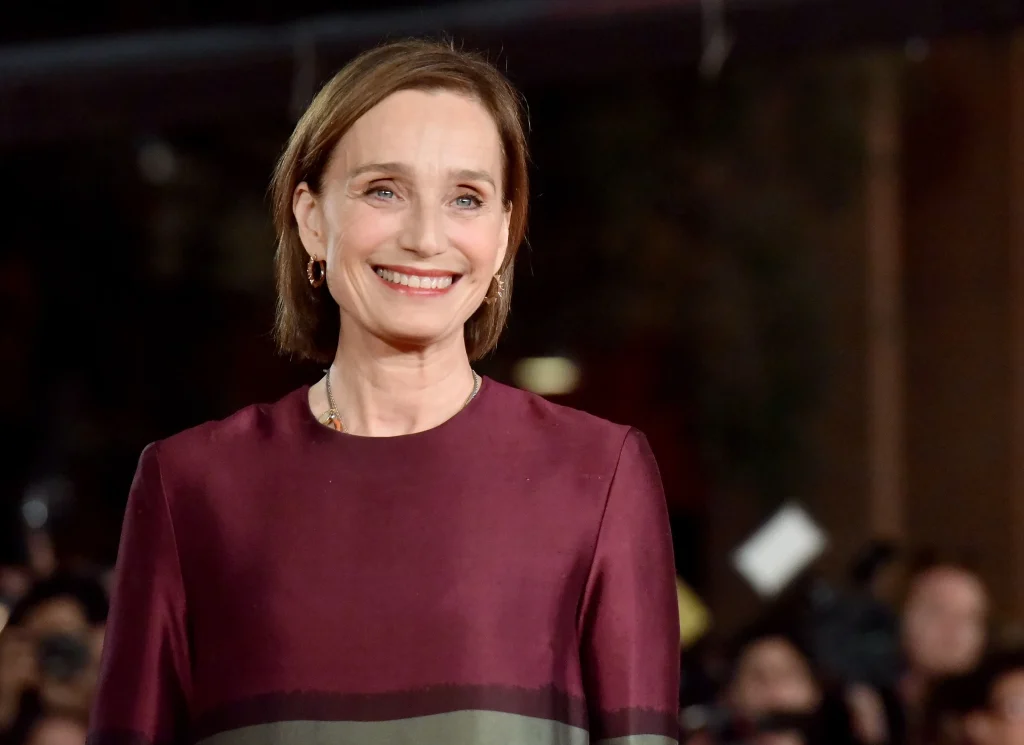
There are actresses who become famous. Then there are actresses who become institutions.
Kristin Scott Thomas belongs firmly in the second category. Over four decades in the industry, she has done something most performers only dream of — she has built two entirely separate, equally respected careers, in two different languages, across two different continents.
Born in a small Cornish town, shaped by early tragedy, and drawn to Paris at nineteen, she grew into one of the most quietly commanding screen presences of her generation. Her face can carry grief, desire, wit, and steel — often at the same time — without a single unnecessary gesture.
She has been nominated for an Oscar. She has won a BAFTA, a César, an Olivier, and a European Film Award. She has been made a Dame by the Queen and a Chevalier of the Légion d’Honneur by France. And in 2025, she stepped behind the camera for the first time as a director.
This article is a full portrait of her life, her craft, and the remarkable career she has built on her own terms.
Early Life — A Cornish Girl With a French Soul
Kristin Scott Thomas was born on May 24, 1960, in Redruth, Cornwall, to Deborah Hurlbatt and Lieutenant Commander Simon Scott Thomas, a Royal Navy pilot. When she was just four years old, her father died in a flying accident. Her stepfather, also a pilot, died in a similar tragedy six years later.
Those back-to-back losses left a permanent mark. She grew up in Dorset with her mother and siblings, including her younger sister Serena, who would also go on to become an actress. The household was shaped by absence — by the weight of what had been taken away.
She was educated at Cheltenham Ladies’ College and then St Antony’s Leweston in Dorset. From there she moved to London to study at the Central School of Speech and Drama. She was training to become a drama teacher, not a star.
Then, at nineteen, she made the decision that changed everything.
She left England for Paris, initially to work as an au pair. It was meant to be temporary. It became permanent. She stayed on to study acting at the ENSATT — the École Nationale Supérieure des Arts et Techniques du Théâtre — and fell in love with French language, French culture, and the particular way French cinema treats its performers.
France, she would later say, gave her the space to grow. She considers herself more French than British. She raised her three children in Paris. She has lived there for longer than she ever lived in England. That dual identity — English reserve filtered through French artistic seriousness — became the defining quality of her work.
The Early Career — Finding Her Footing on Screen
Her first film role came in 1986. She was cast in Under the Cherry Moon, directed by and starring Prince. It was an unusual debut — a black-and-white musical film built entirely around a pop icon. She held her own, but the film itself was not a critical success.
Her real arrival came two years later with A Handful of Dust (1988), based on Evelyn Waugh’s novel. The film earned her the Evening Standard Award for Most Promising Newcomer. Critics took notice. Here was an actress with genuine depth — cool on the surface, dangerous underneath.
She continued to build her reputation through television and smaller film roles through the late 1980s and early 1990s. She was working, learning, developing the contained intensity that would soon make her unmistakeable.
Breaking Through — Kristin Scott Thomas and the Roles That Changed Everything
Four Weddings and a Funeral (1994)
In 1994, Richard Curtis’s Four Weddings and a Funeral became one of the biggest British films in history. Hugh Grant played Charlie, the hapless romantic at its centre. But it was the character of Fiona — Charlie’s quietly devoted friend who spends years in invisible, unrequited love — that stayed with audiences.
Fiona didn’t shout. She didn’t weep dramatically. She simply existed, composed and aching, saying more with a glance than most characters manage in entire monologues. Kristin Scott Thomas played her with a restraint that felt almost unbearably true.
She won the BAFTA Award for Best Actress in a Supporting Role for the performance. The film was a global phenomenon, and suddenly she was famous in a way she hadn’t been before.
The English Patient (1996)
If Four Weddings made people notice her, The English Patient made them remember her.
Anthony Minghella’s adaptation of Michael Ondaatje’s novel is a vast, sweeping wartime romance. She played Katharine Clifton, a married Englishwoman who becomes entangled in a passionate and ultimately fatal affair with the explorer Almásy, played by Ralph Fiennes.
Katharine is not an easy role. She is conflicted, sometimes cruel, sometimes desperate, always complicated. She needed to be passionate without being reckless, intelligent without being cold. Kristin Scott Thomas delivered every dimension of her.
The performance earned her an Academy Award nomination for Best Actress. The film swept the Oscars that year, winning nine including Best Picture. Her nomination placed her at the very top of her profession.
Kristin Scott Thomas Movies and TV Shows — A Career That Defies Categorisation
Very few performers can honestly claim to have built serious careers in two separate national cinemas. Kristin Scott Thomas is one of them. A complete survey of her movies and TV shows reads like two entirely different filmographies running in parallel.
The Hollywood Chapter
After The English Patient, Hollywood came calling — and she answered, selectively.
She appeared in Mission: Impossible (1996) alongside Tom Cruise, playing Claire Phelps. It was a commercial blockbuster of the highest order, and she brought her usual poise to a thriller that didn’t especially require it.
In The Horse Whisperer (1998), directed by Robert Redford, she played Annie MacLean, a magazine editor whose daughter is badly injured in a riding accident. It was a quieter, more internal role, and she delivered it beautifully.
But Hollywood’s appetite for spectacle over substance was never quite her world. She drifted back towards Europe, back towards the kind of cinema she had always found more nourishing.
The French Films
Her work in French cinema is arguably where she has been most creatively free.
Tell No One (2006), Guillaume Canet’s taut thriller, showed a French-speaking Kristin Scott Thomas in a supporting role that lingered long after the credits. She was entirely at home.
Then came I’ve Loved You So Long (2008), directed by Philippe Claudel. She played Juliette, a woman released from prison after a fifteen-year sentence who tries to rebuild a relationship with her younger sister. It is one of the great performances of her career — stripped back, honest, devastating. She won the European Film Award for Best Actress and the London Critics Circle Award for British Actress of the Year for it. French critics embraced her as one of their own.
Leaving (2009) and Love Crime (2010) continued her French work, each time reminding audiences that she was not a tourist in that cinema. She was a full citizen.
English-Language Films Across the Decades
Her English-language filmography is equally rich.
Gosford Park (2001), Robert Altman’s razor-sharp dissection of the British class system, gave her a role that suited her perfectly — Lady Sylvia McCordle, elegant, brittle, and quietly vicious. The ensemble was extraordinary, and she stood out within it.
Salmon Fishing in the Yemen (2011) paired her with Ewan McGregor and Emily Blunt in a lighter romantic comedy-drama. She played a political aide with a gift for deadpan delivery.
Darkest Hour (2017) saw her as Clementine Churchill alongside Gary Oldman’s towering Winston Churchill. It was a brief role, but she brought dignity and emotional weight to every scene.
Tomb Raider (2018) and Downton Abbey (2019) added further range to her recent work, demonstrating her continued appeal across very different genres.
Television Work
Her television career has been selective but always well chosen.
Her cameo in Fleabag — Phoebe Waller-Bridge’s groundbreaking series — was brief and entirely unforgettable. She played a composed, slightly terrifying figure who appeared just long enough to leave a mark.
Other TV credits include Gulliver’s Travels, Belle Epoque, Body and Soul, and The Secret Life of Ian Fleming. She has never been a heavy presence on television, but when she appears, she makes it count.
The Stage — Where Her True Self Lives
Theatre, for Kristin Scott Thomas, is not a career detour. It is a home.
She has spoken many times about the particular demands of live performance — the concentration required, the connection with an audience that film simply cannot replicate. Her stage work has been as acclaimed as anything she has done on screen.
Her production of The Seagull at the Royal Court Theatre in 2007 won her the Olivier Award for Best Actress — the highest honour in British theatre. The production transferred to the West End and was celebrated on both sides of the Atlantic.
More recently, she starred in Lyonesse at the Harold Pinter Theatre alongside Lily James. And in 2025 and 2026, she is headlining a production of The Cherry Orchard in the West End — Chekhov’s meditation on loss, change, and the inability to let go. It is exactly the kind of material she was born to perform.
Her commitment to theatre is not nostalgia. It is craft. The discipline of live performance informs the economy and precision she brings to every film role.
Honours and Awards — A Career Measured in Accolades
The awards and honours accumulated by Kristin Scott Thomas over her career tell a story of consistent, cross-cultural recognition.
In 2005, the French government awarded her the title of Chevalier of the Légion d’Honneur — one of France’s highest civilian honours, recognising her contribution to French culture and cinema. In 2014, Queen Elizabeth II made her a Dame Commander of the Order of the British Empire for her services to drama.
To be formally honoured by two countries is an achievement almost without precedent for an actor.
Her individual awards include the BAFTA for Four Weddings and a Funeral, the European Film Award for I’ve Loved You So Long, the Olivier Award for The Seagull, and the César Award for Best Supporting Actress for I’ve Loved You So Long in the French ceremony. She has been nominated five times for BAFTA and five times for the Olivier.
The Oscar nomination for The English Patient remains the most famous recognition of her work, though many critics have argued — with some justification — that the nomination should have been a win.
Kristin Scott Thomas the Director — A New Chapter Begins
In 2025, she did something few expected. She directed her first feature film.
My Mother’s Wedding, which she also co-wrote with her husband John Micklethwait, premiered at the Toronto International Film Festival in September 2023 before its theatrical release in the United States in August 2025 and the United Kingdom in May 2026. She also appears in the film herself.
The cast she assembled is remarkable. Scarlett Johansson, Sienna Miller, Emily Beecham, and Freida Pinto star as a set of daughters returning home for the wedding of their twice-widowed mother — the role played by Kristin Scott Thomas herself.
It is a comedy-drama about family, grief, resilience, and the complicated love between mothers and children. In other words, it is deeply personal territory.
The film’s journey to screens was a long one — from festival premiere to US release took nearly two years — but it arrived as a confident, fully formed directorial debut. Critics noted that she brought the same restraint and emotional intelligence to directing that she has always brought to acting. She knows what is true. She knows what to leave out.
Moving behind the camera represents a significant evolution. It suggests that after four decades of interpreting other people’s stories, she now wants to tell her own.
Personal Life — Private by Nature, Defined by Resilience
Kristin Scott Thomas has always kept her private life carefully guarded. She has given interviews, but she has never been tabloid fodder. She does not perform her personal life for public consumption.
She was married for many years to François Olivennes, a French obstetrician. They have three children together — Hannah, Joseph, and George — all raised in Paris. The marriage ended in 2005.
In September 2024, she married John Micklethwait, the journalist and editor, with whom she has been in a relationship for a number of years and with whom she co-wrote My Mother’s Wedding.
She has spoken thoughtfully in interviews about ageing in the film industry — about the particular challenges faced by women once they reach middle age, about the roles that disappear and the ones that deepen. She has, characteristically, refused to be diminished by it. Her career post-fifty has been arguably richer and more varied than her career in her thirties.
That resilience — rooted, no doubt, in the losses she experienced as a child — is visible in every role she plays. She understands fragility. She also understands survival.
The Craft — What Sets Her Apart
It is worth pausing to examine what actually makes her so singular as a performer.
The quality most often cited by directors and critics alike is stillness. She does not fill space unnecessarily. She does not indicate emotion — she embodies it. There is a reason she is often cast as characters who are containing something: grief, desire, fury, love. She is extraordinarily good at the weight of a thing unsaid.
Her bilingual fluency is a genuine technical achievement. She has dubbed herself in the French versions of her own films. She moves between languages with complete naturalism. Many actors speak a second language adequately; she acts in it with full emotional access.
She also brings an intellectual rigour to character preparation that is apparent in the depth of her performances. The roles she chooses tend to be morally complex, psychologically layered, not easily summarised. She is not interested in simple people.
Directors who have worked with her — Minghella, Altman, Polanski, Canet, Claudel — have consistently described her as an actor who arrives fully prepared and who instinctively understands where the truth of a scene lives. She does not need to be directed towards it. She knows.
That combination — technical precision, emotional depth, intellectual seriousness, and an almost supernatural economy of means — is what has sustained a career that most actors could only dream of.
Conclusion
Careers like the one Kristin Scott Thomas has built do not happen by accident. They happen through choices — a willingness to live in two cultures rather than one, to prioritise artistic seriousness over commercial safety, to take on difficult roles rather than comfortable ones.
She could have settled for being a polished English actress of a certain type. She chose instead to be something far more interesting: a bilingual, bicultural performer who has pushed against the boundaries of what screen acting can do, in two languages, across genres and decades, in cinema and theatre alike.
The result is a body of work that will last. From Fiona’s quiet heartbreak in Four Weddings to Katharine Clifton’s doomed passion in The English Patient, from Juliette’s devastated stillness in I’ve Loved You So Long to whatever she brings to The Cherry Orchard on stage right now — this is work that endures.
And now, with a film on screens that she wrote, directed, and starred in, she is making clear that she is far from finished.
The best chapters, it seems, are still being written.
FAQ 1: Who is Kristin Scott Thomas?
Kristin Scott Thomas is a British actress born on 24 May 1960, known for her Oscar-nominated role in The English Patient (1996) and her BAFTA-winning performance in Four Weddings and a Funeral (1994). With a career spanning over four decades in both English and French cinema, she is widely regarded as one of the most accomplished actresses of her generation and holds both British and French citizenship.
FAQ 2: Where was Kristin Scott Thomas born and raised?
She was born in Redruth, Cornwall, to Deborah Hurlbatt and Lieutenant Commander Simon Scott Thomas, a Royal Navy pilot who died in a flying accident in 1964. She grew up in Dorset, England, before leaving for Paris at the age of nineteen — a move that would permanently shape both her personal life and her professional career.
FAQ 3: Does Kristin Scott Thomas hold French citizenship?
Yes, she holds dual nationality. She holds both British and French citizenship. She brought up her children in Paris and has said she sometimes considers herself more French than British. French citizenship was formally naturalised in December 2017, according to official government records.
FAQ 4: How did Kristin Scott Thomas get the role in The English Patient?
The casting involved a remarkable fight. She actively lobbied director Anthony Minghella for the part of Katharine. Minghella was dubious at first, especially after their first meeting, which she labelled as “disastrous.” She was cast after writing him a letter which included the statement “I am ‘K’ in your film.” The studio wanted Demi Moore for the role, but Minghella stuck to his preference for Scott Thomas — and the original studio pulled out. Harvey Weinstein eventually stepped in and saved the production.
FAQ 5: Was Kristin Scott Thomas nominated for an Oscar?
She was nominated for the Academy Award for Best Actress for The English Patient (1996). She did not win — Frances McDormand took the award that year for Fargo — but her nomination remains one of the most celebrated of the decade and is widely considered one of the finest performances ever to go unrewarded at the Oscars.
FAQ 6: What is Kristin Scott Thomas’s role in Slow Horses?
She plays Diana Taverner, the power-hungry Deputy Director General of MI5, designated “Second Desk” until the end of Series 5 when she is promoted to “First Desk,” Director General of MI5. She delivers a bracing, biting performance, giving Diana wit, intelligence, and a clammy layer of anxiety under her apparent competence — making her one of the most acclaimed characters in the Apple TV+ spy series.
FAQ 7: Has Kristin Scott Thomas won any major theatre awards?
She won the Olivier Award for Best Actress in 2008 for the Royal Court revival of The Seagull. She is also a five-time Olivier Award nominee overall. The Olivier Award is the highest honour in British theatre, and her win placed her at the very top of the live performance world alongside her celebrated screen career.
FAQ 8: What honours has Kristin Scott Thomas received from the British and French governments?
She has been honoured by both countries at the highest level. She was appointed Dame Commander of the Order of the British Empire (DBE) in the 2015 New Year Honours for services to drama, and was named a Chevalier of the Légion d’honneur by the French government in 2005. Being formally recognised by two nations for contributions to their respective cultures is a distinction almost without precedent for an actor.
FAQ 9: What is Kristin Scott Thomas’s directorial debut?
My Mother’s Wedding is a comedy-drama film directed by Kristin Scott Thomas in her directorial debut, from a screenplay she co-wrote with her husband John Micklethwait. It stars Scott Thomas alongside Scarlett Johansson, Sienna Miller, Emily Beecham, and Freida Pinto. The film premiered at the Toronto International Film Festival on 7 September 2023 and was released in the United States on 8 August 2025. It marks a bold new chapter in a career already full of bold choices.
FAQ 10: Who is Kristin Scott Thomas married to?
In September 2024, Scott Thomas married John Micklethwait, the editor-in-chief of Bloomberg News, after a five-year romance. She was previously married to French obstetrician François Olivennes, with whom she has three children — Hannah, Joseph, and George — all of whom were raised in Paris.
FAQ 11: How many languages does Kristin Scott Thomas speak and act in professionally?
She speaks and acts professionally in both English and French, as well as having performed phonetically in Romanian. Speaking almost perfect French, with only a small hint of an English accent, she has provided her own dubbing in most of her movies shot in English. This bilingual fluency is one of the rarest technical distinctions in contemporary acting.
FAQ 12: What are Kristin Scott Thomas’s most famous movies and TV shows?
Her most celebrated work includes Four Weddings and a Funeral (1994), The English Patient (1996), Mission: Impossible (1996), Gosford Park (2001), I’ve Loved You So Long (2008), Darkest Hour (2017), and the Apple TV+ series Slow Horses (2022–present). She has also appeared in four films nominated for the Best Picture Oscar: Four Weddings and a Funeral, The English Patient, Gosford Park, and Darkest Hour.
FAQ 13: What is Kristin Scott Thomas’s net worth?
Her net worth is estimated at approximately $14 million in 2025, reflecting earnings from her extensive work across film, television, theatre, and voice work. Her income derives from a uniquely broad career spanning two national industries, making her financial standing a reflection of consistent high-level output rather than a single breakout franchise.
FAQ 14: Why did Kristin Scott Thomas leave Hollywood?
She has spoken about this directly in multiple interviews. Growing disillusioned with being typecast as elegant, aloof Englishwomen, she found that French cinema gave her the opportunity to break free of typecasting and revitalise her career, offering roles that didn’t just involve being aloof and beautiful. She also cited personal reasons — not wanting to be away from her children in Paris for extended periods for projects she did not feel passionate about.
FAQ 15: What is Kristin Scott Thomas’s connection to Captain Robert Falcon Scott?
She is the great-great-niece of the polar explorer Captain Robert Falcon Scott — the British Antarctic explorer who famously lost the race to the South Pole to Roald Amundsen in 1912 and died on the return journey. She also comes from a long line of decorated naval figures, adding an unusual historical depth to her family background.
FAQ 16: Did Kristin Scott Thomas always want to be an actress?
Not exactly. She began training to become a drama teacher at the Central School of Speech and Drama. During her time at the school, she requested to switch degree courses to acting but was refused. It was only after leaving England and studying at ENSATT in Paris that she found the full encouragement and training she needed to pursue acting as a vocation rather than a teaching career.
FAQ 17: What was Kristin Scott Thomas’s film debut?
She made her film debut in Under the Cherry Moon (1986) alongside Prince. The film was widely panned critically, but it launched her professional screen career. Her real breakthrough came two years later with A Handful of Dust (1988), for which she won the Evening Standard Award for Most Promising Newcomer.
FAQ 18: Has Kristin Scott Thomas spoken about ageism in the film industry?
Yes, and with considerable honesty. She has spoken about the “famous thing about women over 50 becoming invisible” — not being listened to and being dismissed — and how her string of Hollywood leading roles ended when she entered her forties. She has used her platform to speak about the challenges older women face in the industry, while simultaneously demonstrating through her own work that those challenges can be overcome.
FAQ 19: What stage productions has Kristin Scott Thomas appeared in recently?
Her recent stage work includes Lyonesse at the Harold Pinter Theatre alongside Lily James, and she is currently starring in The Cherry Orchard at the Harold Pinter Theatre in the West End. Theatre has always been central to her career — she views it as the discipline that sharpens everything she does on screen.
FAQ 20: Is Kristin Scott Thomas related to actress Serena Scott Thomas?
She has three siblings, including Serena Scott Thomas. Serena is her younger sister and also a professional actress, known for roles in The World Is Not Enough and Gosford Park. The fact that both sisters built significant acting careers from the same difficult childhood is a remarkable thread in the family’s story.
FAQ 21: What character does Kristin Scott Thomas play in Gosford Park?
She played Lady Sylvia McCordle in Robert Altman’s Gosford Park (2001) — the cold, imperious hostess at the centre of the country house murder mystery. She admits to having been difficult on the set of Gosford Park, but explains she was in character: “I was playing this woman who was difficult and so I became difficult” — and she did apologise to the cast and crew during filming.
FAQ 22: What has Kristin Scott Thomas said about acting in French compared to English?
She finds the two experiences genuinely different and has spoken about it warmly. In her own words: “I really like acting in French. It’s actually quite different for me, from acting in English. It’s fun acting in a foreign language. You’re liberated or freed from preconceptions.” That sense of freedom in French — detached from the expectations audiences carry for her in English — has consistently produced some of her most uninhibited performances.
FAQ 23: What upcoming projects is Kristin Scott Thomas involved in?
She is part of the cast of the upcoming biopic Lost and Found in Paris and the thriller drama Paramour. She is also currently appearing in The Cherry Orchard on the West End stage, and Slow Horses has been renewed for a sixth and seventh series on Apple TV+, where she will continue as Diana Taverner. Her schedule in 2026 reflects a performer with no intention of slowing down.
FAQ 24: Why is Kristin Scott Thomas often called the “Ice Queen” and how does she feel about it?
The label has followed her for decades, largely because of the composed, aristocratic roles she played through the 1990s. Her view on it is clear. She has said: “If I see the words ‘ice queen’ attached to me, I feel like banging my head against the wall. There’s this perception that I can only be in a film if I have a glass of champagne in my hand and a stately home in the background.” Her French film career, her stage work, and her role as the brutal Diana Taverner in Slow Horses have done more than enough to retire the label permanently.

