
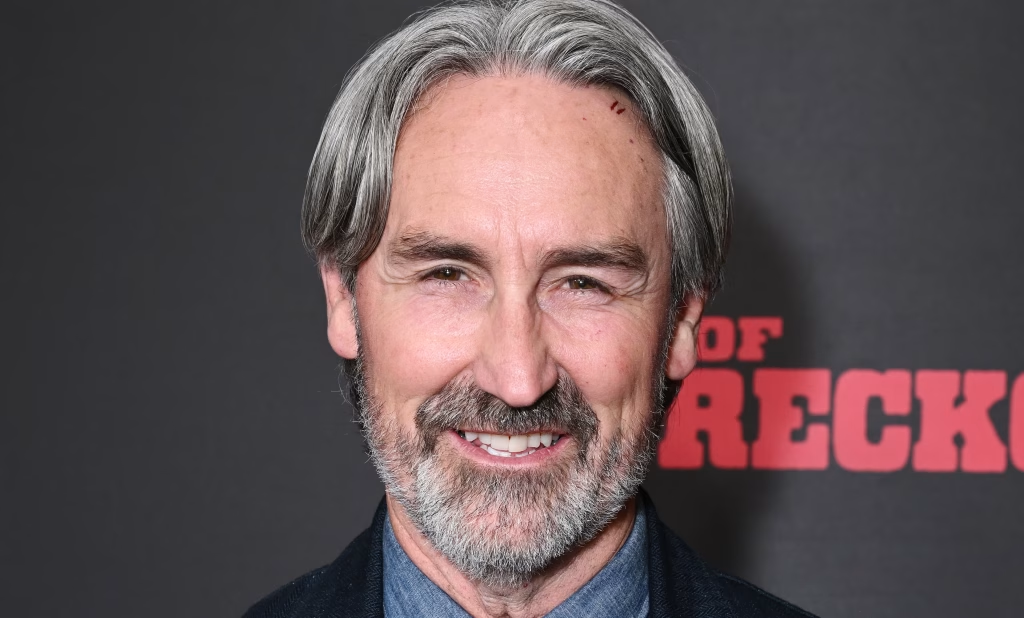
Most people drive past abandoned gas stations, crumbling storefronts, and boarded-up homes without a second thought. They see decay. They see demolition candidates. They see the past slipping away quietly, one vacant building at a time. Mike Wolfe sees something entirely different. He sees potential, character, and stories worth saving. The American Pickers star has spent the better part of his life hunting for forgotten treasures across the back roads of America. But over the past few years, his focus has shifted from collecting antiques to something far bigger. The mike wolfe passion project is a real-world effort to restore historic buildings, revitalize struggling downtowns, and prove that small-town America still has a bright future. What started as a childhood habit of picking through neighbors’ discarded belongings in Bettendorf, Iowa, has grown into a multi-million-dollar investment in Columbia, Tennessee. Wolfe is not just renovating old buildings. He is rebuilding community pride, attracting heritage tourism, and showing the rest of the country what happens when one person decides to care deeply about a place. This article takes a close look at the origins, the key projects, the setbacks, and the lasting impact of this preservation movement that continues to gain momentum heading into 2026.
The Origins Behind Mike Wolfe’s Passion Project
From Childhood Picking to Cultural Stewardship
Long before television cameras followed him into dusty barns and forgotten attics, Mike Wolfe was already a picker at heart. Growing up in Bettendorf, Iowa, he started rummaging through alleyways and neighbors’ trash at the age of four. Most kids his age were collecting baseball cards. Wolfe was dragging home rusty bicycle parts, old signs, and anything that looked like it had a story behind it. That childhood instinct never faded. Instead, it deepened into a genuine understanding that discarded objects carry memories, craftsmanship, and cultural significance that deserve to be honored. By 2000, Wolfe had turned this instinct into a business. He opened Antique Archaeology in Le Claire, Iowa, a shop that became a destination for vintage enthusiasts long before the cameras ever showed up. The store was more than a retail space. It was a statement of purpose. Wolfe believed that the things Americans threw away were often the very things that told the most honest stories about who we were as a country.
How American Pickers Became the Launchpad
Everything changed on January 18, 2010, when American Pickers premiered on the History Channel. The debut episode drew 3.1 million viewers, making it the network’s highest-rated premiere since Ice Road Truckers in 2007. Audiences fell in love with Wolfe’s genuine enthusiasm, his encyclopedic knowledge of Americana, and his respectful approach to the people he met along the way. But for Wolfe, the show was always a means to a larger end. Television gave him the platform, the visibility, and the financial foundation to pursue what truly mattered to him. He did not just want to buy old motorcycles and gas pumps. He wanted to save the buildings, the towns, and the traditions that created those objects in the first place. This is where the mike wolfe passion project really took shape. The transition from television personality to community preservationist did not happen overnight. It grew steadily as Wolfe traveled across America and witnessed firsthand how many small towns were losing their historic cores to neglect, demolition, and indifference. He decided that collecting stories was no longer enough. He needed to protect the places where those stories were born.
Inside the Mike Wolfe Passion Project in Columbia, Tennessee
Why Columbia Became Ground Zero
Wolfe first passed through middle Tennessee on a motorcycle ride back in 2002. Something about the region stuck with him. He eventually moved to the area around 2012 and began exploring the communities within an hour’s drive of Nashville. Columbia, Tennessee, stood out immediately. The town sits in Maury County and carries the unofficial title of the “Antique Capital of Tennessee.” Its downtown is lined with 19th-century brick buildings, many of which had sat vacant or underused for decades. Where most investors saw liabilities, Wolfe saw opportunity. He has spoken publicly about Columbia’s unique appeal on multiple occasions. In one interview, he explained that if you draw a circle around Nashville an hour out in any direction, there is no community that has what Columbia has to offer in terms of history, architecture, and people. That conviction turned into action. As of early 2026, Wolfe owns six properties in downtown Columbia and has invested well over $1.5 million in purchases and renovations. His work there has become the most visible and concentrated expression of the mike wolfe passion project to date.
Revival — Transforming a Forgotten Gas Station Into a Community Gathering Space
The centerpiece of Wolfe’s Columbia efforts is a restored 1940s Esso gas station that he purchased in September 2022 for $600,000. The building had been ignored for years. Cracked concrete, peeling paint, and overgrown weeds defined the property. Most developers would have leveled it and started fresh. Wolfe took the opposite approach. He poured roughly $38,630 into documented renovations, partnering with the design firm Living Exo to bring his vision to life. The result is a venue called Revival. It features inviting outdoor seating, a central fire pit that has become a magnet for community gatherings, a pergola, and a stage for live events. The space is designed to serve food and craft cocktails while functioning as a bookable venue for private events. In May 2025, Wolfe unveiled the finished project on Instagram. The response was immediate and overwhelmingly positive. Fans and locals flooded the comments with praise. One person wrote that they kept driving by and it looked incredible. Another said it was beautiful beyond words. Revival is not just a bar or a restaurant. It is a living example of what happens when someone chooses preservation over demolition and community over profit. The path to opening was not smooth. The project failed fire and gas inspections in 2023, pushing the timeline back by more than a year. But Wolfe stuck with it, adjusted, secured new permits, and finally passed inspections by mid-2025. The space is now open to the public, serving as exactly the kind of community anchor Wolfe envisioned.
The 1873 Italianate House Restoration
Another flagship project within the mike wolfe passion project is the restoration of a stunning Italianate house built in 1873. Wolfe purchased the property in May 2022 for $700,000. At that point, the home was in rough shape. Its signature tower and cupola had been removed decades earlier. The front porch had deteriorated. The interior needed extensive work to bring it back to its original grandeur. Wolfe has approached this restoration with painstaking historical accuracy. He tracked down original photographs of the house and is using them as blueprints to rebuild the cupola, restore the porch, replace windows, and replicate architectural details that had been lost to time. He has collaborated with preservation expert Bill Powell, who has spent nearly five decades restoring over 75 historic buildings. Together, they are ensuring that every renovation decision respects the structure’s original character. With over $200,000 invested in renovations so far and work expected to continue into late 2026, this project showcases the patience and commitment that define Wolfe’s approach. He has shared updates on social media showing the shutters going up on the rebuilt tower, new brickwork, and carefully restored interior spaces. In one Instagram post, Wolfe noted that the gentleman who built the house in 1873 was deeply interested in astrology and reportedly only fired brick when the moon and stars were aligned. That kind of detail matters to Wolfe. It is not just about fixing walls. It is about honoring the people who built them.
Columbia Motor Alley and Two Lanes Guesthouse
Wolfe’s investment in Columbia extends well beyond Revival and the Italianate house. Columbia Motor Alley is a multi-building complex centered around a restored 1947 Chevy dealership and an old Texaco station. The space celebrates Columbia’s deep automotive heritage and serves as a mixed-use development focused on vintage motorcycles, restoration shops, and American-made goods. It hosts exhibitions, events, and educational programs that connect visitors with the history of American motoring. Then there is the Two Lanes Guesthouse, a short-term vacation rental situated in a meticulously restored historic building on Columbia’s town square. The building dates back to 1857 and sits above a bicycle shop. Guests can stay overnight and then walk to Revival, the restored Esso station, and Motor Alley. The idea is total immersion. Wolfe has designed a connected ecosystem of properties that gives visitors a reason to come to Columbia, stay for a while, and experience firsthand what thoughtful preservation looks like in practice.
The Philosophy Driving Mike Wolfe’s Passion Project
Preservation Over Demolition
At the heart of everything Wolfe does in Columbia is a simple but powerful belief. Old buildings anchor community identity. When they are demolished, a piece of a town’s character disappears forever. You cannot get that back. This philosophy puts Wolfe at odds with conventional real estate development, where the standard playbook is to tear down aging structures and maximize new square footage. Wolfe does the opposite. He prioritizes historical authenticity and community benefit over profit margins. His guiding principle is adaptive reuse. Rather than demolish and rebuild, he repairs, restores, and repurposes. Original materials are preserved wherever possible. Modern amenities are added carefully, without erasing the character of the space. The goal is to create something that feels both timeless and functional. This approach costs more. It takes longer. It requires expertise that most contractors simply do not have. But for Wolfe, the result is worth every extra dollar and every delayed timeline. A restored building tells a story. A new building on the same lot tells nothing.
Storytelling as the Heart of Preservation
Wolfe has said many times that he does not collect items. He collects the stories attached to them. An antique motorcycle without context is just a piece of metal. But when you know who rode it, where it traveled, and what it meant to the person who kept it in their barn for sixty years, that motorcycle becomes a living piece of American culture. The same principle applies to his building restorations. Each property in Columbia is tied to a narrative. Who built it, why it mattered to the community, and what it can still become. This storytelling approach is what separates the mike wolfe passion project from ordinary real estate development. It transforms bricks and beams into vessels of memory and meaning. Wolfe uses his Two Lanes platform, his social media presence, and his television appearances to share these stories with a national audience. The effect is powerful. People who might never have heard of Columbia, Tennessee, are now booking stays at the Guesthouse and visiting Revival because they feel connected to the story Wolfe is telling.
Economic and Community Impact of the Passion Project
Boosting Heritage Tourism in Small-Town Tennessee
The economic argument for historic preservation is strong and growing stronger. The global heritage tourism market reached over $604 billion in 2024. In the United States alone, the heritage tourism segment is projected to hit $162 billion by 2030, growing at roughly four percent annually. Heritage tourists tend to spend more and stay longer than average visitors. Comparable market data shows that heritage tourism spending averages over $336 per person per overnight trip. Those dollars spread across hotels, restaurants, shops, and local services. Wolfe’s interconnected properties in Columbia are designed to capture exactly this kind of visitor spending. A guest books the Two Lanes Guesthouse, has dinner at Revival, explores Columbia Motor Alley, and shops in downtown stores along the way. The economic ripple effect extends far beyond Wolfe’s own investments. This is what makes the mike wolfe passion project significant on a community-wide level, not just as a personal endeavor.
Job Creation and Local Business Growth
Research consistently shows that historic rehabilitation creates more economic activity than new construction. For every 100 jobs generated by a historic restoration project, an estimated 186 additional jobs are created elsewhere in the local economy. New construction, by comparison, generates only about 135 additional jobs per 100 direct positions. The difference comes from the skilled labor required for restoration work and the tendency to source materials locally. In Columbia, the impact is visible. Property values in the downtown area have increased. New businesses have opened near Wolfe’s restored properties. Foot traffic has grown measurably. And importantly, Wolfe has been intentional about avoiding the kind of rapid gentrification that displaces longtime residents and small business owners. His restored buildings often serve as incubators for local entrepreneurs. Affordable spaces for people who want to start something new in a town that is finally getting the attention it deserves. The mike wolfe passion project is proving that preservation and economic growth are not competing goals. They reinforce each other.
Challenges and Setbacks Along the Way
Regulatory Hurdles and Inspection Failures
No preservation project of this scale comes without serious challenges. The Revival venue alone faced failed fire and gas inspections in 2023 that delayed its opening by more than a year. Navigating permits, zoning requirements, and the constant tension between historic building codes and modern safety standards requires patience, expertise, and deep pockets. Wolfe has spoken openly about the financial and emotional toll of these delays. He admitted in late 2024 that he felt overwhelmed, announcing a brief hiatus from American Pickers for the first time in the show’s 15-year run. The reality of restoration work is that timelines are unpredictable, costs escalate, and bureaucratic hurdles can stall progress for months at a time. But Wolfe has consistently pushed through. Each setback has been met with adjustments, new permits, and renewed commitment.
Closing Antique Archaeology Nashville
In April 2025, Wolfe made the difficult decision to close his Antique Archaeology store in Nashville after nearly 15 years of operation. The store had been a cultural landmark in the city, drawing fans from across the country. But keeping it running required time and energy that Wolfe increasingly wanted to direct toward his Columbia projects and his family. The closure marked a clear turning point. It signaled that the mike wolfe passion project was no longer a side venture running alongside his television career. It was the main event. His original Le Claire, Iowa store remains open and continues to attract visitors, but Columbia is now unquestionably the heart of his preservation mission.
Two Lanes — The Brand Extension of the Mission
Wolfe’s Two Lanes brand serves as the connective tissue between his physical restoration work and his public audience. Part blog, part online shop, and part visual love letter to forgotten America, Two Lanes celebrates backroads culture, small-batch American craftsmanship, and the beauty of slowing down. The brand sells goods from independent artisans and makers. It features storytelling through grainy photographs, personal essays, and behind-the-scenes updates on Wolfe’s restoration progress. It gives fans a way to stay engaged with the mike wolfe passion project even if they cannot visit Columbia in person. Two Lanes also serves a strategic purpose. It builds a community of like-minded people who value preservation, authenticity, and handmade quality. That community, in turn, becomes a built-in audience for Columbia’s heritage tourism offerings. The brand and the physical projects feed each other in a way that creates long-term sustainability.
What the Mike Wolfe Passion Project Means for the Future
A Blueprint for Saving Small-Town America
What Wolfe has done in Columbia is remarkable not just for its scale but for its replicability. He did not rely on government grants or viral crowdfunding campaigns. He used personal investment, strategic vision, and a willingness to take on risk that most people would avoid. That makes his work a potential blueprint for other individuals and communities looking to revitalize their own forgotten downtowns. Wolfe has also been involved in broader initiatives beyond Columbia. He partnered with well-known preservationist Aubrey Preston on a project called Nashville’s Big Backyard, which encouraged people to discover and invest in small communities of 5,000 or fewer residents along a corridor stretching from Muscle Shoals, Alabama, to Leiper’s Fork, Tennessee. The broader trend of remote work has made this vision more achievable than ever. People who can work from anywhere are increasingly choosing small towns with character, affordability, and community spirit. Wolfe’s projects demonstrate what those towns can become with the right investment and care.
Continuing the Mission Beyond Columbia
Wolfe shows no signs of slowing down. Season 27 of American Pickers premiered in July 2025. He has announced a new History Channel show and made his first film appearance. His Le Claire store continues to thrive as a cultural destination. And while Columbia remains the primary focus, the principles behind the mike wolfe passion project are clearly designed to be applied elsewhere. The message Wolfe keeps returning to is simple and resonant. The past is not something to discard. It is something we build upon. If we preserve the right stories and the right places today, future generations will inherit a richer, more meaningful cultural landscape. That is the legacy Wolfe is working toward, one restored building at a time.
Conclusion
Mike Wolfe started as a four-year-old kid pulling rusty treasures out of his neighbors’ garbage in Iowa. Decades later, he is reshaping the downtown of a Tennessee town that most Americans had never heard of. The mike wolfe passion project is proof that one person’s dedication can transform an entire community. Through Revival, the 1873 Italianate house, Columbia Motor Alley, Two Lanes Guesthouse, and the restored Esso gas station, Wolfe has created a connected ecosystem of spaces where history is not frozen behind glass but lived, enjoyed, and shared. His work has attracted heritage tourists, boosted local businesses, raised property values, and reignited community pride. None of it came easily. Failed inspections, financial risk, and the emotional weight of closing his Nashville store tested his resolve at every turn. But the results speak for themselves. Columbia, Tennessee, is no longer just another quiet Southern town. It is a living example of what happens when passion meets purpose. And for anyone wondering whether the forgotten corners of America are worth saving, Wolfe has delivered a clear and compelling answer. They are not just worth saving. They are waiting for someone to see their potential.
FAQ 1: What is the mike wolfe passion project?
The mike wolfe passion project is a historic preservation and community revitalization initiative led by American Pickers star Mike Wolfe. It focuses on restoring abandoned buildings and breathing new life into small-town downtowns, primarily in Columbia, Tennessee. The project blends storytelling, heritage tourism, and adaptive reuse to protect America’s cultural legacy.
FAQ 2: Where is the mike wolfe passion project located?
The primary hub of the mike wolfe passion project is downtown Columbia, Tennessee, in Maury County. Wolfe also maintains his original Antique Archaeology store in Le Claire, Iowa, and has been involved in preservation efforts across middle Tennessee, including Williamson and Maury counties.
FAQ 3: How much has Mike Wolfe invested in Columbia, Tennessee?
Mike Wolfe has invested over $1.5 million in Columbia, Tennessee, including property purchases and renovation costs. His portfolio includes the Revival venue purchased for $600,000, the 1873 Italianate house bought for $700,000, Columbia Motor Alley, and the Two Lanes Guesthouse.
FAQ 4: What is Revival in Columbia, Tennessee?
Revival is a dining and community gathering space housed inside a restored 1940s Esso gas station in downtown Columbia. The venue features outdoor seating, a central fire pit, a pergola, a stage for live events, and serves food and craft cocktails. It was unveiled by Wolfe on Instagram in May 2025.
FAQ 5: Can you visit Mike Wolfe’s restored properties in Columbia?
Yes, several of Wolfe’s properties are open to the public. Revival welcomes visitors for food, drinks, and events. Two Lanes Guesthouse is a bookable vacation rental. The restored Esso gas station outdoor space is accessible to anyone visiting downtown Columbia.
FAQ 6: Is the mike wolfe passion project connected to American Pickers?
While both share Wolfe’s core values of preservation and storytelling, the passion project operates independently from the television show. American Pickers gave Wolfe the platform and financial foundation, but his Columbia restoration work is a separate, self-funded initiative focused on community impact rather than TV content.
FAQ 7: Is Mike Wolfe still on American Pickers in 2026?
Yes. Season 27 of American Pickers premiered on the History Channel in July 2025. Wolfe continues to host the series alongside his brother Robbie Wolfe and friend Jersey Jon Szalay. He has also announced a new History Channel show and his first film role.
FAQ 8: Why did Mike Wolfe close his Nashville Antique Archaeology store?
Wolfe closed the Nashville Antique Archaeology location in April 2025 after nearly 15 years of operation. The decision was driven by his desire to redirect his time, energy, and financial resources toward his Columbia preservation projects and his family. His original Le Claire, Iowa store remains open.
FAQ 9: What is the Two Lanes brand?
Two Lanes is Mike Wolfe’s lifestyle brand that celebrates backroads American culture through storytelling, vintage merchandise, and goods from small-batch artisans. It also operates a blog featuring 35mm photography, personal essays, and progress updates on Wolfe’s restoration work. The Two Lanes Guesthouse in Columbia is part of this brand ecosystem.
FAQ 10: What challenges has the mike wolfe passion project faced?
The project has encountered significant hurdles, including failed fire and gas inspections at the Revival venue in 2023 that delayed its opening by over a year. Wolfe has also navigated complex permitting requirements, rising renovation costs, and the emotional difficulty of managing multiple large-scale restoration projects simultaneously.
FAQ 11: How does the mike wolfe passion project benefit the local economy?
Historic rehabilitation creates strong economic ripple effects. Research shows that every 100 jobs in historic restoration generate roughly 186 additional jobs in the surrounding economy. In Columbia, Wolfe’s work has increased downtown foot traffic, boosted property values, attracted heritage tourists, and encouraged new businesses to open near his restored properties.
FAQ 12: What is Mike Wolfe’s net worth?
As of 2025, Mike Wolfe’s estimated net worth is approximately $7 million to $8 million. His wealth comes from American Pickers salary earnings, Antique Archaeology retail revenue, real estate investments, book royalties, the Two Lanes brand, and product licensing deals.
FAQ 13: What is Columbia Motor Alley?
Columbia Motor Alley is a multi-building complex in downtown Columbia restored by Wolfe from a former 1947 Chevy dealership and an old Texaco station. The space celebrates Columbia’s automotive heritage and functions as a mixed-use development featuring vintage motorcycles, restoration shops, and American-made goods.
FAQ 14: What is the 1873 Italianate house project?
This is one of Wolfe’s most ambitious Columbia restorations. He purchased the 1873 Italianate house for $700,000 and has invested over $200,000 in renovations. The project involves rebuilding the missing cupola and tower using original photographs as blueprints, in collaboration with preservation expert Bill Powell.
FAQ 15: How is the mike wolfe passion project different from real estate flipping?
Unlike conventional flipping, Wolfe prioritizes historical authenticity and community benefit over profit margins. His approach involves adaptive reuse, preserving original materials and architectural character while adding modern functionality. The goal is community revitalization, not quick returns.
FAQ 16: Does Mike Wolfe offer micro-grants to artisans?
Reports suggest that Wolfe quietly provides micro-grants ranging from $2,000 to $10,000 to small-town artisans such as blacksmiths, sign painters, and neon benders through the Two Lanes platform. Grant recipients are featured on Two Lanes, helping drive customers to their workshops and keep traditional American crafts alive.
FAQ 17: What happened to Frank Fritz from American Pickers?
Frank Fritz left American Pickers in July 2021 and suffered a stroke in July 2022. He and Wolfe reportedly reconciled before Fritz passed away on September 30, 2024, at the age of 60. Wolfe’s brother Robbie and friend Jersey Jon Szalay have since taken over as co-hosts on the show.
FAQ 18: What is heritage tourism and how does it relate to the passion project?
Heritage tourism involves traveling to experience places, artifacts, and activities that authentically represent the past. The global heritage tourism market exceeded $604 billion in 2024. Wolfe’s interconnected Columbia properties are designed to attract heritage tourists who spend more and stay longer than typical visitors, directly boosting the local economy.
FAQ 19: How can fans support the mike wolfe passion project?
Fans can visit Columbia to dine at Revival, book stays at Two Lanes Guesthouse, and shop at local businesses near Wolfe’s restored properties. They can also purchase American-made goods through the Two Lanes website, follow Wolfe on social media for updates, and share his restoration stories to spread awareness about small-town preservation.
FAQ 20: Is Mike Wolfe involved in preservation work outside Columbia?
Yes. Wolfe partnered with preservationist Aubrey Preston on Nashville’s Big Backyard, an initiative encouraging people to discover and invest in small communities of 5,000 or fewer residents along a corridor from Muscle Shoals, Alabama, to Leiper’s Fork, Tennessee. He has also been involved in restoration efforts throughout Williamson and Maury counties.
FAQ 21: What is Nashville’s Big Backyard initiative?
Nashville’s Big Backyard is a tourism and community development initiative that Wolfe worked on with preservationist Aubrey Preston. The project encourages remote workers and entrepreneurs to explore, invest in, and relocate to small towns within the corridor stretching from Muscle Shoals, Alabama, to Leiper’s Fork, Tennessee.
FAQ 22: Does Mike Wolfe have a new TV show besides American Pickers?
Yes. In addition to continuing American Pickers, Wolfe announced a brand-new History Channel show in late 2024 and early 2025. He has also made his first film appearance in a neo-Western called Day of Reckoning. Details on the new show’s premiere date are expected to be announced in 2026.
FAQ 23: Who is Bill Powell and what is his role in the passion project?
Bill Powell is a preservation expert with nearly 50 years of experience who has restored over 75 historic buildings. Wolfe collaborates with Powell on his Columbia restorations to ensure that every renovation respects the original architecture while adapting spaces for modern use. Powell’s expertise is especially visible in the 1873 Italianate house project.
FAQ 24: Can the mike wolfe passion project model be replicated in other towns?
Absolutely. Wolfe’s approach serves as a potential blueprint for individual-led community revitalization without relying on government grants or crowdfunding. The core principles are personal investment, historical authenticity, adaptive reuse, and community engagement. With the rise of remote work making small-town living more viable, this model is increasingly replicable across America.

