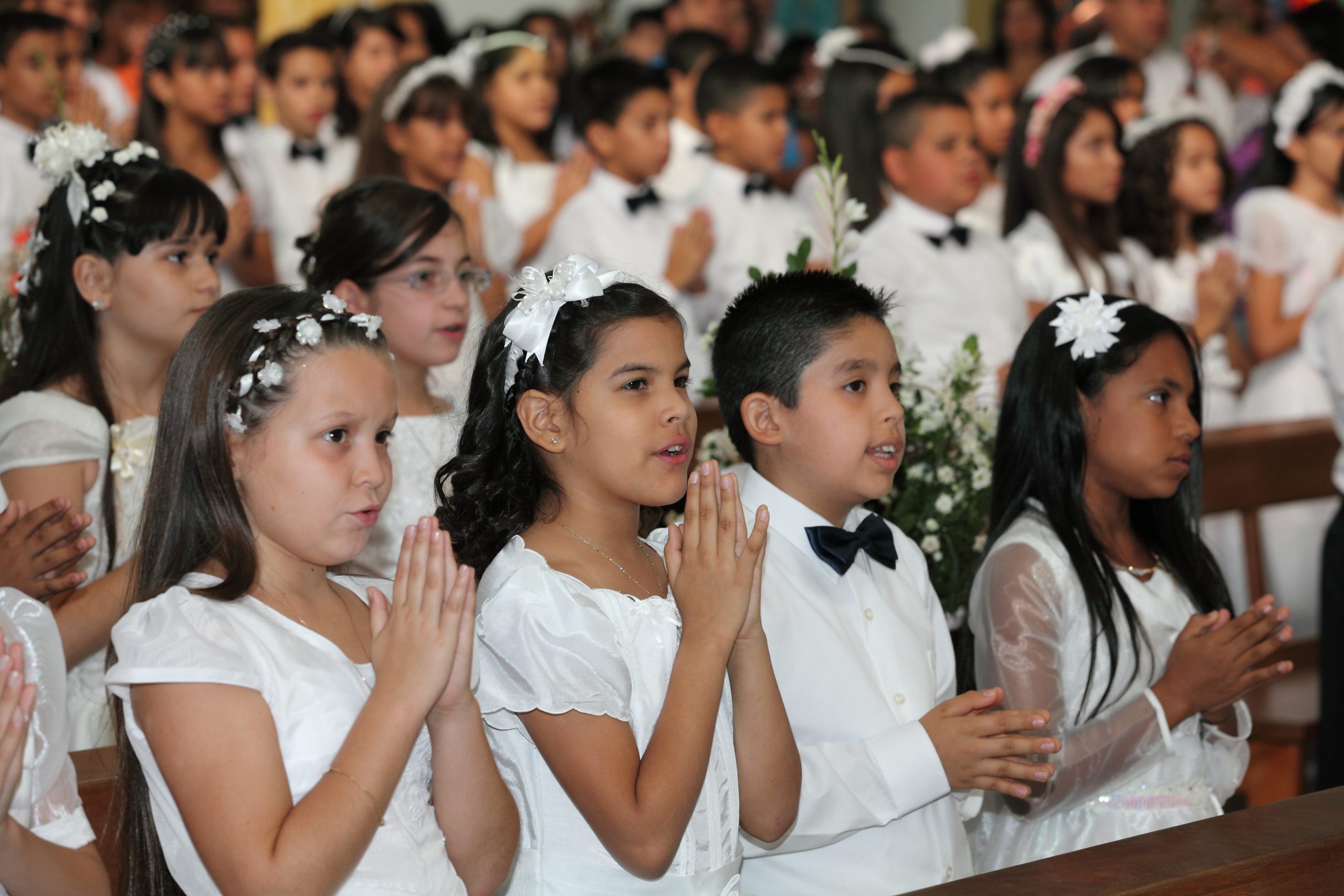
Picture a child dressed in white, hands folded, walking slowly toward the altar for the very first time. There is something quietly extraordinary about that moment — the kind that stays with a family for decades, talked about at kitchen tables and pulled from memory on ordinary Tuesday afternoons.
That moment is first communion. And if your family is approaching it for the first time, you probably have a lot of questions. What exactly is it? What does it mean spiritually? How do you prepare? What should she wear? What gift actually makes a difference?
This guide answers all of those questions in one place. Whether you are a parent, a grandparent, a godparent, or simply a guest trying to understand what you are attending, you will leave here knowing exactly what first communion is, why it matters, and how to honor it well.
What Is First Communion and Why Does It Matter?
First communion is the first time a person receives the Sacrament of the Holy Eucharist — the bread and wine that Catholics believe are truly the Body and Blood of Jesus Christ. It is not simply a ceremony or a tradition carried down for its own sake. It is a moment of genuine spiritual initiation.
In Catholic teaching, the Eucharist is at the very heart of the faith. To receive it for the first time is to step into something ancient, sacred, and deeply personal. The child is not just participating in a ritual — they are entering into a living relationship with Christ at the altar.
First communion sits as the third Sacrament of Initiation, following Baptism and preceding Confirmation. Through this sacrament, the young communicant participates in what the Church calls the Paschal Mystery — the death and resurrection of Christ — uniting themselves with His sacrifice in a real and lasting way.
It is also worth noting that first communion is not exclusive to the Catholic Church. It is celebrated in many parts of the Lutheran Church, the Anglican Communion, and other Christian denominations, though the age, form, and spiritual emphasis vary across traditions.
The Biblical Foundation of the Eucharist
The roots of this sacrament go all the way back to the night before Jesus was crucified. At the Last Supper, He took bread and wine, gave thanks, and shared them with His disciples — telling them that the bread was His body and the wine was His blood, poured out for the forgiveness of sins. He then commanded them to “do this in remembrance of me.”
That single act at a Passover table in Jerusalem is the foundation for everything that happens at every Mass, at every altar, in every church across the world. When a child receives first communion, they are stepping into that same tradition — one that stretches back over two thousand years.
A Brief History of First Communion
First communion has not always looked the way it does today. Its history is long, sometimes contested, and shaped by the decisions of popes, councils, and theologians across many centuries.
In the earliest years of Christianity, Baptism, Confirmation, and the Eucharist were typically celebrated together in a single ceremony, usually at Easter. Babies, children, and adults alike received all three sacraments at once. There was no separate rite of first communion — it was simply part of entering the Church.
By the Middle Ages, things had changed considerably. The Eucharist had become so elevated in theological importance that the Church grew increasingly strict about who could receive it and when. For a period, access was actually limited in ways that left ordinary people receiving communion only rarely, if at all.
The Fourth Lateran Council in 1215 brought some order to the conversation, establishing that communion should be received at least once a year by those who had reached the “age of reason” — roughly age seven. That phrase, age of reason, became central to how the Church thought about children and the sacraments.
The most defining moment in modern history came in 1910, when Pope Pius X issued the decree Quam Singulari. He lowered the age for first communion to around seven years old — precisely that age of reason — arguing that children were capable of understanding the difference between ordinary bread and the Eucharist, and should not be kept from the sacrament unnecessarily.
That decision changed the celebration as we know it. Instead of adolescents receiving first communion as a rite of passage into adulthood, it became a milestone for young children. Families began building traditions around it. The white dress, the party afterward, the gifts — all of these grew naturally from that shift.
As for timing, first communion ceremonies in many Western countries are held in April or May. This is tied directly to Easter. The original tradition of receiving the sacraments at the Easter Vigil has carried its spirit forward, and the Easter season — full of themes of new life and resurrection — makes a fitting backdrop for a child’s first encounter with the Eucharist.
Preparing Your Child for First Communion
Preparation for first communion is not something that happens the week before. It is a process — spiritual, intellectual, and personal — that typically takes place over one to two years.
Most parishes begin formal preparation when children are around six or seven years old, usually in second grade. The preparation involves religious education classes held at the church or school, where children learn the basics of Catholic teaching — what the Eucharist is, why it matters, how Mass is structured, and what the prayers mean.
Children also learn the specific responses used during Mass and practice how to receive the host — with open palms or on the tongue, depending on their preference and their parish’s customs. These practical details matter, because first communion day can feel overwhelming for a child who has never stood at the altar before.
There is one sacrament that must come before first communion, and that is Confession — also called the Sacrament of Penance or Reconciliation. The Church requires that a child be in a state of grace before receiving the Eucharist. Confession allows the child to examine their conscience, acknowledge wrongdoing honestly, and approach the altar with a clear heart. For many children, this is their first real engagement with the idea of moral responsibility — and it is handled gently, with age-appropriate language.
How Parents Can Support the Process
Parents carry the most important role in this preparation, and it extends well beyond driving to class on Tuesday evenings. Children learn faith primarily at home, not in classrooms. When parents attend Mass regularly, pray before meals, and talk openly about what they believe, children absorb those habits naturally.
During the preparation year, parents can practice the Mass responses with their child at home, read age-appropriate books about the Eucharist together, and discuss what it means to receive Jesus for the first time. These conversations do not need to be formal or lengthy — a few minutes at bedtime goes a long way.
The Role of Godparents
Godparents hold a special place in this celebration. While they are not required to participate in a formal way at first communion as they are at Baptism, many families invite godparents to sit with the family, offer prayers, and give a meaningful gift. The day offers a natural opportunity to strengthen that spiritual bond and remind the child that they have people walking alongside their faith journey.
What Happens During the First Communion Mass
The ceremony itself follows the structure of a typical Catholic Mass. There are Scripture readings, a homily from the priest, the Liturgy of the Eucharist, and finally the moment the children have been preparing for — walking forward to receive the Host for the first time.
Guests are welcome to participate by singing hymns and joining in the spoken responses, but non-Catholics typically do not receive communion during the Mass. This is not a matter of exclusion — it reflects the Church’s teaching that full communion requires shared belief. Guests can still participate meaningfully by being present, attentive, and reverent.
Afterward, families typically host a reception or party — a chance to celebrate, share a meal, and mark the occasion in a way that the child will remember for the rest of their life.
First Communion Traditions Around the World
One of the most beautiful things about first communion is how differently cultures have shaped its celebration — while the spiritual meaning remains exactly the same everywhere.
In Ireland and the Philippines, first communion is a major community event, with large gatherings, elaborate outfits, and sometimes even school processions. In Poland, children bring decorated bread as a gift for the Church. In Spain, Germany, Austria, and several other European countries, girls have traditionally been dressed as little brides, with full veils and formal gowns. In Scotland, boys wear kilts for the ceremony — a nod to heritage as much as faith.
In Switzerland, the tradition leans toward simplicity: both boys and girls wear plain white robes with wooden crosses around their necks. In Vietnam, girls wear white áo dài. In many Latin American countries, boys are dressed in military-style formal uniforms adorned with gold braid.
Each of these customs carries its own meaning. The specifics differ, but the thread running through all of them is the same — white for purity, family gathered close, and a child at the center of something that matters.
First Communion Dresses — How to Find the Right One
Few decisions in the lead-up to first communion get as much attention — or cause as much stress — as choosing the dress. And that makes sense. The dress is visible. It is photographed. It may even be kept for decades.
But the dress is not just fashion. It carries spiritual meaning. White has been associated with first communion for centuries, rooted in the early Church tradition of wearing white after Baptism as a symbol of new life in Christ. When a girl wears a white dress to receive the Eucharist for the first time, she is participating in that same symbolism.
Key Guidelines When Shopping for First Communion Dresses
Before falling in love with a particular style, check with your parish. Every church has its own guidelines, and some are stricter than others. Generally speaking, the rules that most parishes follow include white or ivory as the required color, tea-length or ankle-length hemlines as the standard, coverage of the shoulders as expected, and a preference for simple elegance over flashy embellishment.
Avoid dresses that feel more like party gowns than church attire. The day has a sacred quality to it, and the outfit should reflect that without being dull or overly austere. The goal is modest elegance — something that honors the occasion and makes the child feel truly special.
Popular Styles and What Works in 2025
The most popular silhouettes for first communion dresses remain A-line, ball gown, and simple sheath styles. Each works well for different body types and personal preferences.
In terms of fabric and detail, the trends in recent years have leaned toward layered tulle with subtle sparkle for an ethereal, soft effect, lace with delicate floral motifs for a romantic and traditional look, satin for a classic, polished finish, and embroidered bodices that add elegance without being overly ornate.
Accessories matter too. A simple veil remains a beloved choice — either a short chapel veil or a longer mantilla style. Flower crowns and tiaras offer a more modern alternative. White gloves, a pearl necklace, and low-heeled dress shoes complete the look without overwhelming it.
One practical note: start shopping early. Communion season runs roughly from January through May. Waiting until April leaves very few options, and alterations take time. If you find something you love in January or February, buy it.
Boys’ First Communion Attire
Boys deserve the same level of thought and care. A dark navy or charcoal suit with a dress shirt and tie is the most common choice in the United States and much of Europe. The suit should fit well and allow the child to move comfortably through a long ceremony.
Some families opt for a simple blazer with dress trousers rather than a full suit. Either works. The key is that the outfit looks intentional and respectful — not like something pulled from the back of a closet.
For boys in cultural communities where traditional dress is part of the celebration, those choices are always appropriate and often deeply meaningful.
First Communion Gifts That Truly Mean Something
Choosing a gift for first communion is a chance to give something that will last far longer than the day itself. The best gifts connect to faith, memory, or the child’s personality in a way that a generic card with cash simply cannot.
Traditional Religious Gifts That Never Go Out of Style
Religious gifts have been associated with first communion for generations, and for good reason — they remind the child of the sacrament they received and carry meaning that grows over time.
A rosary is one of the most classic choices, especially when it is made from quality materials or personalized with the child’s name and the date. A children’s Bible or daily devotional gives them something to grow with over the coming years. A prayer book designed specifically for children is another thoughtful option.
Other traditional choices include: a small religious statue or icon for their bedroom, a personalized holy card, a saint medal on a chain, or a framed blessing certificate from the day. These items create what amounts to a little spiritual environment for the child — objects that remind them, quietly and daily, of what they received.
Modern and Personalized Gift Ideas
Not every gift needs to be overtly religious to carry meaning. Personalized jewelry — a pearl necklace, a gold cross bracelet, a ring engraved with the date — serves as a keepsake the child can wear into adulthood.
A beautifully made memory box where they can keep their veil, prayer card, and photos from the day is a gift that parents and grandparents often end up treasuring just as much as the child. A journal for writing prayers is another option that works well for older children.
For godparents who want to give something both personal and faith-centered, a handwritten letter about what the faith means to you — tucked inside a meaningful gift — carries a weight that no store-bought item can match.
A Few Tips for Gift-Givers
If you are not close to the child and are unsure what to give, ask the parents discreetly. They will likely have a sense of what the child would love. Combining a small religious item with something more personal — a rosary alongside a gift card, for example — strikes a balance that tends to work well.
Presentation matters too. A thoughtfully wrapped gift with a handwritten card means more than an expensive item dropped in a gift bag. Take the time to write something personal. That note may end up being the thing they remember most.
Planning the First Communion Celebration
The Mass itself is the heart of the day. But the celebration that follows is where families create the memories that last.
Some families host a large backyard gathering. Others keep it small — a quiet lunch at a favorite restaurant with just the immediate family. Both are equally valid. What matters is that the child feels seen and celebrated, not just shuffled through a schedule.
For decorations, white and gold tones tend to work beautifully, paired with fresh flowers and a few religious touches like a cross or a framed photo of the child at the altar. Personalized banners with the child’s name and the date are simple and meaningful.
Photography is worth prioritizing. Hire a photographer if the budget allows — or designate a family member who is actually good with a camera, rather than everyone assuming someone else is handling it. The quiet moments are often the most powerful: hands folded in prayer, eyes closed at the altar, a hug with a grandparent afterward. Those are the pictures that get framed.
Consider creating a simple guestbook where attendees write a blessing or a piece of advice for the child. Years from now, reading those words will mean more than any gift that was given that day.
Final Thoughts
First communion is one of those rare days that carries weight on both sides — the child stepping into something sacred for the first time, and the adults around them remembering what it felt like when they did the same.
There is nothing about it that needs to be perfect. The dress does not need to be the most expensive one in the shop. The party does not need a caterer. What matters is that the child knows they are loved, supported, and celebrated — and that the day is treated with the reverence and joy it deserves.
Take the preparation seriously. Choose the dress with care. Give a gift that means something. And when the child walks back from the altar for the first time, be present for that moment. It goes quickly, and it does not come around again.
FAQ 1: What is first communion?
First communion is the first time a person receives the Sacrament of the Holy Eucharist — the consecrated bread and wine that Catholics believe are truly the Body and Blood of Jesus Christ. It is one of the seven sacraments of the Catholic Church and is considered the third Sacrament of Initiation, following Baptism and preceding Confirmation. The ceremony marks a deeply personal and spiritual milestone in a child’s faith journey, rooting them more deeply in the life of the Church and in their relationship with Christ. It is not merely a tradition — it is a sacred, living act of faith that traces its origins to the Last Supper.
FAQ 2: What age do children make their first communion?
In the Catholic Church, children typically receive first communion between the ages of seven and eight. This age is known as the “age of reason” — the point at which a child is considered capable of distinguishing between ordinary bread and the Eucharist, and of understanding the moral significance of the sacrament. This standard was established in 1910 by Pope Pius X through the decree Quam Singulari, which lowered the age from what had previously been ten, twelve, or even fourteen in some regions. Today, most parishes in the United States and across the world celebrate first communion during second grade.
FAQ 3: Does a child need to be baptized before making their first communion?
Yes. Baptism is an absolute requirement before a person can receive first communion. The Catholic Church teaches that Baptism is the gateway to all the other sacraments, and without it, a person is not yet a member of the Church in the full sacramental sense. A child who has not been baptized cannot receive the Eucharist, regardless of how well-prepared they are in other ways. Parents are asked to provide a baptism certificate when registering their child for first communion preparation. This requirement applies equally to adults entering the faith — Baptism must come first.
FAQ 4: Is confession required before first communion?
Yes. The Sacrament of Penance — also called Reconciliation or Confession — must take place before a child receives first communion for the first time. The Church requires that a person be in a state of grace when they approach the Eucharist. Confession allows the child to examine their conscience, acknowledge wrongdoing, and receive absolution from a priest. Most parishes hold a dedicated First Reconciliation ceremony, usually a few weeks or months before the first communion Mass. It is not just a formality — it is a genuinely formative spiritual experience that helps children understand responsibility, forgiveness, and the seriousness of receiving Christ.
FAQ 5: What is the difference between first communion and confirmation?
First communion and Confirmation are two separate Sacraments of Initiation, though both are deeply connected. First communion is typically received around age seven or eight and involves receiving the Eucharist — the Body and Blood of Christ — for the first time. Confirmation, on the other hand, is usually received later, often during middle or high school, and involves being “sealed with the gift of the Holy Spirit.” It strengthens the baptized person’s faith and formally deepens their commitment to the Church. In the traditional order of Catholic sacraments, Baptism comes first, then Confirmation, then the Eucharist — though in most Western parishes today, first communion is received before Confirmation. Adults entering the Church through RCIA receive all three sacraments at once at the Easter Vigil.
FAQ 6: What is the difference between first communion and baptism?
Baptism and first communion are both Sacraments of Initiation, but they serve distinct spiritual purposes. Baptism is the very first sacrament — it cleanses original sin, brings the person into the life of the Church, and marks the beginning of their Christian journey. Most Catholic children are baptized as infants. First communion, by contrast, comes years later and involves the child actively and knowingly receiving Christ in the Eucharist for the first time. While Baptism initiates the spiritual life, first communion nourishes it — the Catechism describes the Eucharist as “the food of eternal life.” Together, along with Confirmation, these three sacraments form the complete foundation of Christian initiation.
FAQ 7: Can an adult make their first communion?
Yes, absolutely. Adults who were never baptized, or who were baptized but never received proper catechetical formation, can make their first communion at any age. In the Catholic Church, adults typically go through the RCIA program — the Rite of Christian Initiation for Adults — which is a structured journey of faith formation that usually spans one year. Upon completing the program, adults receive Baptism (if not yet baptized), Confirmation, and first communion together at the Easter Vigil Mass. Adults who were baptized Catholic but missed sacramental preparation as children can also receive first communion after adequate instruction, without necessarily going through the full RCIA process.
FAQ 8: Do you have to fast before first communion?
Yes. Canon Law requires that anyone receiving the Eucharist must fast from all food and drink — except water and medicine — for at least one hour before receiving communion. This applies to first communion as well. The Eucharistic fast is a long-standing practice in the Church, rooted in the idea of creating a physical and spiritual hunger for Christ before receiving Him. Water and medication do not break the fast. Exceptions are made for the elderly, the seriously ill, and those caring for them, who may receive communion even if they have eaten within the hour. The one-hour rule refers to the time before the moment of receiving communion itself — not before Mass begins.
FAQ 9: Is first communion only a Catholic tradition?
No, though it is most strongly associated with the Catholic Church. First communion is also observed in many Lutheran, Anglican, and some Methodist communities, though the theological understanding and level of ceremony vary by denomination. In the Lutheran Church, first communion typically occurs between ages seven and ten, depending on the parish and the synod. In some Anglican churches, a separate rite of first communion is celebrated, while others administer communion immediately after Confirmation. Eastern Orthodox and Oriental Orthodox Christians receive the Eucharist from infancy, so there is no distinct “first communion” ceremony in those traditions. The Catholic celebration tends to be the most elaborate and culturally significant version of the rite.
FAQ 10: What prayers should a child know before first communion?
Before receiving first communion, a child should be familiar with the core prayers of the Mass and the most common Catholic prayers. These typically include the Our Father, the Hail Mary, the Glory Be, the Act of Contrition (used during Confession), and the responses used throughout the Mass — such as the Holy, Holy, Holy and the Memorial Acclamation. Many parishes also teach children a short prayer of thanksgiving to say after receiving the Eucharist. Parents play a huge role in this — children who attend Mass weekly and hear these prayers repeated naturally absorb them over time, far more effectively than cramming before a preparation class.
FAQ 11: What does a child wear for first communion?
Girls traditionally wear white or ivory dresses symbolizing purity and new life in Christ. The dress is typically modest in design — tea-length or ankle-length, with covered shoulders, and minimal but elegant embellishments like lace, satin, or soft tulle. A veil is a classic and widely used accessory, though floral crowns and tiaras have become popular alternatives. White shoes, gloves, and a simple cross necklace are common additions. Boys wear dark or navy suits with dress shirts and ties, or in some cultures, traditional formal dress. The U.S. Bishops’ guidance is that first communion attire should convey “respect, solemnity, and joy” — it does not need to be expensive, but it should be thoughtful and church-appropriate.
FAQ 12: Why do girls wear white dresses for first communion?
White has carried spiritual symbolism in Christianity since the early Church, when newly baptized Christians wore white robes to represent their new life in Christ and the washing away of sin. That tradition was carried forward into first communion attire, where white continues to represent purity, innocence, and a clean heart prepared to receive Jesus. The Catholic Church’s teaching that the communicant becomes, in a sense, a bride of Christ on this day has also contributed to the bridal quality of first communion dresses in many cultures. The symbolic weight of the white dress is real and intentional — it is not simply fashion.
FAQ 13: What are good first communion gifts?
The most meaningful first communion gifts connect directly to faith and memory. Traditional religious gifts include rosaries, personalized prayer books, a children’s Bible, holy cards, saint medals, and small religious statues or icons for the child’s room. More modern and personalized options include engraved jewelry such as a pearl necklace or gold cross bracelet, a keepsake box to store mementos from the day, a personalized photo frame, or a journal for prayers and reflections. For older children, a devotional book about their patron saint or a beautiful illustrated book on the Eucharist can be deeply meaningful. The best gifts are those chosen with the child’s personality in mind, paired with a handwritten note that will carry its own lasting weight.
FAQ 14: How long does a first communion Mass last?
A first communion Mass typically lasts between one hour and one hour and thirty minutes, though the exact length depends on the parish, the priest, the number of children receiving the sacrament, and the musical program included. Some parishes hold group Masses with a large number of children from the same class, which may run slightly longer. Others celebrate first communion at a regular Sunday Mass with just a few children, which keeps things closer to the standard one-hour length. Families should plan to arrive at least fifteen to twenty minutes early, as seating can fill quickly and punctuality is expected for a liturgical ceremony.
FAQ 15: What happens during a first communion ceremony?
The first communion ceremony takes place within a standard Catholic Mass. The service opens with entrance hymns, Scripture readings, and a homily from the priest. During the Liturgy of the Eucharist, the priest consecrates the bread and wine — the central mystery of the Mass. The children who are making their first communion then walk forward to the altar first, before the rest of the congregation, to receive the Eucharist for the very first time. They receive either the host alone (the Body of Christ) or, in some parishes, both the host and wine. After the Mass concludes, the new communicants receive a special blessing. Families typically gather outside the church for photographs and then proceed to a celebration.
FAQ 16: Can non-Catholics attend a first communion Mass?
Yes, non-Catholics are warmly welcome to attend a first communion Mass. The Mass is open to all. However, non-Catholics are asked not to receive communion during the service. This is not an exclusion meant to offend — it reflects the Catholic Church’s theological teaching that receiving the Eucharist is an expression of full unity in faith, life, and worship, which requires being in full communion with the Church. Non-Catholic guests can still participate meaningfully in the Mass by standing, sitting, singing hymns, and joining in the spoken responses. When the time for communion comes, they may remain seated in the pew or approach the altar with arms crossed over the chest to receive a blessing rather than the Eucharist.
FAQ 17: What is the “age of reason” and why does it matter for first communion?
The age of reason is the point — traditionally understood as around age seven — at which a child becomes capable of distinguishing right from wrong and can think with basic moral understanding. It matters for first communion because the Church teaches that a person must be able to understand the difference between the Eucharist and ordinary bread before they are allowed to receive it. Pope Pius X formally established age seven as the minimum age for first communion in 1910, shifting the practice away from the older adolescent model that had been common for centuries. Today, this concept still guides preparation — the goal is not perfect theological knowledge, but genuine, age-appropriate understanding and reverence for what the child is receiving.
FAQ 18: Why is first communion usually celebrated in April or May?
The tradition of celebrating first communion in spring is tied to the Church’s liturgical calendar and specifically to Easter. In the early centuries of Christianity, the three Sacraments of Initiation — Baptism, Confirmation, and Eucharist — were typically celebrated together at the Easter Vigil. As practices evolved and children began receiving first communion separately from Baptism and Confirmation, the spring timing was retained as a nod to that original Easter tradition. Additionally, the Code of Canon Law retains an “Easter obligation” — the requirement that Catholics receive communion at least once during the Easter season. The spiritual themes of the Easter season — new life, resurrection, and renewal — make it an especially fitting time for a child’s first encounter with the Eucharist.
FAQ 19: What is the difference between first communion and first Holy Communion?
There is no meaningful difference — the two terms refer to exactly the same sacramental event. “First communion” and “first Holy Communion” are used interchangeably in everyday language, in parish communications, and in most Catholic writing. “First Holy Communion” is simply the more formal and traditionally reverent expression, emphasizing the sacred nature of the Eucharist. Some older Catholic texts and formal Church documents prefer “First Holy Communion,” while modern family and parish use has made “first communion” the more conversational standard. Both terms refer to the same milestone: the first time a person receives the Body and Blood of Christ in the Eucharist.
FAQ 20: What should guests wear to a first communion?
Guests at a first communion should dress in smart casual to semi-formal attire that honors the solemnity of the occasion without overshadowing the child. For women, a modest midi dress, a blouse with tailored trousers, or a skirt suit in soft, muted colors works well. Avoid white, which is traditionally reserved for the child receiving the sacrament. For men, a suit or blazer with dress trousers and a collared shirt is ideal — navy, light gray, and beige are classic choices. The overall tone to aim for is elegant, modest, and appropriate for both a church ceremony and a family reception. Think of it as similar to dressing for a daytime wedding — formal enough to show respect, simple enough to keep the focus on the child.
FAQ 21: How long does first communion preparation take?
Preparation for first communion typically takes one to two years and usually begins when a child is in first or second grade, around age six or seven. Most parish programs include weekly religious education classes, family participation in Sunday Mass, and parent meetings throughout the year. Children also attend dedicated workshops preparing them for First Reconciliation (Confession), which must occur before first communion. The preparation covers the meaning of the Eucharist, the structure of the Mass, the prayers and responses used during the liturgy, and the moral and spiritual expectations of a Catholic life. Parents are considered essential partners in the process, not just drivers who drop children off at class.
FAQ 22: Can a child with special needs make their first communion?
Yes. The Catholic Church is clear that the sacraments are available to all baptized Catholics, including those with physical, intellectual, or developmental disabilities. The standard is not perfect understanding in an academic sense — it is whether the child can distinguish the Eucharist from ordinary food and approach it with some degree of reverence and desire. Many dioceses have dedicated special needs sacramental preparation programs designed to meet children where they are. Parents of children with special needs are encouraged to contact their parish well in advance to discuss the specific needs of their child and to develop a preparation plan that works for the whole family. The right to receive the sacraments is not contingent on neurotypical development.
FAQ 23: What is the role of godparents at first communion?
Godparents do not have a required formal role at first communion in the same way they do at Baptism, but their presence is both welcome and meaningful. Many families invite godparents to sit with them at the Mass, and some ask godparents to accompany the child to the altar or offer a personal blessing. The first communion day is a natural opportunity for godparents to reaffirm their spiritual bond with their godchild and to give a meaningful gift that reflects their shared faith. Some parishes hold a special ceremony where godparents renew their commitment to support the child’s faith journey. Even if a godparent cannot attend in person, a thoughtful card and gift sent ahead of the day carries real significance.
FAQ 24: What is transubstantiation, and why does it matter for first communion?
Transubstantiation is the Catholic Church’s teaching that during the consecration at Mass, the bread and wine are truly and completely transformed into the Body and Blood of Jesus Christ — not symbolically, but in reality. The outward appearance of bread and wine remains unchanged, but the substance is entirely different. This belief is central to why first communion is treated with such reverence and seriousness. When a child receives the Eucharist for the first time, Catholics believe they are receiving Christ Himself — not a memorial, not a symbol, not a representation, but the real presence of God. Understanding this — even at a child’s level — is why preparation for first communion is so carefully structured, and why the Church requires fasting, confession, and a state of grace before approaching the altar.