
You clean your floors. You mop, vacuum, and scrub. Then someone walks in from outside and undoes all of it in ten seconds. Mud, rain, dirt, and grit get dragged right across your clean entryway floor like it never happened. Sound familiar?
That’s exactly the problem waterhog mats were built to solve, and they do it better than almost anything else on the market. Not because of clever marketing, but because of how they’re actually constructed. Once you understand what sets waterhog mats apart, you’ll see why so many homeowners and facility managers call them the last doormat they ever had to think about.
This guide covers everything — how they work, which type fits your space, how to care for them properly, and what to expect from popular options including LL Bean waterhog mats. By the end, you’ll know exactly what to buy and why.
What Makes a Waterhog Mat Different From a Regular Doormat
Most doormats are designed to look presentable on a porch. A waterhog mat is designed to actually do a job. That distinction sounds simple, but it changes everything about how it’s built.
The design starts with a bi-level surface — a raised “waffle” pattern of squares or ridges with deep channels running between them. When you step onto the mat, those raised squares physically scrape dirt, mud, and debris from the bottom of your shoes. The loosened particles fall into the recessed channels below. They sit there, trapped between the ridges, rather than spreading across your floor.
The fiber used is a hydrophobic PET (polyethylene terephthalate) material — typically a 24-ounce polyester fabric in standard models and a heavier 30-ounce version in premium lines. Here’s the key thing: these fibers don’t absorb water the way a cloth mat does. Instead, they hold moisture below shoe level so your feet never actually contact the wet surface. The mat contains it, disperses it, and allows it to dry without spreading outward.
Underneath the fibers sits a rubber backing. That backing creates a seal between the mat and your floor. Moisture can’t migrate underneath and pool on hardwood, tile, or laminate. The rubber also grips the floor firmly so the mat stays exactly where you put it — even in high-traffic areas where lighter mats tend to bunch or slide.
The Science Behind the Waffle Pattern
The waffle pattern is not decorative — it’s structural. Every raised square serves two purposes. First, it provides a scraping surface that physically removes material from shoe soles with each step. Second, it creates a textured platform that gives shoes grip and reduces the risk of slipping at the entry.
The channels between the raised squares act as a built-in reservoir. A well-constructed entrance mat of this type holds up to 1.5 gallons of water per square yard — a performance benchmark verified across commercial matting evaluations. For a standard 3-foot by 5-foot mat, that’s a significant volume of liquid being kept entirely off your floors.
The bi-level structure also keeps the mat functional when it’s fully loaded with moisture. A flat cloth mat that’s saturated is essentially useless — it becomes a wet surface people can slip on. The raised pattern keeps shoe contact above the waterline even when the mat is carrying a heavy moisture load.
The Real-World Benefits of Waterhog Mats
Understanding the design is one thing. Seeing what it delivers in daily use is another. Here’s what makes these mats a genuinely worthwhile investment for homes and commercial spaces alike.
Superior Dirt and Moisture Control
The primary job of any entry mat is to stop contamination at the door. Performance data from comparative testing shows that a quality mat in this category traps 30% more dirt than comparable products like 3M Nomad mats. In a busy home or commercial building, that difference compounds quickly.
Less dirt getting past the entryway means less frequent mopping, less wear on interior flooring, and meaningfully lower cleaning costs over time. In commercial facilities, entrance matting is consistently one of the highest-value maintenance investments — and this product line sits at the top of that category for moisture-heavy environments.
Genuine Slip Resistance
Wet entryways are one of the most common causes of slip-and-fall incidents, both at home and in commercial buildings. The National Floor Safety Institute (NFSI) tracks flooring-related injuries, and wet entryways consistently rank high in their findings.
The rubber backing holds the mat firmly against the floor surface even when both are wet. Independent testing has shown a reduction in slip incidents of up to 40% compared to standard doormats. Many models carry NFSI certification — meaning they’ve been tested against established anti-slip standards, not just rated by the manufacturer. The raised edges and beveled corners on most versions also reduce tripping hazards by creating a gradual transition from floor to mat surface.
Long-Term Durability That Actually Saves You Money
This is where entry mats built on the waterhog design separate themselves from nearly every other option. A popular coir mat looks good for about six weeks. After that, fibers shed, patterns fade, and the mat ends up looking worse than no mat at all. These mats are built from polypropylene and polyester blends that resist fading, rotting, crushing, and fiber breakdown under repeated moisture exposure.
Commercial durability benchmarks place them at up to five years of reliable performance in heavy-traffic environments. In a home with normal use, they last considerably longer. The crush-resistant fiber configuration maintains its structure even after years of daily foot traffic — unlike mats that flatten and lose their scraping and trapping ability within a single season.
Buying a quality mat once at a slightly higher price beats buying a cheap mat twice a year. The economics over five years aren’t even close.
Eco-Friendly Construction
Many product lines — including the L.L. Bean Everyspace Recycled version — are made from at least 90% post-consumer recycled polyester derived from plastic bottles. That’s a verifiable specification, not a vague sustainability claim. The mats are also naturally stain-resistant and mildew-resistant, so they don’t require chemical treatments to maintain performance. Several popular lines are manufactured entirely in the USA.
Which Type of Waterhog Mat Is Right for Your Space?
Not all versions are built the same way. There are distinct product lines, and choosing the right one makes a real difference in how the mat performs and how well it fits your space.
WaterHog Classic
This is the original. It’s the version that established the product category and the one commercial buildings have relied on for decades. The Classic focuses entirely on function — waffle pattern, rubber backing, solution-dyed fibers in a range of solid colors. No frills, no decorative elements. Just consistent, reliable performance at a reasonable price point.
It works well for home entryways and commercial lobbies alike, and it’s the right choice when you need proven performance without spending more than necessary. Classic waterhog mats are the go-to for anyone who wants function first.
WaterHog Fashion and Decorative Styles
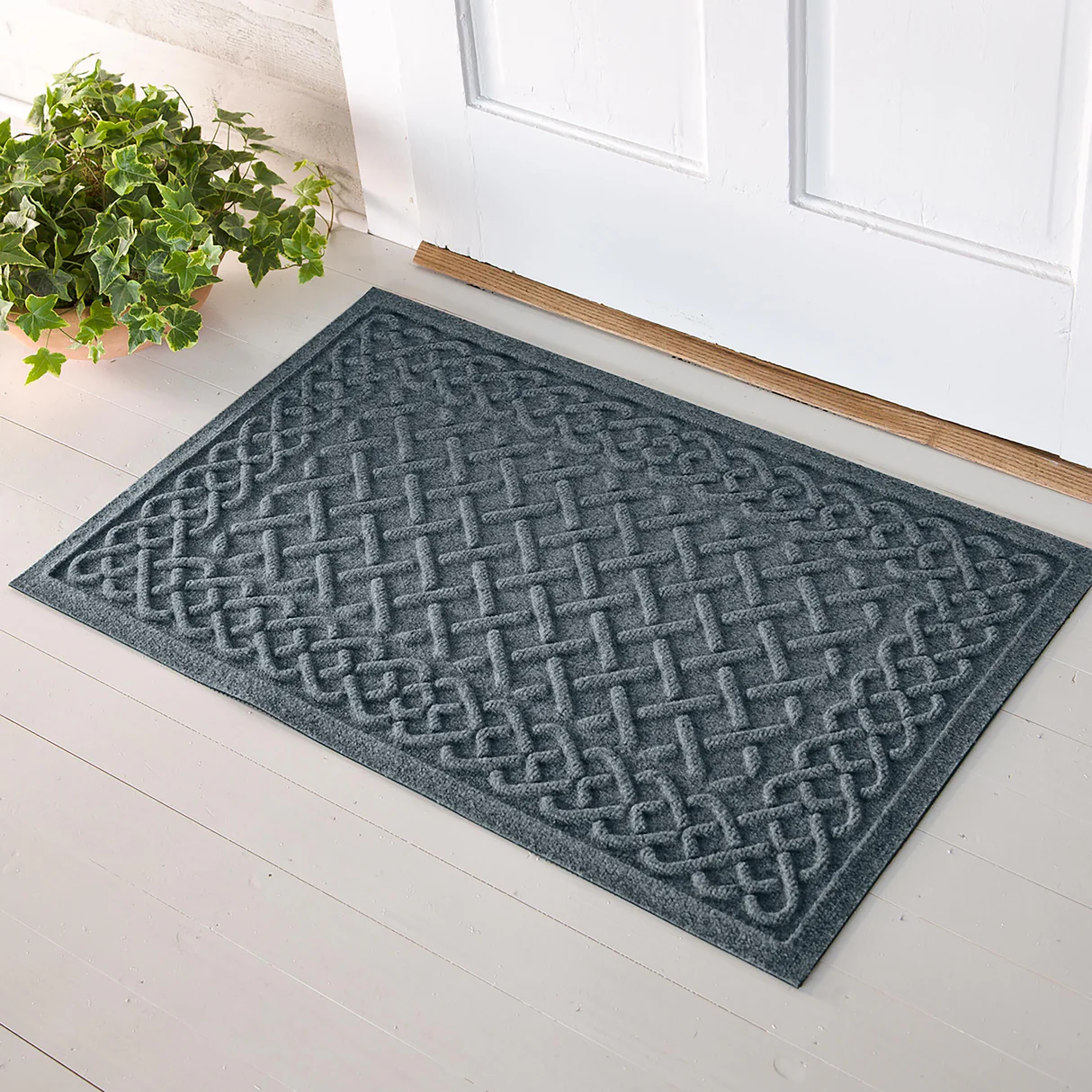
This line takes the same performance construction and adds visual variety. Patterns include plaid, chevron, diamond, half-moon, crescent, and seasonal designs like trees, boot prints, and holiday-themed options. L.L. Bean’s Everyspace line, for example, offers dozens of colors and patterns across its decorative range.
The performance specs are essentially the same as the Classic. The difference is purely aesthetic. These are designed for homeowners who want a mat that fits their entryway’s visual style — not just one that does the job.
WaterHog Max and Heavyweight Versions
The heavyweight versions step up to a 30-ounce fabric versus the standard 24-ounce. More material means more moisture capacity, greater durability under extreme foot traffic, and a longer service life in demanding environments.
L.L. Bean’s Heavyweight Recycled Waterhog Doormat falls into this category. It’s the same mat the company uses at its own flagship store in Freeport, Maine — a location that handles roughly 7.5 million visitors per year. That’s a real-world stress test most consumer products never face.
This version is right for retail stores, office buildings, schools, hospitals, and any entrance that sees constant heavy use.
The Waterhog Entry Mat: Indoor vs. Outdoor Versions
This distinction matters more than most buyers realize. There are two main border configurations designed for different placements.
The grooved border style allows water to drain away from all sides — it’s built for outdoor use where moisture needs to flow out rather than be contained. The ridged border style creates a raised perimeter that keeps moisture on the mat surface — designed for indoor placement just inside a door.
Using the indoor version outdoors won’t ruin it, but it won’t drain properly. Using the outdoor version indoors means water can creep past the edges onto your floor. Getting the right waterhog entry mat for your specific placement is a small decision that makes a meaningful difference in day-to-day performance.
Custom and Logo Mats for Commercial Spaces
For businesses, these mats can be ordered with custom logos, brand colors, and text. Corporate lobbies, hotel entrances, hospitals, schools, and retailers all use this option extensively. Commercial versions also come in modular tile formats that allow large-scale coverage across wide entrances or long corridors, with individual sections replaceable when worn.
Why LL Bean Waterhog Mats Have Such a Devoted Following
L.L. Bean didn’t invent this mat design. But they built one of the most recognized product lines around it, and they’ve earned a loyal following by consistently delivering on quality.
Their Everyspace Recycled version is the flagship. Made from at least 90% recycled polyester and constructed in the USA, it comes in sizes from 18″ x 27″ up to 4′ wide in multiple lengths. It carries a 4.7-star average across hundreds of verified customer reviews — unusually strong for a functional household product. It resists mildew, shedding, and fading. It’s stain-resistant by default and works indoors and outdoors without any additional treatment.
Everyspace vs. Heavyweight: Which L.L. Bean Option Is Worth It?
The Everyspace handles typical residential traffic well and comes in enough patterns and colors to suit most entryways. For most homes, it covers every requirement in one product.
LL Bean waterhog mats in the Heavyweight line are worth considering for garage entryways, mudrooms, or any entry that sees heavy boots and wet weather gear throughout the day. The heavier fabric handles sustained abuse better. The Heavyweight Plaid features an L.L. Bean-exclusive raised-square design that looks notably different from the standard waffle pattern.
Both versions are worth the price. The slight premium over generic alternatives pays back through years of performance that cheaper options simply can’t sustain.
Choosing the Right Waterhog Door Mat — Size, Placement, and Use Case
Choosing the right product line is only half the decision. Placement and sizing determine whether any mat actually performs the way it should.
Sizing It Correctly
The widely cited guideline in matting research is the six-to-ten-foot rule: the mat should be long enough to allow several full steps across it, giving each step the chance to progressively clean the shoe sole. A mat that’s only 18 inches deep gives someone barely one step before they’re past it.
For a standard single door, 22″ x 32″ is a reasonable starting point. For wider doors or double entries, a 3-foot-wide option in an appropriate length is more practical. Large commercial entrances may need a system spanning six feet or more. Don’t undersize to save money — a small mat in a wide entryway is only marginally better than no mat at all.
Indoor vs. Outdoor Placement
Outdoors under a covered porch: grooved border for drainage. Indoors just inside the door: ridged border for containment. The most effective setup for most homes is a layered system — a coarser scraper mat outside to remove heavy debris, paired with an interior mat to capture remaining moisture and finer particles. Together, they outperform either one used alone.
Residential vs. Commercial Needs
At home, standard sizing and the Classic or Everyspace line handle most situations. There’s no reason a mat can’t look intentional and work hard at the same time.
In commercial settings, size for the full entrance width. Choose heavyweight or Max versions for sustained daily traffic. Consider beveled edges where ADA accessibility is a requirement. For medical or chemical environments, specialty resistant versions are available through commercial matting suppliers.
How to Keep Your Waterhog Mat Performing Like New
These mats are low maintenance by design — that’s one of their biggest practical advantages. Waterhog mats were engineered to be cleaned quickly and easily, which matters whether you’re managing a home entryway or a commercial lobby. But the right habits extend their lifespan significantly and keep performance at full capacity.
Everyday and Weekly Cleaning
For dry debris — dust, sand, pet hair, grit — a vigorous shake outdoors removes most of it. Take the mat outside, shake well, and the material trapped in the ridges falls free. This is the quickest method and handles routine maintenance effectively.
Vacuuming is the next level up. A standard household vacuum works, but pace yourself — move slowly. The dirt sits below the surface in the channel ridges, so a fast pass doesn’t pull it out effectively. Slow, overlapping strokes in both horizontal and vertical directions give the best results. At home, weekly cleaning is typically sufficient. In a busy commercial entry, daily vacuuming is the standard practice.
Deep Cleaning When It Gets Dirty
When the mat needs a thorough clean — after muddy season, after heavy rain, or as part of scheduled maintenance — hosing it down is the most effective method.
Take the mat outside. Use a garden hose with a standard nozzle held about 12 inches from the surface. Rinse thoroughly from one end to the other. For stubborn grime, add a small amount of mild dish soap or neutral floor cleaner, work it in with a soft-bristled brush using circular motions, let it sit a few minutes, then rinse completely. Lay flat or hang to dry — never put it in a dryer.
For stubborn stains like red clay, wine, or pet accidents: apply a mild spot remover, let it sit 10 to 15 minutes, scrub gently, and rinse well. This removes most stains without damaging fibers or the rubber backing. Small mats can go into a heavy-duty washing machine on a gentle cycle with cold or warm water and mild detergent. Large, heavy mats should always be hosed down by hand.
Care Mistakes to Avoid
Never use bleach. It breaks down PET fibers and degrades the rubber backing, even in diluted form.
Never use petroleum-based products. Solvents attack the rubber and cause it to deteriorate and crack over time.
Never put the mat in a clothes dryer. Heat warps the rubber backing, causes curling, and can permanently deform the fiber structure.
Let both the mat and the floor dry before repositioning. Moisture trapped between rubber backing and floor creates conditions for mold growth underneath.
New mats sometimes have a noticeable rubber smell when first unboxed. This is normal off-gassing from the rubber backing and fades within a day or two. It’s not a defect and not a reason for concern.
How These Mats Stack Up Against the Alternatives
There are other matting options available. Here’s a fair and straightforward comparison.
Coir mats are the most popular consumer alternative. They look appealing when new, but fibers shed constantly, they’re difficult to clean thoroughly, patterns fade quickly, and they deteriorate badly under repeated moisture exposure. Most coir mats are a seasonal replacement item, not a durable solution.
3M Nomad mats are a legitimate commercial-grade alternative that performs well in dry-debris environments. But performance testing consistently shows these mats retain 30% more moisture than Nomad — a meaningful difference in wet climates. Nomad also tends to carry a higher price point for comparable commercial configurations.
Generic polypropylene mats work adequately for light use but compress, fade, and lose grip relatively quickly under sustained traffic. For a rarely used side entrance, they’re acceptable. For any primary entry in a busy home or facility, they fall short of what’s needed over time.
The math over five years firmly favors a quality mat. Buying a $25 generic mat twice a year for five years costs $250. A quality waterhog mat bought once costs less and performs better throughout that entire period.
The Bottom Line on Waterhog Mats
The reason this product has held its place for so long — in homes, offices, hospitals, schools, and retail spaces — comes down to one thing: it works, and it keeps working.
Choose the right type for your placement. Size correctly for your entrance width. Clean it regularly. Avoid bleach, solvents, and the dryer. That’s genuinely all these mats need. For most homes, the LL Bean Everyspace Recycled version answers every question at once. For heavy commercial use, step up to the heavyweight version and size for the full entrance.
An entry mat that quietly does its job year after year, without fading, shedding, curling, or needing replacement every season — that’s exactly what well-chosen waterhog mats deliver.
FAQ 1: What are waterhog mats and what makes them different from regular doormats?
Waterhog mats are commercial-grade entrance mats built with a bi-level “waffle” surface design and a rubber water dam border. Unlike regular doormats that absorb and spread moisture, these mats trap dirt and water in the recessed channels below shoe level, preventing it from being tracked inside. The rubber backing seals moisture in and holds the mat firmly in place, which is something most standard doormats cannot do.
FAQ 2: How much water can a waterhog mat actually hold?
A waterhog mat can hold up to 1.5 gallons of water per square yard. This is made possible by the hydrophobic PET or polypropylene fiber system combined with the raised water dam border around the edges of the mat. The moisture gets trapped below foot level inside the recessed channels and stays there until the mat is cleaned — it does not spread onto surrounding floors.
FAQ 3: Are waterhog mats worth the money compared to cheap doormats?
Yes — and the math supports it. A cheap coir or vinyl mat typically lasts one to two seasons before shedding, fading, or deteriorating. A quality waterhog mat, with proper care, lasts five to seven years in commercial settings and even longer in residential use. Over five years, spending $25 twice a year totals $250. A quality waterhog mat bought once costs less and performs better throughout that entire period. The performance gap — 30% more dirt retention than products like 3M Nomad — makes the investment even clearer.
FAQ 4: What is the difference between WaterHog Classic and WaterHog Fashion?
The difference between WaterHog Classic and WaterHog Fashion is the border style, not the performance. The Classic version has a traditional black beveled rubber border, which gives it a bold, framed look commonly seen in commercial settings. The Fashion version uses a matching fabric border that blends with the mat surface, creating a softer, less industrial aesthetic. Both share the same bi-level surface construction, fiber system, water-trapping performance, and rubber backing.
FAQ 5: Can waterhog mats be used outdoors year-round?
Yes. The rubber backing will not curl up or crack due to extreme temperatures or sun exposure, and the anti-static polypropylene surface is fade-, mildew-, and rot-resistant. For outdoor placement, the grooved-border drainage version is recommended because it allows water to flow away from all sides. The ridged-border version is better suited for indoor use, where moisture needs to stay contained on the mat surface. Using the wrong version in the wrong placement reduces overall performance.
FAQ 6: What is the “water dam border” on a waterhog mat?
The water dam border is a raised rubber perimeter built around the edge of the mat. Its purpose is to act as a containment wall — keeping all the dirt and moisture that gets scraped off shoes trapped on the mat rather than allowing it to seep onto surrounding floors. The bi-level surface features stain-resistant fabric over durable rubber nubs, recessed channels, and a water dam border. The nubs effectively scrape dirt and wipe moisture from shoes, trapping it in the channels below shoe level to prevent tracking. Without this border, the mat’s performance would be significantly reduced on wet days.
FAQ 7: Are waterhog mats ADA compliant?
Yes. Waterhog door mats are in compliance with ADA (American with Disabilities Act) guidelines. Additionally, these mats are certified as safe using OSHA’s standards for slip resistance (ASTM C 1028-89 Static Coefficient of Friction Dry 0.70). Furthermore, these mats have been certified slip-resistant by the NFSI (National Floor Safety Institute). All standard versions come with beveled (sloped) edges that allow smooth transitions on and off the mat for wheelchair users, walkers, people who shuffle their feet, and women in high heels. All waterhog door mats are approximately 3/8″ thick (less than 1/2 of an inch).
FAQ 8: What floor surfaces can waterhog mats be placed on safely?
Waterhog mats can be placed on virtually any floor surface — hardwood, tile, marble, laminate, luxury vinyl tile (LVT), terrazzo, rubber, and carpet. The mats are safe to use on laminate wood flooring and Luxury Vinyl Tile (LVT) as well as virtually any other type of floor (wood, marble, vinyl, carpet, terrazzo, rubber) without issue. Two rubber backing types are available: smooth-backed for hard floors and cleated-backed for carpeted surfaces. The only precaution is to ensure both the floor and the mat backing are fully dry before placement to prevent moisture from becoming trapped underneath.
FAQ 9: How do I clean a waterhog mat properly?
For routine cleaning, shake the mat vigorously outdoors to dislodge trapped debris, then vacuum slowly using overlapping strokes. For hose, pressure wash, or extract cleaning: WaterHog mats can be hosed off, pressure washed, or extracted to remove containments. Use a light to medium setting. The nozzle should be 12 inches from the mat surface and apply even strokes. A mild detergent can be used for difficult stains. Hang mat to dry. Never use bleach or petroleum-based products. Small mats can be machine-washed in a heavy-duty washer on a gentle cycle, but always air dry — never use a clothes dryer.
FAQ 10: Why does my new waterhog mat smell like rubber?
This is completely normal and not a defect. It is normal for a new mat to have a slight odor to it (much like new tennis shoes). This is due to the “off-gassing” of rubber, and will typically go away in a day or two after being out of the box. If the odor persists longer, airing the mat outside in a ventilated area or placing it rubber-side up in indirect sunlight for a few hours speeds up the off-gassing process. Avoid prolonged direct sun exposure, which can overheat the backing.
FAQ 11: What size waterhog mat do I need for my door?
A doormat should be large enough for both feet to make contact before stepping inside. For a standard 36-inch door, a medium or large WaterHog gives plenty of space to scrape and absorb. As a general rule, follow the six-to-ten-foot guideline: the mat length should allow several full walking steps to progressively clean the shoe sole. For double doors, look for a mat that spans at least 60 to 72 inches across, or opt for a 3’×8′ runner to cover both openings in one sweep. Sizing too small is the most common buyer mistake and significantly reduces effectiveness.
FAQ 12: What sizes do waterhog mats come in?
While the smallest door mat size is 18″ x 27″ (about 1.5′ x 2.5′), most waterhog floor mats can be produced up to 6′ wide and up to 60′ long — with incremental widths of 3′, 4′, and 6′ and 1′ incremental lengths from 3′ to 60′. For home use, standard sizes like 22″ x 32″, 23″ x 35″, 3′ x 5′, and 3′ x 8′ runner formats are most popular. Commercial installations can be scaled to fit wide lobbies, corridors, and multi-entrance configurations. All standard mats are non-directional and work equally well in either orientation.
FAQ 13: Can waterhog mats be cut to a custom size?
All waterhog mats can be cut down with either a sharp pair of shears or, ideally, a razor (utility knife) without having to worry about the mat unraveling or coming apart. This makes them highly adaptable for unusual entry shapes, alcoves, or spaces where standard sizes don’t fit cleanly. For large-scale commercial installations that need precise dimensions without cutting, custom-order sizes are available through commercial matting distributors. Note that cutting the mat voids most manufacturer warranties.
FAQ 14: Do waterhog mats slide on hardwood or tile floors?
No — when placed on a clean, dry floor surface, the rubber backing grips firmly and the mat stays in place. The premium SBR rubber used in the backing is specifically designed to resist “creep” across smooth floor surfaces. Waterhog mats are designed to hold in place better than most other matting products, especially vinyl-backed mats. Additionally, the premium rubber used will not break down even with high-traffic, constant use. If sliding occurs, the most common cause is moisture or dust between the mat backing and the floor at the time of placement.
FAQ 15: What is the difference between PET and polypropylene waterhog mats?
Both are synthetic fibers, but PET (polyethylene terephthalate) is the superior choice for moisture management and durability. It’s hydrophobic, meaning it resists soaking up water, and it stays color-stable under UV light. Polypropylene tends to fade faster and can flatten with wear. M+A Matting (the original manufacturer) began transitioning all 24-ounce polypropylene mats to PET starting in 2018. For buyers comparing options, PET versions offer better long-term color retention and moisture performance, especially in outdoor or high-UV environments.
FAQ 16: Are waterhog mats made from recycled materials?
Many versions are. The 24 oz. polyester fabric is made from at least 90% recycled polyester. The rubber backing also contains recycled content — standard versions contain 20% pre-consumer recycled rubber, while ECO versions use 100% post-consumer recycled polypropylene on the surface. WaterHog mats are backed with SBR rubber which contains 20% post-consumer recycled rubber from car tires. L.L. Bean’s Everyspace Recycled Waterhog Mat line is one of the most widely available eco-certified options for home buyers.
FAQ 17: How long do waterhog mats last before needing replacement?
Typically, WaterHog mats can last for five to seven years with proper care. However, this can change if they are used in areas with heavy foot traffic or extreme weather conditions. Their high-grade polypropylene surface and reinforced rubber backing are designed for long-term use, as they resist wear and tear remarkably well. In residential settings with moderate traffic and regular cleaning, many owners report ten or more years of service life. Signs it’s time to replace: flattened fibers that no longer scrape effectively, rubber backing that cracks or no longer grips, or edge fraying that creates a tripping hazard.
FAQ 18: Can waterhog mats be used in kitchens or areas with grease?
These mats should not be used in areas exposed to animal fats (kitchens) or petroleum products. Grease, cooking oils, and petroleum-based substances chemically degrade the SBR rubber backing, causing it to soften, lose grip, and eventually deteriorate. For kitchen environments, anti-fatigue mats or grease-resistant rubber matting with different backing compounds are the appropriate choice. Waterhog mats are best suited for entryways, lobbies, hallways, and any area where moisture and dirt — not oils or chemicals — are the primary concern.
FAQ 19: What is the difference between smooth-backed and cleated-backed waterhog mats?
Both backing types use the same SBR rubber compound, but the surface profile differs for specific floor types. The smooth-backed version lays flat on hard surfaces like tile, hardwood, marble, and LVT, providing full-contact grip without damaging polished floors. The cleated or “universal” backing features small rubber nubs on the underside that anchor into carpet fibers for use on carpeted floors. The standard backing is a 78-mil SBR (styrene-butadiene rubber) with either a smooth surface for placement on smooth floors (like marble, wood, or tile) or with a universal cleated surface designed to perform on both carpeted and smooth floors. Choosing the wrong backing type for your floor surface can result in sliding or poor grip.
FAQ 20: Can I put a waterhog mat in the washing machine?
Yes, small mats can be cleaned in heavy-duty washing machines. Use a gentle cycle, cold or warm water, and mild detergent. However, you should always allow mats to air-dry, rather than putting them in the dryer. Larger and heavier mats should not go in a residential washer — the weight can damage both the mat and the machine. For these, a garden hose and mild detergent produce equally good results. Never use bleach or harsh detergents in the wash cycle, as these break down the fiber system and degrade the rubber backing over time.
FAQ 21: Do waterhog mats work on covered porches and patios?
Yes, and they’re an excellent choice for these locations. A covered porch calls for a mat that still handles dirt, grit, and sudden downpours. WaterHog’s bi-level PET surface traps debris deep in its channels, while the quick-drying fibers prevent mildew from forming. Its rubber backing grips the porch surface and stays flat, even on humid or uneven floors. For uncovered areas exposed to full sun and rain, the outdoor grooved-border version is the right choice as its drainage design prevents water from pooling on the mat surface during heavy rainfall.
FAQ 22: How do I stop my waterhog mat from curling or not lying flat?
New mats occasionally curl at the edges due to how they’re rolled during packaging and shipping. To flatten them: bring the mat indoors to reach room temperature, then place it rubber-side up in indirect sunlight or a warm room for 10 to 20 minutes to relax the rubber. Follow with a reverse roll — lay the mat flat and roll it firmly with the rubber side facing outward, which counteracts the packaging curl. Repeat once if the curling is stubborn. Sometimes all your mat needs to do is relax. Bring it indoors and allow it to warm up to room temperature, or place rubber-side up in direct sunlight for approximately 10–20 minutes, then execute the reverse roll method (laying the mat flat and rolling rubber side out). Use caution if placing in direct sunlight; it will get hot if exposed for too long.
FAQ 23: What is the best color to choose for a waterhog mat?
Color choice depends on practical needs and aesthetic preferences. Darker colors can hide dirt and stains better, making them ideal for high-traffic areas or outdoor use. Bright or light-colored mats may need more frequent cleaning, but they can brighten up a space or create a fresh, airy look. For entryways that see mud, heavy rain, or pet traffic, darker shades like charcoal, black, or camel are the most practical. For indoor placement or lower-traffic entries, lighter tones and patterned options work well. Note that waterhog mat colors can appear slightly different under indoor versus natural lighting due to the multi-fiber construction — when in doubt, request a sample before ordering.
FAQ 24: When were waterhog mats invented, and who makes them?
WaterHog was introduced commercially in 1986 and quickly became America’s favorite mat. The original and genuine WaterHog mat is manufactured by M+A Matting (formerly Anderson Company), based in the USA. The brand’s extreme popularity has led to many imitation products using similar-sounding names, but M+A Matting holds the original patents and design standards. WaterHog is often imitated, but it is never replicated. M+A uses the highest quality raw materials and meticulous design standards to manufacture commercial grade mats made to perform for years. L.L. Bean, through its licensing partnership, is the best-known consumer retail partner for the product line.