
Picture this — you just spent good money on a quality battery pack for your RC car or drone. You fly it, land it, come home, plug it into whatever charger came in the box, and walk away. Three weeks later, your pack is puffed, dead, or worse. That story plays out more often than most hobbyists want to admit, and in nearly every case, the charger is the problem — not the battery.
Here is the truth that most beginner guides skip over: the lipo battery charger you use matters just as much as the battery itself. A quality pack paired with a bad charger will degrade fast. A quality pack paired with the right charger, used correctly, can last hundreds of cycles and still perform like new.
This guide covers everything — how a lipo charger works, the different types available, what all the specs actually mean, how balancing works, and the safety rules that genuinely protect your packs (and your home). Whether you are brand new to LiPo batteries or you have been flying and driving for a few years, there is something in here worth knowing.
What Is a Lipo Battery Charger and Why It Is Not Interchangeable
How a Lipo Charger Actually Works
A lipo battery charger is not like the charger you use for your phone or your AA batteries. It operates using a method called CC-CV charging — constant current followed by constant voltage. In the first phase, the charger pushes a steady current into the pack, and the voltage rises gradually. In the second phase, the voltage is held at exactly 4.2V per cell, and the current tapers down until the charge is complete.
That precision is the whole point. LiPo cells are extremely sensitive to voltage. Go even slightly above 4.2V per cell and the chemistry inside the cell becomes unstable — the risk of swelling, venting, or fire increases significantly. A NiMH or NiCd charger operates completely differently and will not respect those voltage limits. Using the wrong charger on a LiPo pack is one of the fastest ways to destroy it and potentially cause a fire.
A proper battery charger for lipo batteries is essentially a safety device as much as it is a charging device. It monitors, controls, and cuts off automatically. That is why the charger deserves just as much attention as the battery when you are building out your gear setup.
The Difference Between Basic and Smart Chargers
Basic chargers are simple and cheap. They come bundled with ready-to-run models and handle the job of getting a battery from empty to full. What they typically lack is any real intelligence — no per-cell monitoring, no automatic cutoff based on cell voltage, and no balance charging. They get the job done for basic use, but they offer no protection against the things that quietly kill packs over time.
Smart chargers are a significant step up. They detect battery chemistry automatically, support multiple types including LiPo, LiFe, LiHV, NiMH, and NiCd, and display individual cell voltages in real time. They let you adjust the charge current, set the mode, and they cut off automatically when the pack reaches full charge. Most smart chargers also include built-in balancing, which is where the real value for LiPo users comes in.
If you are serious about the hobby — even casually serious — a smart charger is not a luxury. It is the baseline.
Types of Lipo Battery Chargers Matched to Real Use Cases
AC vs. DC Chargers — Bench Use vs. Field Use
The first decision most buyers face is whether to go AC, DC, or a combination of both.
AC chargers plug directly into a wall outlet. They are self-contained, easy to use, and ideal for home bench charging. You do not need a separate power supply. For someone who charges at home before every session, an AC charger is the most convenient option.
DC chargers connect to an external power source — usually a 12V car battery or a dedicated DC power supply. They are lighter and more portable, which makes them the choice for racetracks, flying fields, and any situation where you need to charge away from a wall outlet. FPV drone pilots who run multiple packs per session tend to rely on DC setups with a high-capacity power supply.
AC/DC combo chargers do both. They are slightly heavier but genuinely versatile. If you charge at home most of the time but occasionally hit the field, an AC/DC unit keeps you covered without needing two separate chargers.
Single-Port vs. Multi-Port Chargers
Single-port chargers focus all their power on one battery at a time. This makes them simple, reliable, and a great fit for people who run one or two packs per session. The charge is focused, and there is nothing to manage beyond one connection.
Multi-port chargers — dual-port and quad-port units being the most common — allow you to charge two or more batteries simultaneously, each with independent cell monitoring. This is genuinely useful when you have four or more packs to cycle through before a race or a flying session. Each port operates independently, so a problem with one battery does not affect the others.
For anyone building a larger battery fleet, a dual-port charger with a combined output of 200W or more is often the smarter long-term investment.
Parallel Charging — What It Is and When to Use It
Parallel charging is a workflow, not a charger type. It allows you to connect multiple batteries of the same cell count and voltage to a single charger port through a parallel charging board. The charger sees all the packs as one large battery and charges them together.
The benefit is speed — instead of charging four packs back to back, you charge them all at once. The requirement is discipline. Every pack connected in parallel must be within approximately 0.1V per cell of the others before you connect them. If one pack is at 3.7V per cell and another is at 3.5V, connecting them creates a current spike that can damage cells or cause overheating.
Parallel charging is not complicated, but it rewards people who check their voltages first. For beginners, it is worth learning once you are comfortable with basic balance charging.
The RC Lipo Battery Charger — What Makes It Different
Why RC Applications Demand More From a Charger
RC vehicles and drones put serious stress on their batteries. High-discharge packs — 3S, 4S, 6S configurations — are common in performance setups, and they have to be charged precisely to deliver their best on track or in the air. Undercharge them and you leave power on the table. Overcharge or imbalance them and you shorten their life dramatically.
Wattage becomes critical here. The math is simple: Watts equals Volts multiplied by Amps. If you want to charge a 5000mAh 4S pack at 1C, that means 5A at roughly 16.8V — which requires at least 84W from the charger. A budget charger rated at 50W will throttle the current and either charge slower than expected or stop entirely with an error. A good rc lipo battery charger is rated with headroom, not just the minimum.
Performance hobbyists also need faster turnaround times between sessions. A charger capable of 2C or 3C charging (where the battery chemistry allows) can cut charge time significantly. That kind of flexibility is built into mid-range and high-end chargers but absent from entry-level models.
Popular RC Charger Formats and the Brands Worth Knowing
The market breaks down into three clear tiers.
Entry-level chargers, typified by the iMAX B6 and similar units, are affordable and cover the basics well. They support balance charging, handle 1S through 6S packs, and work fine for hobbyists charging one or two packs at a time. Their weak points are lower wattage ceilings and less precise cell monitoring.
Mid-range chargers from brands like ISDT and ToolkitRC are where most active hobbyists land. These units offer more wattage, better displays, accurate cell readings, and smart features like storage mode and internal resistance measurement — all at a price point that makes sense for regular use.
High-end chargers from iCharger, SkyRC, and similar manufacturers are built for serious racers and commercial users. They offer high wattage output, dual channels, data logging, and the kind of reliability that justifies the price when you are cycling through a large pack fleet daily.
What makes any charger worth buying — regardless of tier — is accurate cell monitoring, temperature protection, automatic cutoff, and firmware that does not throw false errors.
Understanding the Balancing Lipo Battery Charger
What Balancing Actually Means
This is the concept that confuses most new LiPo users, and it is worth taking the time to understand properly because it directly affects both performance and safety.
A LiPo battery pack is made up of multiple individual cells connected in series. A 3S pack has three cells. A 6S pack has six. Each cell has its own voltage, and under ideal conditions they all sit at the same level. In reality, they drift apart over time. Usage patterns, temperature differences, and natural variation in cell chemistry cause some cells to charge faster and discharge faster than others.
When cells drift too far apart, the pack becomes imbalanced. If you charge an imbalanced pack without balancing, the charger targets the overall pack voltage. That means one cell might reach 4.3V or higher while another sits at 4.0V. The overcharged cell is now in dangerous territory. Over time this pattern accelerates cell degradation and creates the kind of imbalance that leads to puffing, reduced capacity, and eventually a battery that is not safe to use.
Research from Battery University has shown that unbalanced 4S LiPo packs lose up to 35% of their capacity after just 50 cycles, compared to roughly 12% capacity loss in well-balanced packs. That difference alone justifies using a balancing lipo battery charger on every single charge.
How a Balancing Lipo Battery Charger Does the Work
The balance port on your battery — typically a white JST-XH connector — gives the charger direct access to each individual cell’s voltage. When you plug in both the main discharge lead and the balance lead, the charger can monitor and control every cell independently rather than treating the pack as one unit.
There are two approaches to balancing. Passive balancing works by diverting excess energy from the higher-voltage cells through resistors, converting it to heat until all cells reach the same level. It is simple, cost-effective, and reliable. Most hobbyist-grade smart chargers use passive balancing, and for casual to moderate use, it works perfectly well.
Active balancing is more sophisticated. Instead of wasting excess energy as heat, it redistributes that energy from the higher-voltage cells to the lower-voltage ones. It is faster, more efficient, and generates less heat. Active balancing shows up in high-end chargers and is particularly useful in competitive racing or large-fleet FPV setups where charge speed and pack longevity are both priorities.
For most hobbyists, a mid-range charger with passive balancing handles the job well. The key is using the balance port every time — not just occasionally.
Balance Mode vs. Charge Mode vs. Storage Mode — When to Use Each
Most smart chargers offer at least three relevant modes, and understanding when to use each prevents a lot of unnecessary battery degradation.
Balance Charge is the default for everyday use. It charges the battery while simultaneously monitoring and equalizing each cell. It takes a little longer than a standard charge, but it protects cell health and ensures every pack is ready at its best. Use this mode unless you have a specific reason not to.
Charge Only skips the active balancing process and simply charges to full voltage. This mode makes sense for packs that are already well-balanced and in good health, when you need a faster turnaround. Using it too often on older packs or packs that see heavy use allows imbalances to quietly build up over time.
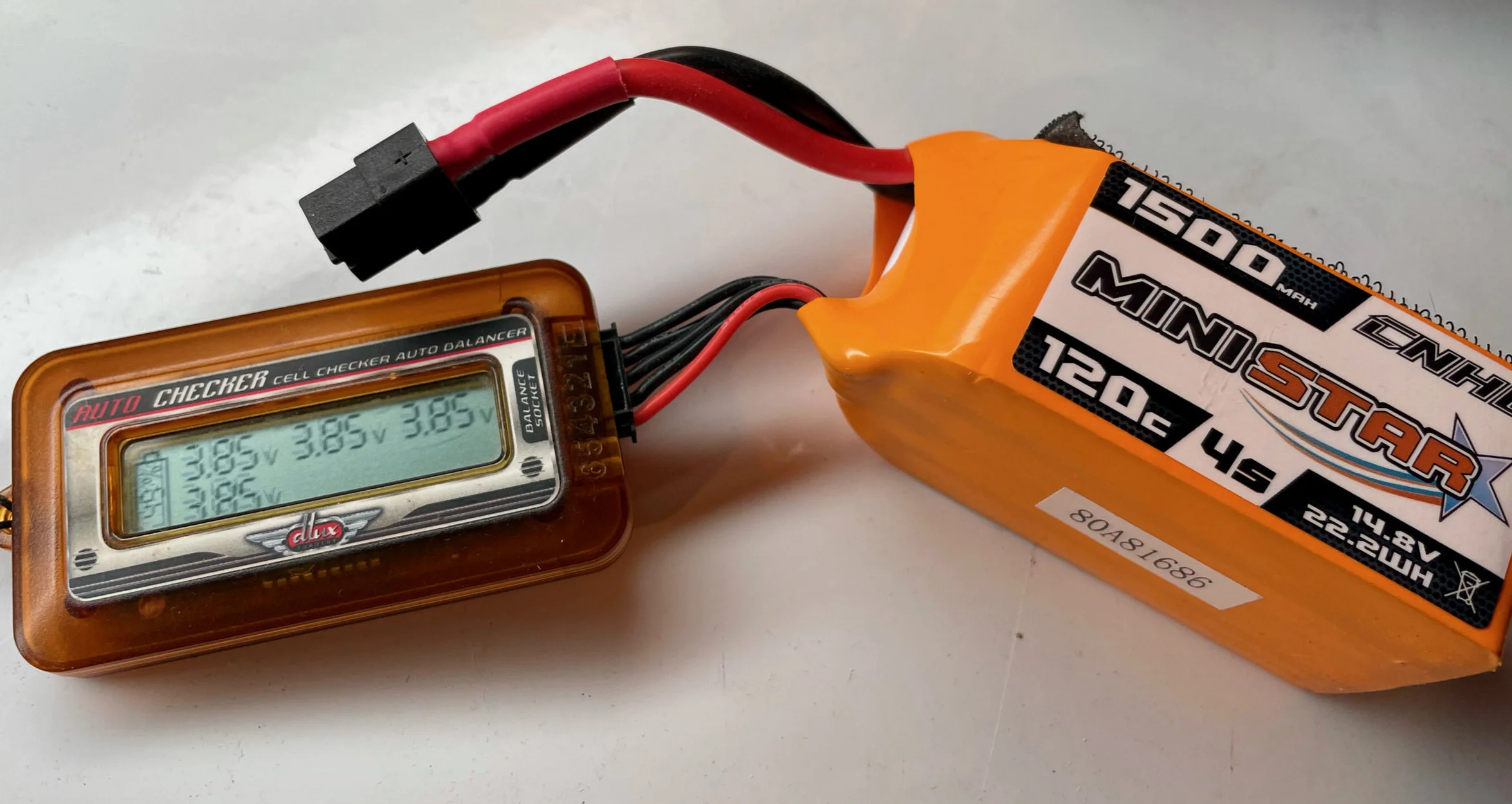
Storage Mode is the one mode that most beginners overlook entirely, and it matters more than most people realize. It brings each cell to approximately 3.80–3.85V — the chemically stable voltage for LiPo storage. A fully charged pack left sitting for two or three weeks will degrade measurably. A fully discharged pack left sitting is even worse and can suffer permanent cell damage. Storage mode hits the middle ground that keeps the chemistry stable between sessions.
The rule is simple: if you are not going to use a pack within 24 to 48 hours, put it in storage mode.
How to Read the Specs on a Battery Charger for Lipo Batteries
Cell Count (S Rating) and Voltage Compatibility
Every LiPo battery is labeled with an S-rating that tells you how many cells it contains. 1S means one cell at a nominal 3.7V. 2S is two cells at 7.4V nominal. 3S is 11.1V. 4S is 14.8V. 6S is 22.2V. The charger you buy must support the S-rating of every pack in your collection.
Most mid-range chargers support 1S through 6S, which covers the vast majority of hobby applications. If you run larger packs — 8S or higher — used in some boats and high-performance builds — you need a charger that explicitly supports that range.
Always confirm the cell count setting on the charger before starting a charge, even if the charger has auto-detection. A mismatch between what the charger thinks the pack is and what it actually is creates the conditions for a dangerous overcharge. Take 10 seconds to verify. Every time.
Charge Current, C-Rating, and the 1C Rule
The C-rating in the context of charging is simply a multiplier tied to the battery’s capacity in amp-hours. Charging at 1C means you are pushing one amp of current for every 1000mAh (1Ah) of capacity.
A 3000mAh pack charged at 1C receives 3 amps. A 5000mAh pack at 1C receives 5 amps. At 1C, a fully depleted pack reaches full charge in approximately one hour. That is the standard recommendation because it charges the battery without generating excessive heat and without accelerating cell degradation.
Higher C-rates are possible if your battery’s label permits it. Some high-performance packs are rated for 2C or even 3C charging. But heat increases with charge rate, and heat shortens cell life. Unless you have a specific reason to charge faster — a tight session turnaround at a race, for example — there is no advantage to pushing above 1C for everyday use. Slower is genuinely kinder to your packs.
Wattage — The Number Most Beginners Ignore
Wattage determines whether your charger can actually deliver the current you set. The formula is Watts equals Volts multiplied by Amps. If your charger is rated at 100W and you try to charge a 6S pack at 5A, you need 25.2V multiplied by 5A, which equals 126W. Your 100W charger cannot sustain that, so it will either reduce the current automatically or throw an error.
This is why buying a charger just to match your current packs can leave you frustrated later. If you plan to expand into higher-cell-count batteries, buying a charger with 200W or more gives you room to grow without needing a new unit. Think of wattage as headroom, not just a number to hit.
Lipo Battery Charger Safety — Rules That Actually Matter
Before You Plug In — The 60-Second Pre-Charge Checklist
Good charging habits start before anything gets plugged in. A quick visual inspection of the battery takes less than a minute and prevents the majority of charging incidents.
- Check the battery for swelling or puffing — any visible inflation means do not charge it
- Look for damage to the casing, wires, or connectors — damaged packs should not be charged
- Smell the pack briefly — a chemical or sweet smell can indicate internal damage
- Feel the pack — if it is still warm from use, let it cool to room temperature before charging
- Check your charging surface — hard tile or concrete is ideal; avoid wood, carpet, or foam
Always use a fireproof LiPo charging bag or a metal container. These do not prevent a thermal event, but they contain it long enough to react safely.
During the Charge — What Normal Looks Like and What Is a Red Flag
A normal charge on a healthy pack looks like this: voltage climbs steadily across all cells, the pack gets slightly warm but not hot, cell voltages remain close to one another throughout, and the charger completes the cycle cleanly with a beep or indicator.
Warning signs to watch for include any of the following: the pack gets noticeably hot during charging, one cell’s voltage diverges significantly from the others, the pack begins to swell or bulge, or you notice any chemical smell. If any of these occur, stop the charge immediately, disconnect the pack, and move it to a safe outdoor area away from flammable material.
The single most important safety rule is this: never leave a charging LiPo battery unattended. Stay within sight and sound during the entire cycle. Set a timer if your charger does not have automatic shutoff. Keep a CO2 fire extinguisher or a bucket of dry sand accessible. This is not excessive caution — it is just standard practice for anyone who takes the hobby seriously.
Common Mistakes That Damage Packs and Chargers
Most LiPo battery failures trace back to a handful of recurring mistakes.
- Using the wrong charging mode: Selecting NiMH or NiCd mode on a charger while a LiPo is connected can push voltage well beyond the 4.2V per cell limit. Always confirm you are in LiPo mode.
- Charging immediately after use: A battery that just powered a 10-minute bashing session or an FPV flight is warm. Charging a warm pack amplifies stress on the cells. Wait 20 to 30 minutes minimum.
- Setting the wrong cell count: The most dangerous configuration error. If the charger thinks a 3S pack is a 6S, it will try to push double the intended voltage. Check the setting before every charge.
- Skipping storage mode: Leaving a fully charged pack untouched for weeks accelerates electrolyte breakdown. Leaving a fully discharged pack the same way risks dropping cells below the safe voltage floor of 3.0V per cell, which causes permanent damage.
- Parallel charging mismatched voltages: Connecting packs with significant voltage differences through a parallel board causes uncontrolled current flow between the packs before the charger even begins. Always match voltages within 0.1V per cell.
Choosing the Right Battery Lipo Charger for Your Setup
Match the Charger to Your Battery Fleet
The right charger depends almost entirely on how you use your batteries.
If you run one or two packs on weekends for casual use — weekend trail bashing, occasional flying — a reliable 100W AC smart charger with built-in balancing handles everything you need. No need to overcomplicate it.
If you are an active hobbyist running four to eight packs per session, a dual-port charger with 200W to 300W total output lets you cycle through packs faster without sacrificing any safety or accuracy. The time savings at a full-day event are significant.
If you are a competitive racer or an FPV pilot doing multiple long sessions per week, a high-wattage charger with multi-port capability, fast charge support, and internal resistance monitoring gives you the data and speed you need. App connectivity and data logging are useful at this level for tracking pack health over time.
The question to ask yourself before buying: how many packs do I charge per session, and how long can I afford to wait between them? The honest answer to that question tells you what wattage and how many ports you actually need.
Features Worth Paying For vs. Features You Can Skip
Not every feature on a premium charger justifies its cost for every user. Here is a practical breakdown.
Worth paying for in almost every case:
- Accurate per-cell voltage display
- Built-in balance charging
- Storage mode
- Adjustable charge current
- Temperature monitoring and automatic cutoff
- Sturdy connector ports and quality build materials
Worth it for active or competitive users:
- High wattage output (200W or more)
- Dual or multi-port charging
- Internal resistance measurement
- Fast-charge support above 2C
Can skip for most users:
- Bluetooth app integration (useful if you log data obsessively, unnecessary otherwise)
- Charging rates above 3C (aggressive on packs and rarely needed)
- Exotic connector adapter kits for battery types you do not own
Always avoid:
- No-name chargers with no listed safety certifications and no overcharge protection. The price difference between a safe mid-range charger and a risky budget unit is rarely more than $30. The consequences of getting it wrong are not worth it.
Extending Battery Life Through Smart Charging Habits
Small Habits That Add Hundreds of Cycles to Your Packs
The charger is only half of the equation. How you use it determines whether your packs last 100 cycles or 400.
Use storage mode religiously. Any pack that will sit unused for more than 48 hours should be brought to 3.80–3.85V per cell. This single habit extends pack life more than almost any other.
Charge slower when you can. If time allows, charging at 0.5C to 0.7C instead of 1C reduces heat and cell stress meaningfully. Save the 1C charges for when you actually need the turnaround speed.
Cycle your packs monthly. If a pack sits in storage for a month without a charge-discharge cycle, the cells can drift out of balance. Running them through a full cycle once a month keeps everything active and balanced.
Track internal resistance over time. Many mid-range and high-end chargers measure the internal resistance of each cell. A healthy LiPo cell has low IR. As a pack ages, IR rises — and if one cell climbs significantly higher than the others, that pack is nearing the end of its useful life. Catching this early prevents using a compromised pack in the field.
Retire packs when the signs appear. Visible puffing, sudden drops in run time, cells that consistently diverge during charging, or IR readings that spike without explanation are all signals to retire a pack. A damaged or aging pack does not get better with more charging. It becomes a liability.
Conclusion
The right lipo battery charger does not have to be the most expensive one on the market. But it does have to match your packs, support balance charging, have enough wattage for your cell count and current needs, and include the safety features that protect both the battery and everything around it.
Treat your charger as part of your setup — not an afterthought. The packs that last longest and perform best are almost always the ones owned by people who chose their charger carefully and use it correctly every time. Check the specs against your batteries before you buy, use storage mode between sessions, and never skip the balance port. Those three habits alone will extend your pack life dramatically and keep your charging sessions safe from the kind of incidents that end hobbies and damage property.
As LiPo battery technology continues to evolve — higher capacities, faster discharge rates, and increasingly compact designs — the importance of a capable and safe charger only grows. Start with the right foundation and your batteries will thank you for it in cycles.
Q1. What is a lipo battery charger and how does it work?
A lipo battery charger is a specialized charging device designed specifically for lithium polymer battery packs. It uses a CC-CV (constant current, constant voltage) method — pushing a steady current into the pack during the first phase, then holding voltage at exactly 4.2V per cell while tapering the current until the charge is complete. This precise voltage control is what separates it from standard chargers and makes it essential for LiPo cell safety and longevity.
Q2. Can I use a regular battery charger for a LiPo battery?
No, you cannot safely use a regular NiMH or NiCd charger on a LiPo battery. These chargers operate under completely different voltage logic and do not respect the 4.2V per cell limit that LiPo chemistry requires. Using the wrong charger risks pushing cells past their safe voltage ceiling, which can cause thermal runaway, swelling, venting, or fire. Always use a charger explicitly designed and labeled for LiPo batteries.
Q3. What is the safest charge rate for a LiPo battery?
The universally accepted safe charge rate is 1C, which means charging at a current equal to the battery’s capacity in amp-hours. For a 3000mAh pack, that is 3 amps. At 1C, the battery reaches a full charge in roughly one hour with minimal heat stress on the cells. Charging below 1C, such as at 0.5C or 0.7C, is even gentler and extends the overall cycle life of the pack. Only exceed 1C if the battery label explicitly allows a higher charge rate.
Q4. What does “balance charging” mean on a lipo battery charger?
Balance charging means the lipo battery charger monitors and equalizes the voltage of every individual cell within the pack during the charge cycle. A multi-cell LiPo pack (2S, 3S, 4S, etc.) connects both the main discharge lead and the balance lead to the charger. The charger reads each cell’s voltage separately and ensures all cells reach 4.2V at the same time. This prevents any single cell from overcharging while another undercharges, which protects cell health, maximizes capacity, and reduces fire risk.
Q5. How long does it take to fully charge a LiPo battery?
At the standard 1C charge rate, a LiPo battery starting from a fully depleted state takes approximately one hour to reach full charge. Starting from storage voltage (around 3.8V per cell), the charge time is shorter — usually 30 to 45 minutes. Charging at slower rates like 0.5C takes roughly two hours but is easier on the cells. Using a balance charge mode adds a small amount of time at the end as the charger equalizes cell voltages, but the difference is usually only a few minutes for healthy packs.
Q6. What is storage mode on a lipo battery charger and when should I use it?
Storage mode is a function on smart lipo battery chargers that brings each cell to approximately 3.80–3.85V — the chemically stable resting voltage for LiPo cells during periods of non-use. You should use storage mode any time a fully charged or partially used battery will sit unused for more than 24 to 48 hours. Storing a LiPo at full charge (4.2V per cell) accelerates electrolyte breakdown and causes the pack to degrade faster. Storing it fully discharged is equally harmful and can cause cells to drop below the safe 3.0V floor, leading to permanent damage.
Q7. Is it safe to leave a LiPo battery charging unattended?
No. You should never leave a charging LiPo battery unattended. While modern smart chargers with proper safety cutoffs are reliable for healthy packs, a damaged, aging, or incorrectly set-up pack can behave unpredictably during charging. The risk of thermal runaway — where the battery enters a rapid, self-sustaining heat cycle — increases if something goes wrong while no one is present to react. Stay within sight and sound of the charging area for the entire cycle, and always charge in a fireproof LiPo bag or metal container.
Q8. What does the “S” rating mean on a LiPo battery and why does it matter for choosing a charger?
The S rating tells you how many individual cells are connected in series inside the battery pack. 1S is one cell at 3.7V nominal, 2S is two cells at 7.4V, 3S is 11.1V, 4S is 14.8V, and 6S is 22.2V. This matters enormously when selecting a lipo battery charger because the charger must be set to match the exact cell count before charging begins. A mismatch — even by one cell — causes the charger to target the wrong maximum voltage, which leads to overcharging and potential fire. Always verify the cell count setting manually before every charge.
Q9. How do I know what wattage lipo battery charger I need?
Calculate the minimum required wattage using the formula: Watts equals Volts multiplied by Amps. Find the fully charged pack voltage (4.2V multiplied by the number of cells) and multiply by your target charge current in amps. For example, a 6S pack charging at 5A needs at least 126W from the charger. Always buy a charger with headroom above your calculated minimum — a 150W or 200W charger for that example — so the unit does not strain at its maximum and has room to handle future packs with higher cell counts or capacity.
Q10. What is the difference between AC and DC lipo battery chargers?
An AC lipo battery charger plugs directly into a standard wall outlet and is self-contained, making it ideal for home bench use without any additional equipment. A DC lipo battery charger connects to an external 12V power source such as a car battery or a bench power supply, making it lighter and portable — the preferred choice for charging at racetracks or flying fields. AC/DC combination chargers do both and suit hobbyists who charge at home and also need field capability. Neither type is inherently safer; the choice comes down entirely to how and where you use your batteries.
Q11. Can I charge multiple LiPo batteries at the same time?
Yes, but the method matters. A multi-port charger allows you to charge two or more packs simultaneously, with each port operating independently and monitoring its own battery. Parallel charging is another method that connects multiple packs of the same cell count and similar voltage through a parallel board to a single charger port. For parallel charging to be safe, all packs must be within approximately 0.1V per cell of each other before connecting. Mixing packs with significantly different voltages on a parallel board creates uncontrolled current flow between the packs and is dangerous.
Q12. What voltage should a LiPo battery be at before I charge it?
A LiPo battery should never drop below 3.0V per cell under load, and ideally should not sit at rest below 3.2V per cell. If cells are reading below 3.0V at rest, the pack may be permanently damaged and should be inspected carefully before attempting a charge. The typical pre-charge resting voltage for a pack coming off a session is between 3.5V and 3.8V per cell. Storage voltage sits at 3.80–3.85V per cell. A pack at or above storage voltage is ready to charge without any concern about over-discharge damage.
Q13. Why does my LiPo battery get warm during charging — is that normal?
A slight warmth during charging is normal and expected. As the charger pushes current through the cells, a small amount of energy is converted to heat through internal resistance. The pack should feel gently warm to the touch but never hot. If the pack becomes noticeably hot, if it feels significantly warmer than usual, or if the temperature rises rapidly, stop the charge immediately. Excessive heat during charging is a warning sign that points to a damaged cell, an incorrect charge rate, or a pack that is reaching the end of its useful life.
Q14. What is internal resistance (IR) in a LiPo battery and how does a charger help monitor it?
Internal resistance is the opposition to current flow within each cell, measured in milliohms. Low IR means an efficient, healthy cell. As a pack ages or is abused through overcharging or deep discharge, IR rises — and higher IR means more energy is wasted as heat rather than delivered as useful power. Many mid-range and high-end lipo battery chargers include an IR measurement function that reads each cell’s resistance individually. Tracking IR over time lets you identify weakening cells before they become a performance problem or safety concern, and gives you an objective signal for when to retire a pack.
Q15. Can I charge a puffed or swollen LiPo battery?
No. A puffed or swollen LiPo battery should never be charged. Puffing indicates that gas has built up inside the cell due to electrolyte breakdown, overcharging, over-discharging, physical damage, or age. Charging a puffed pack puts additional stress on already compromised cells and significantly increases the risk of thermal runaway, venting, or fire. Disconnect the pack, place it in a fireproof container away from flammable materials, allow it to fully discharge using a safe resistive load, and then dispose of it at a local hazardous waste or battery recycling facility.
Q16. What is the minimum voltage a LiPo battery should be discharged to?
The safe discharge floor for LiPo cells is 3.0V per cell at rest, though stopping use closer to 3.2V to 3.5V per cell is much kinder to cell longevity. Dropping below 3.0V per cell can cause permanent chemical damage to the cells, reducing their capacity and increasing internal resistance. Many ESCs (electronic speed controllers) used in RC vehicles include a low-voltage cutoff that stops drawing power from the pack before it reaches damaging levels. Configuring that cutoff correctly is just as important as using the right lipo battery charger.
Q17. Does cold weather affect how I should use my lipo battery charger?
Yes, significantly. LiPo batteries should never be charged when their temperature is below 0°C (32°F). Cold temperatures slow down the chemical reactions inside the cells, and charging a cold pack can cause lithium plating on the anode — a form of internal damage that reduces capacity and raises the risk of internal short circuits. Cold weather also causes batteries to deliver less power during use, with more pronounced voltage sag under load. Always bring LiPo packs to room temperature before connecting them to the charger, even if that means waiting 20 to 30 minutes after coming in from cold conditions.
Q18. What is battery cycling and should I do it with my lipo battery charger?
Battery cycling refers to performing a full charge-discharge-recharge sequence on a pack, typically using the discharge function built into a smart charger. It is useful for conditioning new packs (performing 3 to 5 break-in cycles helps maximize initial capacity), for identifying weak cells that cannot hold full charge, and for maintaining packs that have been in storage. Most lipo battery chargers with a discharge mode allow you to set a discharge cutoff voltage and monitor capacity delivered. Cycling your packs monthly during periods of low use keeps cells active, balanced, and gives you an accurate read on each pack’s true remaining capacity.
Q19. Can I use a lipo battery charger to charge LiIon or LiFe batteries?
Many smart lipo battery chargers support multiple lithium chemistries, but you must select the correct chemistry mode for whichever battery you are charging. LiIon cells have a nominal voltage of 3.6V and charge to 4.2V per cell — similar to LiPo but with slightly different internal chemistry. LiFe (lithium iron phosphate) cells have a lower nominal voltage of around 3.2V and charge to 3.6V per cell. Using LiPo mode to charge a LiFe battery will overcharge it dangerously. Always confirm the selected mode matches the battery chemistry before every charge session, regardless of how familiar the process feels.
Q20. How do I properly dispose of a LiPo battery and what role does the charger play?
Before disposal, a LiPo battery must be fully discharged to eliminate stored energy and reduce the risk of fire during handling or transport. The discharge function on your lipo battery charger can bring the pack down to the cutoff voltage, and for the final stage, a resistive load such as a light bulb or appropriate resistor can safely drain remaining charge outdoors. Never cut battery leads while the pack still holds charge, and never throw LiPo batteries in regular household trash. Deliver fully discharged packs to a local hazardous waste collection facility or a battery recycling drop-off, as many electronics retailers now accept them.
Q21. What features should I look for when buying a lipo battery charger for the first time?
For a first lipo battery charger, the non-negotiable features are: built-in balance charging (monitors individual cells during every charge), support for the cell count of your batteries (at minimum 1S through 4S for most hobbyists), adjustable charge current, automatic cutoff when full, and overcharge protection. A display showing per-cell voltages is highly useful for understanding your pack’s health. Storage mode is a bonus that most beginners underutilize early on but come to rely on later. Stick to chargers from established brands with documented safety records rather than no-name budget units with unverifiable certifications.
Q22. Why does my lipo battery charger show a cell error or stop before the charge is complete?
A cell error on a lipo battery charger typically means the charger has detected a voltage reading on one or more cells that falls outside expected parameters. Common causes include a poor or loose balance lead connection, a genuinely damaged or deeply discharged cell, the wrong cell count being set on the charger, or a battery that has aged beyond reliable use. Check the balance lead connection first and re-seat it firmly. If the error persists across multiple charger attempts or appears on a second charger, the pack itself is likely the problem and should be inspected for damage or retired.
Q23. Is it safe to charge a LiPo battery indoors?
Charging indoors is acceptable provided you follow established safety practices: always use a fireproof LiPo charging bag or a metal container, charge on a non-flammable surface like concrete or a ceramic tile, keep the area free from paper, wood, carpet, or flammable liquids, and never leave the session unattended. Keeping a CO2 fire extinguisher in the charging room is strongly recommended. Many experienced hobbyists charge on a kitchen countertop or in a utility room with the bag placed in a metal container as an additional layer of containment. The key is preparation and supervision — not the location itself.
Q24. How many charge cycles can I expect from a LiPo battery if I use the right charger correctly?
A quality LiPo battery used with the right charger and proper charging habits is typically rated for 300 to 500 full charge cycles before capacity drops noticeably. Some well-maintained packs in light-duty applications can exceed that range. The factors that most directly shorten cycle life are: regularly charging above 1C, storing packs fully charged for extended periods, allowing deep discharge below 3.0V per cell, skipping balance charging, and charging warm packs without cooling first. Each of those habits quietly reduces cycle count. Reverse every one of them — charge at 1C, use storage mode, balance charge every session, and never skip the cool-down period — and your packs will last significantly longer.