You plug in a space heater on a cold morning. The coffee maker is already running. The microwave starts reheating last night’s leftovers. Then everything goes dark. The breaker tripped again. If that sounds familiar, you are not alone. This is one of the most common electrical frustrations in homes across the country, and it almost always traces back to the same piece of hardware sitting inside your breaker panel.
The 20 amp circuit breaker is the backbone of most residential electrical systems. It protects the wiring in your kitchens, bathrooms, garages, and workshops from overheating and potential fire hazards. Despite how important it is, most homeowners never think about it until something goes wrong. They rarely know how much power it can handle, what wire it requires, or why it keeps tripping on cold mornings.
This guide covers everything you need to understand about the 20 amp circuit breaker and how it fits into your home’s electrical system. You will learn the exact wattage limits for both 120V and 240V circuits, how to calculate the load on your circuits, which breaker models fit which panels, and how to spot the warning signs of an overloaded system. Whether you are dealing with a full breaker panel that needs a Square D QO tandem, troubleshooting a tripping issue, or sourcing a replacement for an old Pushmatic panel, the answers are here. By the time you finish reading, you will know exactly how to size, select, and safely operate the circuits in your home.
How a 20 Amp Circuit Breaker Works
Before you can fix a problem or plan a new circuit, you need to understand what is actually happening inside that small plastic device clipped into your panel. A circuit breaker is not just an on-off switch. It is a safety device engineered to cut power the instant current exceeds a safe threshold.
The Thermal-Magnetic Trip Mechanism
Most residential breakers use a dual-protection system called a thermal-magnetic trip. The thermal side relies on a bimetallic strip — two metals bonded together that bend at different rates when they heat up. When current flows through the strip for an extended period and exceeds the rated amperage, the strip bends far enough to release a spring-loaded mechanism that snaps the breaker open. This protects against slow, sustained overloads, like running too many appliances on a single circuit for hours.
The magnetic side handles the fast, dangerous stuff. A short circuit — say, a frayed wire touching a metal junction box — can spike current to thousands of amps in a fraction of a second. The electromagnetic coil inside the breaker responds almost instantly, yanking the trip mechanism open before the wiring can melt or catch fire. Most residential 20 amp circuit breaker models carry a 10,000 AIC (Ampere Interrupting Capacity) rating, which means they can safely interrupt fault currents up to 10,000 amps.
Single-Pole vs. Double-Pole Configurations
You will find two main configurations in residential panels. A single-pole breaker occupies one slot and protects a single 120V circuit. This is the standard setup for general-purpose outlets, lighting, and small appliances. A double-pole breaker occupies two slots and protects a 240V circuit. Large appliances like electric water heaters, central air conditioners, and electric dryers typically require this configuration.
Both versions can carry a 20 amp circuit breaker rating. The critical difference is the voltage, which directly affects how many watts the circuit can deliver. A single-pole 20A breaker on a 120V line and a double-pole 20A breaker on a 240V line are rated at the same amperage, but the 240V circuit delivers twice the wattage. That distinction matters when you start calculating loads, which is exactly what the next section covers.
How Many Watts on a 20 Amp Circuit Breaker?
This is the single most searched question about residential circuits, and for good reason. Amps are what the breaker is rated for, but watts are how most people think about power. You read the label on a space heater and it says 1,500 watts. You look at the microwave and it says 1,200 watts. You need to know whether those two can run on the same 20 amp circuit breaker without tripping it. The answer comes down to one simple formula.
The Basic Formula — Watts = Volts × Amps
At 120 volts, the math is straightforward. Multiply 20 amps by 120 volts and you get 2,400 watts. That is the theoretical maximum for a single-pole circuit. At 240 volts, the same 20 amps delivers 4,800 watts. These are ceiling numbers, though. They represent the absolute maximum the breaker will allow before it trips. Running your circuit at that limit continuously is not safe, and here is why.
The NEC 80% Rule and Continuous Loads
The National Electrical Code defines a continuous load as any device that runs for three hours or more. Think of a space heater warming a bedroom overnight, a bank of lights illuminating a commercial space, or a server rack humming around the clock. For these types of loads, the NEC requires that you use only 80 percent of the breaker’s rated capacity.
For a 120V circuit, 80 percent of 2,400 watts gives you 1,920 watts. For a 240V circuit, 80 percent of 4,800 watts gives you 3,840 watts. Those are the numbers that actually matter for everyday planning. Think of it like a car engine. Your tachometer has a redline, and sure, the engine can hit it. But you would never cruise down the highway at redline for three hours straight. Your breaker works the same way. It can handle 2,400 watts in short bursts, but sustained loads need to stay at or below 1,920 watts to prevent thermal buildup in the wiring.
Real-World Wattage Examples
Numbers on paper are useful, but real appliances tell the full story. Here is what common household devices actually draw. A microwave pulls between 1,000 and 1,500 watts. A standard coffee maker uses 800 to 1,200 watts. A toaster draws anywhere from 800 to 1,500 watts. A portable space heater typically runs at about 1,500 watts. A refrigerator uses only 150 to 400 watts while running, but its compressor startup surge can spike much higher for a brief moment.
Now picture a typical morning in the kitchen. The coffee maker is running at 1,000 watts. The toaster is going at 1,200 watts. That is already 2,200 watts, which exceeds the 1,920-watt continuous planning limit and is approaching the 2,400-watt maximum. Add a microwave and you have blown past the ceiling entirely. This is exactly why kitchens are required by code to have at least two dedicated circuits, and why understanding your circuit’s wattage capacity is not just technical knowledge but a practical safety skill.
Understanding the Load on Your Circuit
Knowing the wattage limit is only half the equation. You also need to know how to calculate the actual load your devices are placing on any given 20 amp circuit breaker. This is where most homeowners get tripped up, sometimes literally.
Step-by-Step Load Calculation
The process is simpler than it sounds once you break it into steps. First, identify the voltage of the circuit you are evaluating. In most American homes, general-purpose outlets run at 120V, while dedicated appliance circuits run at 240V. If you are not sure, a basic multimeter will tell you. Second, check the nameplate on each appliance connected to that circuit. The nameplate is the small sticker or metal plate on the back or bottom of the device that lists its wattage or amperage rating. Third, if the nameplate lists amps instead of watts, convert it using the formula: watts equals volts times amps. A device rated at 10 amps on a 120V circuit draws 1,200 watts. Fourth, add up the wattage of every device that could realistically run at the same time on that circuit. Not everything runs simultaneously, so use common sense — the toaster and microwave might both run during breakfast, but the blender probably will not be going at the same time. Fifth, compare your total against the 80 percent planning value. If your total exceeds 1,920 watts on a 120V circuit, you are overloading it.
Accounting for Startup Surge
Here is the detail most people overlook. Motors do not draw a steady current. When a refrigerator compressor kicks on, it can momentarily pull three to five times its normal running current. The same goes for air conditioners, sump pumps, shop vacuums, and table saws. A refrigerator that runs at 400 watts might spike to 1,200 watts or more for a split second during startup. That spike, called inrush current, can be enough to trip a breaker even when your total calculated load looks perfectly fine on paper. This is one of the most common reasons homeowners call an electrician convinced their 20 amp circuit breaker is defective, only to discover that the circuit was marginally loaded and a motor surge pushed it over the edge.
Popular 20 Amp Breaker Models for Residential Panels
Not all breakers are interchangeable. The 20 amp circuit breaker you need depends entirely on the panel installed in your home. Two of the most commonly searched models deserve a closer look because they serve very different situations.
Square D QO 2-20 Amp Single-Pole Tandem Circuit Breaker
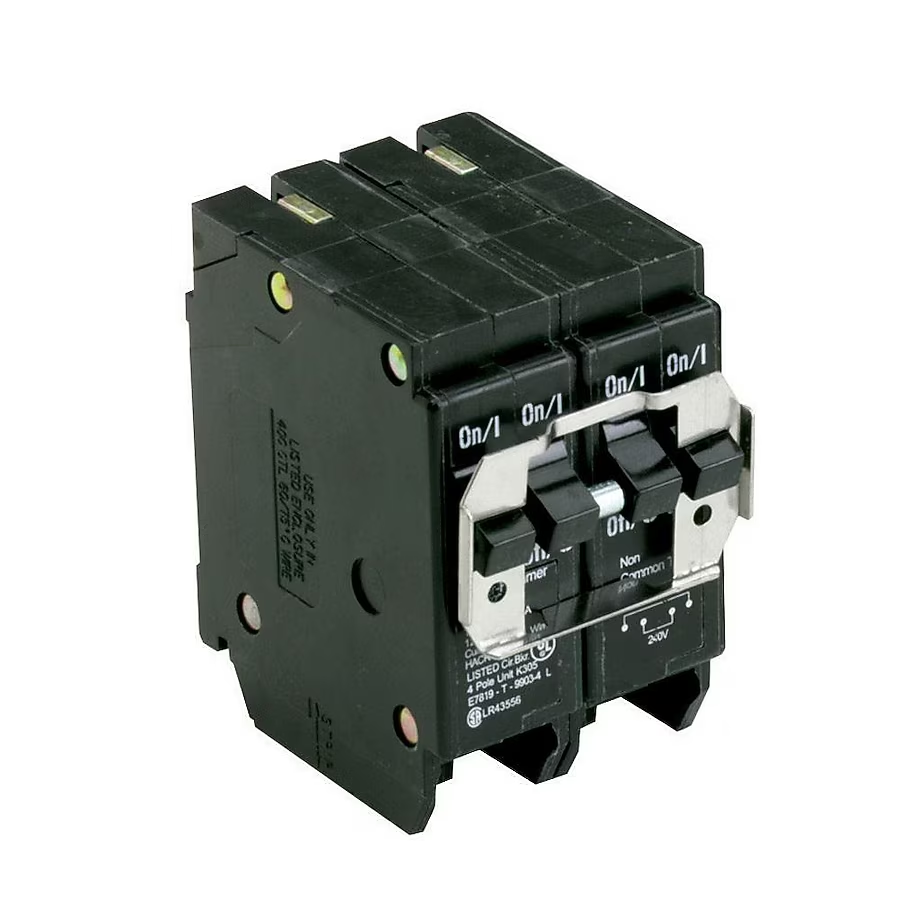
If your breaker panel is full and you need to add another circuit, a tandem breaker is often the simplest solution. The Square D QO tandem fits two independent single-pole circuits into the space normally occupied by one breaker. Each side is independently rated at 20 amps, giving you two fully functional circuits without needing to upgrade your entire panel.
The QO line from Square D (manufactured by Schneider Electric) includes a couple of features worth mentioning. The Visi-Trip indicator is a small red flag that pops out when the breaker has tripped, making it easy to identify which breaker caused the outage in a panel that might contain dozens of breakers. The Qwik-Open mechanism ensures fast, clean tripping under fault conditions. These breakers are rated for 120/240 VAC with a 10,000 AIC interrupting rating, and they carry both ANSI certification and UL listing.
One important compatibility note: tandem breakers only fit in panel slots that are designed to accept them. Square D makes both CTL-rated tandem breakers (for newer panels with circuit-limiting tabs) and non-CTL versions (for older panels manufactured before the CTL requirement). You need to match the breaker to your specific panel. Installing the wrong type can create a code violation and a potential safety hazard.
Pushmatic Circuit Breaker 20 Amp — Keeping Legacy Panels Running
Pushmatic panels tell a different story. Manufactured originally by ITE and later by Bulldog (eventually acquired by Siemens), these panels were installed in homes from the early 1950s onward. If you have ever seen a breaker panel where the breakers turn on and off by pushing a button in and out rather than flipping a toggle switch, you are looking at a Pushmatic system.
These panels are no longer in production, but they still exist in thousands of older homes. The 20 amp Pushmatic breaker uses a push-button reset mechanism with thermal-magnetic protection, rated at 120/240V with a 10,000 AIC interrupting capacity. When one of these breakers fails or trips repeatedly, finding a replacement can be a challenge since major retailers often do not stock them. However, compatible replacement breakers are still manufactured by companies like Connecticut Electric and are available through specialty electrical suppliers. These replacements are ETL or UL listed and designed to fit the original Pushmatic and Bulldog panel bus bars.
A word of caution is warranted here. If your home still runs on a Pushmatic panel, the panel itself is likely 40 to 70 years old. While the breakers can be replaced individually, the panel’s bus bars, connections, and overall capacity may no longer meet modern electrical demands or current code requirements. It is strongly advisable to have a licensed electrician evaluate the entire panel and determine whether a full upgrade is the smarter long-term investment.
Wire Sizing and Outlet Requirements for a 20 Amp Circuit Breaker
The breaker is only one part of the system. The wire and the outlet must match, or the protection the breaker provides becomes meaningless.
Why 12 AWG Wire Is Non-Negotiable
The National Electrical Code is explicit on this point. A 20 amp circuit must be wired with a minimum of 12 AWG (American Wire Gauge) copper conductor. The standard cable used in residential construction is labeled “12-2,” meaning 12-gauge wire with two conductors (one hot, one neutral) plus a bare ground wire. Using 14 AWG wire, which is rated for only 15 amps, on a circuit protected by a 20 amp circuit breaker is a serious code violation and a genuine fire hazard. The reason is simple. The breaker protects the wire, not the appliance. If the wire is rated for 15 amps but the breaker does not trip until 20 amps, the wire can overheat and potentially ignite before the breaker ever activates. This is the single most dangerous mistake a homeowner or unqualified handyman can make when upgrading a breaker.
Matching Outlets to the Circuit
Outlets must also match the circuit’s amperage. A standard household outlet, called a NEMA 5-15R, is rated for 15 amps. Under the NEC, you can use 15 amp outlets on a 20 amp circuit as long as the circuit serves two or more outlets. However, if the circuit serves only a single outlet (a dedicated circuit for a specific appliance), that outlet must be rated at 20 amps. A 20 amp outlet, designated NEMA 5-20R, is easy to identify by the T-shaped neutral slot on the left side.
Additionally, modern electrical codes require GFCI (Ground Fault Circuit Interrupter) protection in wet locations like kitchens, bathrooms, laundry rooms, and garages. Some jurisdictions also require AFCI (Arc Fault Circuit Interrupter) protection in bedrooms and living areas. These protective devices do not change the wattage capacity of the circuit, but they add critical safety layers that prevent electrocution and electrical fires.
Warning Signs That Your Circuit Is Overloaded
A breaker that trips once during a thunderstorm is not a concern. A breaker that trips regularly is telling you something important. Here are the warning signs every homeowner should recognize.
Frequent tripping is the most obvious indicator. If a 20 amp circuit breaker trips every time you run two or three appliances simultaneously, the total load on that circuit exceeds its capacity. The fix is usually straightforward — redistribute some appliances to a different circuit. Outlets that feel warm or hot to the touch signal a more serious problem. This could mean the circuit is overloaded, but it can also indicate a loose wire connection inside the outlet box, which is a fire risk. Either way, stop using that outlet and call an electrician.
Flickering or dimming lights are another common symptom. When a high-draw appliance kicks on — a refrigerator compressor, a hair dryer, a vacuum cleaner — it can momentarily pull enough current to cause lights on the same circuit to flicker. Occasional, brief flickering during motor startup is normal. Persistent flickering is not. Appliances that perform poorly offer yet another clue. A microwave that heats slowly, a power tool that bogs down under load, or an air conditioner that cycles on and off more frequently than it should — all of these can indicate that the circuit is not delivering adequate power. Finally, any buzzing, crackling, or sizzling sounds coming from your breaker panel require immediate professional attention. These sounds can indicate arcing, loose connections, or a failing breaker, all of which are fire hazards.
Safety Tips for Working With Your Electrical System
Electrical work carries real risk. Even a standard 120V household circuit can deliver a lethal shock under the wrong conditions. Safety must come first, always.
When to Call a Professional
Certain tasks should never be a DIY project unless you are a trained electrician. Replacing a breaker, adding a new circuit, upgrading your panel, or working on any circuit that uses 240V all fall into this category. The same applies to homes with older or discontinued panels. If your home has a Pushmatic, Federal Pacific, or Zinsco panel, a licensed electrician should evaluate the system before any work is done. Some jurisdictions require permits for electrical work even as simple as adding a new outlet. Check your local building codes before starting any project.
Everyday Best Practices
Beyond professional work, there are habits every homeowner can adopt. First, avoid daisy-chaining power strips. Plugging a power strip into another power strip does not increase the circuit’s capacity — it just makes it easier to overload. Second, distribute high-wattage appliances across different circuits. The microwave and the toaster oven should not share a circuit if you use them at the same time. Third, label every breaker in your panel clearly and accurately. In an emergency, you need to know instantly which breaker controls which part of the house. Fourth, invest in a basic clamp-on ammeter. For about thirty dollars, you can measure the actual current flowing through any circuit in your panel and compare it to the breaker’s rating. Fifth, and most importantly, never upsize a breaker without also upsizing the wire. A homeowner who replaces a 15 amp breaker with a 20 amp circuit breaker without changing the 14 AWG wire to 12 AWG has created a fire hazard, not a solution.
When Should You Upgrade to a Higher-Amperage Circuit?
There are situations where even a properly loaded 20 amp circuit breaker simply is not enough. Adding an EV charger to your garage is one of the most common triggers for an upgrade. Most Level 2 chargers draw 3,000 watts or more, which exceeds the capacity of a standard 120V circuit. Installing a large window air conditioner, outfitting a serious woodworking shop, or remodeling a kitchen with commercial-grade appliances can also push your needs beyond what a single circuit can deliver.
Upgrading is not as simple as swapping the breaker for a higher-rated one. The breaker, the wire, and the outlet all form a matched system. Moving from a 20 amp circuit to a 30 amp circuit means installing a 30 amp breaker, pulling new 10 AWG wire, and fitting a 30 amp-rated outlet. All three components must match. Skipping any one of them creates a weak link in the chain and a potential hazard. A licensed electrician should handle the upgrade, pull any permits required by your local jurisdiction, and ensure the work passes inspection. It is not the cheapest home improvement, but it is one of the most important for long-term safety.
Frequently Asked Questions
FAQ 1: How many watts can a 20 amp circuit breaker handle?
A 20 amp circuit breaker can handle up to 2,400 watts at 120 volts and up to 4,800 watts at 240 volts. However, the National Electrical Code recommends limiting continuous loads (anything running three hours or more) to 80 percent of that capacity — which means 1,920 watts at 120V and 3,840 watts at 240V for sustained use.
FAQ 2: What is the difference between a 15 amp and a 20 amp circuit breaker?
A 15 amp breaker protects circuits wired with 14 AWG wire and handles up to 1,800 watts at 120V, while a 20 amp breaker requires 12 AWG wire and supports up to 2,400 watts at the same voltage. The 20 amp version is typically used in kitchens, bathrooms, garages, and workshops where higher-draw appliances are common, whereas 15 amp breakers cover standard lighting and bedroom outlets.
FAQ 3: Can I replace a 15 amp breaker with a 20 amp circuit breaker?
Only if the entire circuit is wired with 12 AWG copper wire or larger. If the existing wiring is 14 AWG (rated for only 15 amps), installing a 20 amp breaker creates a serious fire hazard because the wire can overheat before the breaker trips. A licensed electrician should verify the wire gauge before making the swap.
FAQ 4: What size wire do I need for a 20 amp circuit breaker?
A 20 amp circuit requires a minimum of 12 AWG (American Wire Gauge) copper wire. The standard residential cable for this application is labeled “12-2,” meaning two 12-gauge conductors plus a ground wire. Using 14 AWG wire on a 20 amp breaker violates the National Electrical Code and is considered a fire hazard.
FAQ 5: How many outlets can I put on a 20 amp circuit breaker?
The NEC does not set a hard numerical limit, but a widely accepted guideline among electricians is up to 10 outlets per 20 amp circuit. The real constraint is total wattage, not the number of outlets — each outlet is estimated at 180 watts for planning purposes, so 10 outlets equal 1,800 watts, which stays within the 80 percent safety margin of 1,920 watts.
FAQ 6: Why does my 20 amp circuit breaker keep tripping?
The most common causes are circuit overload (too many appliances drawing power at once), motor startup surges from appliances like refrigerators or air conditioners, a short circuit caused by damaged wiring, or a ground fault in wet areas. If the breaker trips regularly, reduce the number of high-wattage devices on that circuit and have a licensed electrician inspect the wiring to rule out a short or a failing breaker.
FAQ 7: Can I run a space heater on a 20 amp circuit breaker?
Yes, but with important limitations. A standard 1,500-watt space heater draws 12.5 amps at 120V, which is within the breaker’s capacity. However, because space heaters run continuously, the NEC 80 percent rule applies, leaving only about 7.5 amps (900 watts) for anything else on that circuit. Running two 1,500-watt heaters on the same 20 amp circuit will exceed its capacity and trip the breaker.
FAQ 8: What is the difference between a single-pole and double-pole 20 amp circuit breaker?
A single-pole 20 amp breaker protects one 120-volt circuit and occupies one slot in your breaker panel, handling up to 2,400 watts. A double-pole 20 amp breaker protects one 240-volt circuit, occupies two slots, and can handle up to 4,800 watts. Double-pole breakers are used for large appliances like water heaters, central air conditioners, and electric dryers.
FAQ 9: What is a tandem circuit breaker and can I use one in my panel?
A tandem (or “slim”) breaker fits two independent circuits into a single panel slot, saving space when your panel is full. Not all panels accept tandem breakers — they can only be installed in slots specifically designed for them. Check your panel’s directory label or consult an electrician to determine which positions in your panel are tandem-compatible.
FAQ 10: Is a 20 amp circuit breaker enough for a kitchen?
Modern building codes typically require at least two dedicated 20 amp circuits for kitchen countertop outlets. A single 20 amp breaker is usually not enough for a busy kitchen because running a microwave (1,000–1,500W) alongside a coffee maker (800–1,200W) or toaster (800–1,500W) simultaneously can exceed the 1,920-watt continuous load limit. High-draw kitchen appliances like a dishwasher or garbage disposal often need their own dedicated circuits as well.
FAQ 11: Can I use a 15 amp outlet on a 20 amp circuit breaker?
Yes, the NEC permits 15 amp-rated outlets on a 20 amp branch circuit as long as the circuit feeds two or more outlets. However, if the circuit is dedicated to a single outlet (for a specific appliance), that outlet must be rated at 20 amps and feature the distinctive T-shaped neutral slot (NEMA 5-20R).
FAQ 12: How long does a 20 amp circuit breaker last before it needs replacing?
Most residential circuit breakers have an expected lifespan of 25 to 40 years under normal operating conditions. However, frequent tripping, exposure to moisture or extreme heat, power surges, and overloading can significantly shorten that lifespan. Warning signs of a failing breaker include tripping with minimal load, a burning smell near the panel, visible scorch marks, and a breaker that feels hot to the touch.
FAQ 13: Is a 20 amp circuit breaker enough for an EV charger?
It depends on the charger. A Level 1 charger (120V, 12–16 amps) can work on a 20 amp circuit, adding roughly 3–5 miles of range per hour of charging. A 16-amp Level 2 charger on a 240V circuit also fits a 20 amp breaker, delivering about 3.8 kW and 12–15 miles of range per hour. However, faster Level 2 chargers (32–48 amps) require 40–60 amp breakers and heavier wiring.
FAQ 14: What happens if I overload a 20 amp circuit breaker?
When the current on a circuit exceeds 20 amps, the breaker’s thermal-magnetic trip mechanism activates and cuts power to the circuit, which is exactly what it is designed to do. Repeatedly overloading a circuit wears out the breaker faster and stresses the wiring, which can cause overheating, melted insulation, and in severe cases, an electrical fire if the breaker fails to trip.
FAQ 15: Do I need a GFCI or AFCI 20 amp circuit breaker?
Current NEC requirements mandate GFCI protection for 20 amp circuits in wet or damp locations including kitchens, bathrooms, laundry rooms, garages, and outdoor areas. AFCI protection is required in bedrooms, living rooms, and most habitable rooms in new construction. A dual-function AFCI/GFCI breaker covers both requirements. These protective features do not change the breaker’s wattage capacity.
FAQ 16: Can I use a 20 amp circuit breaker for a bathroom?
Yes, and in most jurisdictions it is required by code. Bathroom outlets must be on a dedicated 20 amp circuit with GFCI protection because appliances like hair dryers (1,200–1,800W) and curling irons draw significant power. The GFCI protection is critical for safety in wet environments where the risk of electrical shock is elevated.
FAQ 17: What appliances require a dedicated 20 amp circuit breaker?
Appliances that commonly require their own dedicated 20 amp circuit include microwaves, dishwashers, garbage disposals, washing machines, refrigerators, and bathroom outlet circuits. The NEC also requires dedicated circuits for any hardwired appliance or any single-outlet circuit serving a specific device. High-draw portable appliances like 1,500-watt space heaters also perform best on a dedicated circuit.
FAQ 18: Are Pushmatic 20 amp circuit breakers still available?
Original Pushmatic breakers are no longer manufactured by the original brand, but compatible replacement breakers are still produced by companies like Connecticut Electric and Siemens. These replacements are ETL or UL listed and designed to fit original Pushmatic and Bulldog panel bus bars. However, if your home still relies on a Pushmatic panel (typically installed between the 1950s and 1980s), an electrician should evaluate whether the entire panel needs upgrading to meet modern electrical demands.
FAQ 19: How do I know if my circuit needs a 15 amp or a 20 amp circuit breaker?
Check two things: the wire gauge and the intended load. If the circuit is wired with 14 AWG copper, it must have a 15 amp breaker — no exceptions. If it is wired with 12 AWG copper, it can support either a 15 amp or a 20 amp breaker, but a 20 amp breaker should only be used if the expected load justifies the higher rating, such as in kitchens, bathrooms, or workshops.
FAQ 20: Can a 20 amp circuit breaker go bad without tripping?
Yes. A failing breaker may not trip when it should, which is one of the most dangerous failure modes. Internal components can weaken over time due to heat exposure, corrosion, or mechanical wear. If you notice warm outlets, flickering lights, or a burning smell near the panel but the breaker has not tripped, the breaker may be defective and should be tested and replaced by a licensed electrician immediately.
FAQ 21: How many lights can I put on a 20 amp circuit breaker?
There is no code-mandated limit on the number of light fixtures, but the total wattage must remain within the circuit’s capacity. With modern LED bulbs drawing only 8–15 watts each, you could theoretically power well over 100 LED fixtures on a single 20 amp circuit at 120V. The practical limitation is the cumulative wattage and any other devices sharing the same circuit.
FAQ 22: Is it safe to run power tools on a 20 amp circuit breaker?
Most handheld and benchtop power tools are designed to operate on a 20 amp, 120V circuit. However, large shop tools like table saws, planers, and dust collectors can draw 12–15 amps running and spike to three to five times that during startup. If your tools trip a 20 amp breaker regularly, they may need a dedicated circuit, or you may need to avoid running multiple tools simultaneously.
FAQ 23: What does the “80 percent rule” mean for a 20 amp circuit breaker?
The NEC 80 percent rule states that continuous loads (devices running for three hours or more) should not exceed 80 percent of a breaker’s rated capacity. For a 20 amp breaker at 120V, that means keeping continuous loads at or below 16 amps (1,920 watts). This rule prevents thermal buildup in the wiring and breaker contacts, which could otherwise lead to overheating and potential fire.
FAQ 24: Can I install a 20 amp circuit breaker myself, or do I need an electrician?
While some jurisdictions allow homeowners to perform basic electrical work, working inside a breaker panel exposes you to potentially lethal voltage. Most electrical codes require permits for new circuit installations, and improperly installed breakers can cause fires, void home insurance, and create code violations. Unless you have electrical training and your local code permits it, hiring a licensed electrician is the safest and most legally compliant option.
Conclusion
The 20 amp circuit breaker does not get much attention until the lights go out or an outlet starts feeling warm. But it is one of the most critical safety devices in your home. It protects your wiring from overheating, prevents electrical fires, and serves as the first line of defense against overloaded circuits in the rooms where you use the most power.
The key numbers to remember are simple. At 120 volts, your circuit supports up to 2,400 watts in theory and 1,920 watts for any continuous load. At 240 volts, those numbers double to 4,800 watts and 3,840 watts respectively. The wire must be 12 AWG copper at minimum, and the outlet must match the circuit’s rating. Whether you are installing a Square D QO tandem to squeeze an extra circuit into a crowded panel, sourcing a replacement for a legacy Pushmatic system, or simply trying to figure out why your kitchen breaker trips every morning, the principles are the same: calculate your load, respect the 80 percent rule, and never mismatch your breaker, wire, and outlet ratings.
Take twenty minutes this weekend to open your breaker panel, label every circuit, and add up the loads on your busiest ones. It is a small investment of time that pays off in safety, convenience, and peace of mind. And anytime you are unsure, bring in a licensed electrician. Some things are worth getting right the first time.