You load up your trimmer, pull the trigger, and within thirty seconds the line snaps. So you pull out more, reload, and it snaps again. Twenty minutes later, half the spool is gone and your yard still looks rough. Sound familiar? The problem usually is not your trimmer. It is the line you put in it. Most people walk into a hardware store and grab whatever spool is cheapest or closest to the register. They never stop to think about diameter, shape, or material — and that one shortcut costs them hours of frustration every mowing season.
That is where .095 string trimmer line enters the picture. This diameter sits right in the middle of the trimmer line spectrum, thick enough to chew through dense grass and stubborn weeds yet thin enough to run smoothly on most gas-powered and high-end battery trimmers. It is the size that most gas trimmer manufacturers recommend right out of the box, and for good reason. It strikes a balance between cutting power and motor compatibility that thinner and thicker options simply cannot match.
This guide breaks down everything you need to know before you buy your next spool of .095 string trimmer line. We will cover why this diameter is the one most yards actually need, how to pick the right material and shape, which products are worth your money, and which common mistakes send people back to the store empty-handed. No fluff, no filler — just the practical stuff that saves you time and keeps your lawn looking sharp.
Why the .095 Diameter Is the Go-To for Most Homeowners
Where .095 Fits in the Trimmer Line Size Spectrum
Trimmer line comes in a range of diameters, typically from .065 inches on the thin end all the way up to .155 inches for heavy commercial brush cutting. Each thickness serves a different purpose, and using the wrong one creates problems you did not sign up for.
Lines in the .065 to .080 range are designed for light-duty electric trimmers. They work fine for thin grass and gentle edging, but they snap quickly when they hit anything tougher than a dandelion stem. On the other end, .105 and .155 lines are built for commercial brush cutters and heavy clearing jobs. They hold up under punishment, but they also demand a powerful engine to spin them fast enough to cut properly.
The .095 diameter lands right in the sweet spot. It handles thick grass, seasonal weeds, and moderate overgrowth without the constant breakage you get from thinner options. At the same time, it does not create the heavy drag that thicker lines put on your motor. That is exactly why most residential gas trimmers ship with .095 as the recommended diameter. It simply works for the broadest range of yard conditions.
Gas vs. Electric Trimmers — Does Your Engine Dictate the Line?
Your trimmer’s power source absolutely matters when choosing line thickness. A small corded electric trimmer or a basic 20-volt battery model is not built to handle .095 line. The added thickness creates drag that slows down RPM, shortens battery life, and makes the tool work harder than it should. Over time, that extra strain wears out the motor.
However, if you own a brushless battery trimmer in the 40-volt to 80-volt range, .095 line runs just fine. These higher-powered cordless models are designed to compete with gas trimmers and have the torque to spin thicker line without struggling. The same goes for virtually all gas-powered string trimmers, which have been paired with .095 line for decades.
Before you buy any spool of .095 string trimmer line, pull out your owner’s manual and check the manufacturer’s recommended diameter range. That single step prevents feeding problems, motor strain, and wasted money. If your manual says .080 max, do not force .095 into it hoping for better results. You will just create new headaches.
What Makes the Best .095 String Trimmer Line Stand Out
Not all line at this diameter performs the same. A three-dollar spool from a bargain bin and a premium copolymer spool from a trusted brand might look identical on the shelf, but the difference shows up the moment you start cutting. Three factors separate the best string trimmer line .095 from the stuff that falls apart on your first pass around the yard.
Material and Construction — Nylon, Copolymer, and Reinforced Blends
Standard nylon is the most common trimmer line material. It is affordable, widely available, and good enough for light-duty trimming. The catch is that basic nylon gets brittle when exposed to heat and UV light. Leave a spool in your garage over winter and it can crack and snap the next spring like dried pasta.
Copolymer blends solve that problem. By combining different types of nylon resins during manufacturing, copolymer lines gain improved flexibility, better abrasion resistance, and a longer working life. This is the material used in professional-grade products like the Husqvarna Titanium Force series. It bends under impact instead of shattering, which is a huge deal when you are trimming along sidewalks, driveways, and chain-link fences.
Then there are reinforced and composite lines. These use materials like aluminum particles or titanium-infused polymers to add extra strength. They resist breakage on hard surfaces better than plain nylon, and they hold their cutting edge longer between replacements. If your yard has a lot of concrete edges or rocky areas, reinforced line pays for itself fast.
Round, Twisted, or Square — How Shape Affects Your Cut
The cross-section shape of your trimmer line matters more than most people realize. Each shape cuts differently, wears differently, and even sounds different while spinning.
Round line is the most common and the most durable. It feeds smoothly through bump-feed heads, resists breakage around hard obstacles, and works with every trimmer head on the market. The downside is that a round profile has no cutting edge. It tears grass blades instead of slicing them, which can leave brown tips and a ragged-looking lawn.
Twisted line is a step up. The spiral shape reduces air resistance, which drops noise levels by ten to twenty percent compared to standard round. It also creates a slightly sharper cutting action, producing cleaner results on grass and light weeds. Many professional landscapers prefer twisted line for residential properties because it trims quietly enough to use early in the morning without disturbing the neighborhood.
Square and multi-sided lines take cutting power even further. The flat edges act like small blades, slicing cleanly through thick weeds and light brush. The trade-off is faster wear at the corners and a tendency to snag on obstacles like rocks and fencing. These shapes are best suited for overgrown lots or heavy-duty seasonal cleanups rather than regular weekly maintenance.
For most suburban yards, a twisted or dimpled-round .095 line delivers the best overall balance of clean cutting, low noise, and long life.
Spool Size and Packaging — Pre-Cut Lengths vs. Bulk Spools
You will find .095 line sold in two main formats: pre-cut packs and bulk spools. Pre-cut packs contain a handful of short lengths sized to fit specific trimmer heads. They are convenient if you only trim once a month, but the per-foot cost is significantly higher than buying in bulk.
Bulk spools are where the value lives. A one-pound spool gives you around 140 to 200 feet of line depending on the brand, enough for several refills. Step up to a three-pound spool and you are looking at 800 or more feet — typically enough to last an entire season of regular trimming, even on larger properties. Five-pound commercial spools stretch even further and are popular with landscapers who run through line daily.
One storage tip that too many people skip: keep your unused line in a sealed container or a bucket of water. Nylon is hygroscopic, meaning it absorbs moisture from the air to stay flexible. When you leave a spool sitting on a dry shelf in your garage, it loses that moisture and becomes stiff and brittle. Soaking dried-out line in water for 24 hours can restore much of its original flexibility and dramatically reduce breakage.
Top .095 Line Trimmer String Products Worth Considering
With dozens of .095 string trimmer line options on the shelves, narrowing it down can feel overwhelming. Here are four products that consistently earn praise from both homeowners and working landscapers, along with a couple of budget-friendly alternatives that punch above their price.
Husqvarna 639005106 Titanium Force String Trimmer Line .095-Inch by 3-Pound Spool
This is one of the most popular spools on the market for a reason. The Husqvarna Titanium Force is a round, dimpled, co-extruded line made from commercial-grade copolymer resin. It is manufactured in the USA and designed to work with all standard trimmer heads, whether you run a gas-powered Husqvarna, a Stihl, a DeWalt, or anything else that accepts .095 line.
What sets it apart is the patented undulated surface. Those small dimples along the line reduce noise by up to fifty percent compared to smooth round line, making it one of the quietest options you can buy. The copolymer construction provides excellent resistance to abrasion and breakage, especially around hard surfaces like sidewalks and stone walls.
The three-pound spool gives you 840 feet of line, which is enough to carry most homeowners through an entire season without a second purchase. It also comes with a built-in line cutter on the spool for easy measuring and trimming when you reload.
The one downside worth mentioning is that some users report the line can weld to itself inside the trimmer head under extreme heat. This is a common issue with round copolymer lines in general, not unique to Husqvarna. Keeping your head clean and avoiding prolonged full-throttle runs on hot days helps prevent it.
Echo Black Diamond .095
If cut quality is your top priority, the Echo Black Diamond deserves serious consideration. Unlike most .095 lines that use a simple round or twisted profile, this one features a twisted diamond-shaped cross-section. That design combines the thickness and impact resistance of a round line with the cutting precision of a multi-sided shape.
In head-to-head testing, the Black Diamond consistently produces some of the crispest, cleanest cuts available in the homeowner category. Grass blades are sliced rather than torn, which means less browning and a more manicured finish. It also handles contact with rocks and wire fencing better than many competing lines, resisting chipping and premature wear.
It is available in one-pound donuts and larger spools, making it a flexible option for both casual weekend trimmers and more dedicated yard enthusiasts.
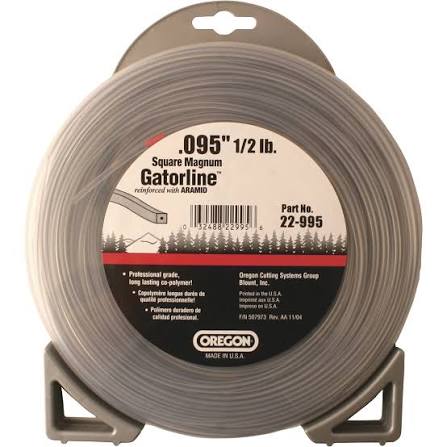
Oregon Magnum Gatorline .095
The Oregon Magnum Gatorline takes a different approach. It is a heavy-duty twisted line with a reinforced inner core that adds serious breakage resistance. Where other twisted lines may snap on thick, woody stems, the Gatorline tends to push through.
This one is especially popular with commercial landscapers who tackle thick brush, ditch lines, and fence rows on a daily basis. It cuts more aggressively than the Husqvarna Titanium Force, though it runs slightly louder due to its more angular twisted profile. If your yard has heavy weed cover or you are doing seasonal property cleanups, it is a solid workhorse.
Budget-Friendly Alternatives
Not every yard needs a premium spool. The Arnold Maxi-Edge .095 gives you a square-profile line at a lower price point, delivering clean cuts on standard grass and garden weeds without breaking the bank. It is a practical choice for smaller yards that do not see heavy weed growth.
The MaxPower round .095 is another reliable option you will find at most hardware stores. It does not have any fancy shapes or coatings, but it feeds smoothly, holds up reasonably well against moderate use, and costs less per foot than premium brands. For light-to-moderate residential trimming, it gets the job done.
How to Choose the Right .095 String Trimmer Line for Your Yard
Knowing what is available is only half the battle. The real question is which line matches the conditions you actually deal with every week. Here is how to narrow it down.
Match the Line to the Job
Think about what your yard throws at you on a typical trimming day. If you are mostly edging along sidewalks and keeping borders neat, a standard round or twisted .095 line handles that without any trouble. You do not need a heavy-duty product for clean-up work on a well-maintained lawn.
If your yard includes patches of overgrown grass, seasonal weed surges, or areas along fences and outbuildings that get out of hand between mowings, step up to a copolymer twisted or dimpled .095 string trimmer line. The improved durability and cleaner cutting action save you time and produce a better-looking result.
For serious clearing jobs — thick brush, vacant lot edges, fence lines choked with vines — a square or reinforced .095 line gives you the aggressive cutting power those conditions demand. Alternatively, if your trimmer supports it, jumping up to .105 line for those heavy jobs can be a smart move.
Consider Your Trimmer’s Power and Head Type
Always match the line to what your trimmer can handle. Your owner’s manual lists the recommended diameter range, and that range exists for a real engineering reason. Running line that is too thick for your motor creates excessive drag, lowers RPM, and accelerates engine wear. On the flip side, running line that is too thin leads to constant breakage and poor cutting performance.
Head type matters too. Bump-feed heads work best with round or twisted line because those shapes wind and feed smoothly. Fixed-line heads can sometimes accommodate square or multi-sided profiles, but check compatibility first. A line that does not feed properly is a line that wastes your time.
Think About Noise and Neighborhood Etiquette
This one gets overlooked constantly. If you trim your yard early on weekend mornings or your property sits close to your neighbor’s bedroom window, the noise your trimmer makes is not just your problem. Twisted and dimpled lines run noticeably quieter than standard smooth round line. The Husqvarna Titanium Force, for example, claims a fifty percent noise reduction thanks to its surface design. That is not just a marketing number — it makes a real difference when you are working close to homes, patios, and outdoor living spaces.
Choosing a quieter 095 string trimmer line is not about being soft. It is about being a decent neighbor and still getting the job done.
Common Mistakes People Make with .095 String Trimmer Line
Even experienced homeowners trip up on a few common mistakes that waste product, damage equipment, and turn a thirty-minute job into a full-morning ordeal.
Storing Line Improperly
This is the number one mistake, and it is the easiest to fix. Nylon and copolymer lines lose moisture when stored in dry environments like garages and sheds. Once that moisture is gone, the line becomes stiff, brittle, and prone to snapping on every bump and turn. A spool that should last two months burns through in two weeks.
The fix is simple. Store your bulk spools in a sealed plastic container or a bucket of water. According to Stihl’s own recommendations, soaking dried-out line in water at room temperature for 24 hours can restore much of its original flexibility. Some grounds crews keep their line submerged in water all season long. You do not need to go that far, but keeping your spool sealed in a bag with a damp towel goes a long way.
Using the Wrong Diameter for the Trimmer
Forcing .095 line into a trimmer rated for .065 to .080 causes poor feeding, sluggish motor performance, and shortened tool life. The motor cannot spin the thicker line fast enough to cut cleanly, and the excess drag puts unnecessary stress on internal components. On the other hand, running .080 in a trimmer designed for .095 results in frequent breakage, poor cutting power, and more trips to the spool than anyone wants to deal with.
Check your manual, match the diameter, and save yourself the trouble.
Ignoring Line Shape for the Task at Hand
Grabbing the cheapest spool without considering shape is a recipe for disappointment. Basic round line tears grass rather than cutting it, leaving behind brown tips and a lawn that looks chewed up rather than trimmed. Spending a few extra dollars on a twisted or multi-sided .095 string trimmer line that matches your typical yard conditions pays for itself in time saved and a noticeably better-looking result.
Maintenance Tips to Get More Life from Every Spool
A quality spool of 095 string trimmer line can last a long time if you treat it right. These small habits add up to real savings over the course of a season.
Keep your line hydrated between uses. Store bulk spools in a sealed container with a damp towel or simply leave them in a bucket of water. This maintains the nylon’s natural flexibility and reduces breakage dramatically. Clean your trimmer head after every few uses. Built-up grass, dirt, and debris create heat that can cause the line to fuse together inside the spool — a problem known as line welding. A quick rinse and inspection after each session prevents that headache before it starts.
Replace line before it gets too short. When the line is excessively short, the trimmer head spins faster than it should, creating more heat, more noise, and an uneven cut. Let the line extend to its full recommended length before trimming.
Finally, inspect the eyelets and line guard on your trimmer head for burrs, nicks, or rough spots. Damaged eyelets shear through line much faster than they should, turning a durable spool into an expensive waste. A quick file or a replacement eyelet costs almost nothing compared to burning through line twice as fast.
Final Thoughts
Choosing the right 095 string trimmer line is not complicated once you understand what matters. Match the diameter to your trimmer, pick a material that holds up to your yard’s conditions, and choose a shape that gives you the cut quality and noise level you want. For most homeowners running a standard gas trimmer or a higher-powered battery model, a copolymer .095 line in a twisted or dimpled-round profile handles just about everything a suburban lawn can throw at it.
If you want a proven starting point, the Husqvarna 639005106 Titanium Force .095-inch spool and the Echo Black Diamond .095 are two of the most consistently well-reviewed options on the market. Both deliver strong durability, clean cutting, and solid value on a per-foot basis, especially when purchased in bulk.
The bottom line is straightforward. Check your trimmer’s manual for the recommended diameter. Pick a line shape that fits the kind of trimming you do most. Buy in bulk to save money. Store your line properly so it stays flexible. Do those four things and you will spend a lot less time reloading and a lot more time enjoying a yard that actually looks the way you want it to.
FAQ 1: What is .095 string trimmer line used for?
A .095 string trimmer line is designed for medium-duty residential and light commercial trimming. It handles thick grass, seasonal weeds, and moderate overgrowth on most standard gas trimmers and higher-powered battery-operated models without creating excessive drag on the motor.
FAQ 2: Is .095 or .080 trimmer line better for home use?
For small, well-maintained lawns with thin grass, .080 line works fine and puts less strain on the motor. However, .095 string trimmer line is the better all-around choice for most homeowners because it lasts longer, resists breakage more effectively, and cuts through thicker vegetation that .080 struggles with.
FAQ 3: Can I use .095 trimmer line in a battery-powered trimmer?
It depends entirely on the trimmer’s voltage and motor design. Most 40-volt to 80-volt brushless battery trimmers handle .095 string trimmer line without any issues. Lower-powered 20-volt models are typically designed for .065 or .080 line, and forcing .095 into them causes excessive drag and shortened battery life.
FAQ 4: What is the difference between .095 and .105 trimmer line?
The .105 line is slightly thicker and more durable against heavy brush, but it creates more drag and requires a more powerful engine to spin effectively. A .095 string trimmer line offers better fuel efficiency, less motor strain, and you get more feet per pound of line, making it the more practical choice for regular lawn trimming.
FAQ 5: Does the shape of .095 trimmer line matter?
Yes, shape significantly affects cutting quality, noise, and durability. Round line is the most durable and feeds smoothly, but it tears grass instead of slicing it. Twisted line runs quieter and cuts cleaner. Square and star-shaped lines offer the sharpest cut through heavy weeds but wear out faster at the edges.
FAQ 6: What trimmers are compatible with .095 string trimmer line?
Most gas-powered string trimmers from brands like Stihl, Husqvarna, Echo, DeWalt, Ryobi, and Troy-Bilt accept .095 line as their standard or recommended diameter. Many higher-end cordless trimmers in the 40V to 80V range are also compatible. Always verify the recommended diameter in your owner’s manual before purchasing.
FAQ 7: Why does my .095 trimmer line keep breaking?
The three most common causes are dried-out line from improper storage, contact with hard surfaces like concrete and rocks, and using an underpowered trimmer that cannot spin the line fast enough. Soaking brittle line in water for 24 hours restores its flexibility and can reduce breakage by up to 30 percent.
FAQ 8: Should I soak my .095 trimmer line in water before using it?
Soaking is recommended, especially if the line has been stored in a dry garage or shed. Nylon trimmer line is hygroscopic and absorbs moisture to stay flexible. A 24-hour soak in room-temperature water restores pliability and significantly reduces snapping during use. There is no benefit to soaking longer than 24 hours.
FAQ 9: How many feet of line are in a 3-pound spool of .095 trimmer line?
A 3-pound spool of .095 string trimmer line typically contains around 840 feet of line, depending on the brand and material. For example, the Husqvarna 639005106 Titanium Force .095-inch spool provides exactly 840 feet, which is usually enough to last an entire mowing season for a standard residential property.
FAQ 10: Is the Husqvarna Titanium Force .095 line worth the price?
The Husqvarna 639005106 Titanium Force string trimmer line .095-inch by 3-pound spool is widely considered one of the best values in its class. Its copolymer construction delivers strong durability, its dimpled surface reduces noise by up to 50 percent, and the 840-foot spool length means fewer purchases per season compared to smaller packs.
FAQ 11: What is trimmer line welding and how do I prevent it?
Line welding occurs when the heat generated inside the trimmer head causes strands of nylon line to fuse together on the spool, preventing them from feeding out properly. Keeping the trimmer head clean, avoiding extended full-throttle runs, and using a dimpled or textured .095 string trimmer line like the Husqvarna Titanium Force helps reduce the risk.
FAQ 12: Can I use .095 line in a trimmer that recommends .080?
It is generally not recommended. Using a thicker line than your trimmer is designed for creates extra drag, lowers RPM, and puts unnecessary strain on the motor and clutch. Some users report success after testing it, but you risk shortened tool life and voiding your warranty. Always follow the manufacturer’s recommended diameter range.
FAQ 13: What is the best .095 string trimmer line for edging?
For clean, precise edging along sidewalks and driveways, a twisted or diamond-shaped .095 line delivers the sharpest results. The Echo Black Diamond .095 is a popular choice among homeowners because its twisted diamond cross-section slices grass cleanly rather than tearing it, producing a manicured finish along hard edges.
FAQ 14: How do I store .095 trimmer line so it does not dry out?
Keep unused spools in a sealed plastic container or a resealable bag with a damp towel. Some landscapers store their line in a bucket with an inch of water in the bottom and a sealed lid. The key is preventing the nylon from losing its natural moisture content, which causes it to become stiff, brittle, and prone to constant breakage.
FAQ 15: Is round or twisted .095 trimmer line better?
Round .095 line is more durable, cheaper, and feeds more smoothly through bump-feed heads. Twisted .095 line runs 10 to 20 percent quieter, produces a slightly cleaner cut, and is favored by professionals who trim near homes and patios early in the morning. For most homeowners, twisted line offers the better overall experience.
FAQ 16: How often should I replace my .095 string trimmer line?
Replace the line whenever it becomes too short to cut effectively, typically when it wears down to about 4 to 5 inches extending from the trimmer head. Running excessively short line forces the motor to work harder and produces an uneven cut. A full spool reload depends on your yard size, but most homeowners refill every two to four trimming sessions.
FAQ 17: Does .095 trimmer line work for cutting thick weeds and brush?
A .095 string trimmer line handles thick weeds and moderate overgrowth effectively, especially when using a square or twisted profile. However, for heavy woody brush and dense undergrowth, stepping up to .105 or .130 line on a more powerful trimmer will give you better results with less breakage and frustration.
FAQ 18: What color is .095 trimmer line and does color matter?
Color varies by brand — orange, yellow, silver, black, and red are all common. Color does not affect cutting performance, but high-visibility colors like orange and yellow help you see how much line is extending from the head. The Husqvarna Titanium Force .095 is silver, while the Echo Black Diamond is black.
FAQ 19: Is pre-cut .095 trimmer line better than a bulk spool?
Pre-cut packs are more convenient for quick reloads but cost significantly more per foot than bulk spools. A bulk spool of .095 string trimmer line is far more economical for anyone who trims regularly. A 3-pound or 5-pound spool can last an entire season and saves money over buying multiple small pre-cut packs throughout the year.
FAQ 20: Can I use any brand of .095 line in my Stihl or Husqvarna trimmer?
Yes. As long as the diameter matches your trimmer’s recommended range, the brand of line does not need to match the brand of trimmer. A Stihl FS 90R runs Oregon, Husqvarna, or Echo .095 line just as effectively as Stihl-branded line. Universal compatibility is one of the advantages of standard .095 diameter trimmer line.
FAQ 21: Does .095 string trimmer line damage tree bark?
Any trimmer line can damage tree bark if held too close for too long. A .095 line has more mass than thinner options and can strip bark faster on contact. To protect trees, keep a safe distance and use a steady sweeping motion rather than pressing the line against the trunk. Round profiles are slightly gentler than square or multi-sided shapes.
FAQ 22: How much noise does .095 trimmer line make compared to other sizes?
Thicker line generally creates more noise because it displaces more air as it spins. However, the shape of the line matters more than diameter alone. A twisted or dimpled .095 string trimmer line like the Husqvarna Titanium Force runs up to 50 percent quieter than a standard smooth round line of the same thickness thanks to its aerodynamic surface design.
FAQ 23: What is the best way to load .095 line into a bump-feed trimmer head?
Cut a length of line matching your trimmer head’s recommended capacity, typically 15 to 25 feet. Feed one end into the spool’s anchor hole, then wind the line evenly in the direction indicated by the arrow on the spool. Avoid packing it too tightly. Cross-winding slightly, as you would on a fishing reel, helps prevent the line from binding during use.
FAQ 24: Is .095 string trimmer line safe for trimming around flower beds and landscaping?
Yes, with proper technique. A .095 line provides enough cutting power for clean trimming while remaining manageable enough to control around delicate landscaping features. Use a lower throttle setting near flower beds and ornamental plants. Round-profile .095 line is the safest option around fragile features because it causes less aggressive cutting than square or star-shaped alternatives.