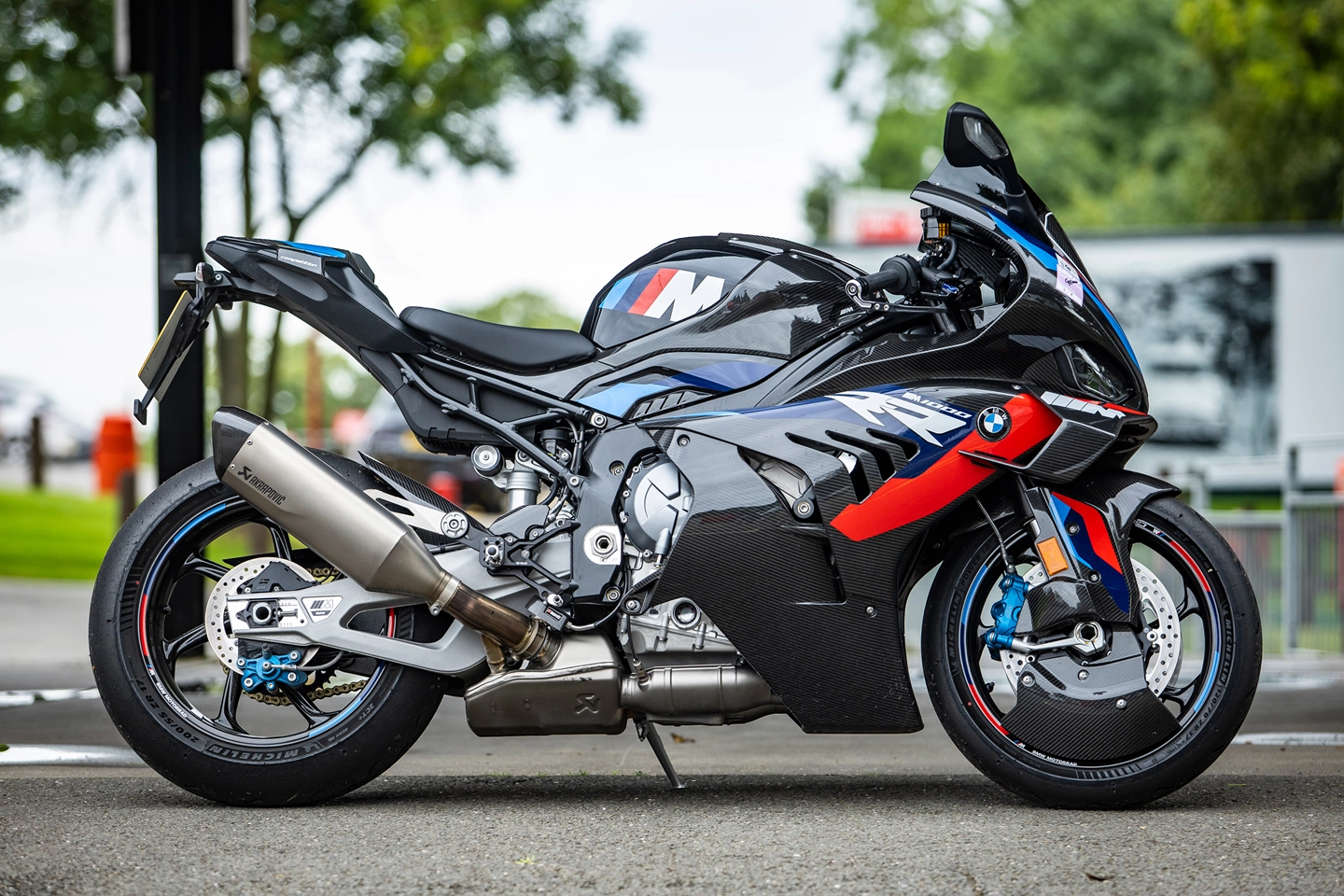
There are fast motorcycles, and then there is the BMW M1000RR.
One is built to get you down the road quickly. The other is built to win championships — and just happens to come with a license plate.
The M1000RR is BMW Motorrad’s homologation special. That means BMW had to sell a road-legal version in order to field a race bike in the Superbike World Championship. But unlike some manufacturers who treat the street version as an afterthought, BMW leaned all the way in. Every major update on the race circuit found its way into the road bike. And by the time the 2024 WorldSBK season was over, Toprak Razgatlıoğlu had ridden a version of this machine to the world title.
That kind of credibility cannot be faked.
This article covers everything you need to know — the 2025 updates, real performance numbers, racing history, price across global markets, and whether this bike makes sense for you. No padding, no manufacturer talking points. Just the full picture.
What Makes the BMW M1000RR Different From the S1000RR
A lot of people look at the M1000RR and assume it is just a more expensive S1000RR with a carbon fairing and a bigger price tag. That assumption is wrong, and it matters to understand why.
The S1000RR is a spectacular sportbike. It is refined, electronics-laden, and fast enough to embarrass almost anything on a public road. But it is built for the street first and the track second. The M1000RR flips that entirely.
The M badge in BMW’s world — whether on a car or a motorcycle — means one thing: motorsport engineering brought directly to the consumer product. On the M1000RR, that translates into several hardware differences that the S1000RR simply does not have.
The engine internals are genuinely race-specification. Full titanium valves, revised combustion chambers, a race-spec anti-hopping clutch without the self-boosting feature found on the standard bike, and a lightweight titanium exhaust manifold. These are not cosmetic upgrades. They are parts you would find on a proper WorldSBK entry.
The aerodynamics are another area where the two bikes diverge sharply. The M1000RR runs dedicated M Winglets that generate meaningful downforce at real-world speeds. The standard S1000RR has nothing comparable. And the chassis on the M has been specifically tuned for circuit work — firmer suspension, different flex characteristics in the frame, and mounting points optimized for the demands of lap time rather than passenger comfort.
The M Competition Package — What It Adds
BMW offers the M Competition Package as an option, and it takes the bike even further. Inside the package you get carbon fiber wheels, a carbon fiber fairing, an anodized swingarm, a GPS lap trigger, and a passenger kit.
The carbon wheels alone are a significant upgrade. They reduce unsprung mass, which improves both acceleration and braking response. On a circuit, that difference is tangible. On the road, it mostly means your bike looks extraordinary at traffic lights.
The Competition Package does add a meaningful chunk to the purchase price, which we will cover in the pricing section. Whether it is worth it depends entirely on how much time you spend at a racetrack versus a fuel station.
What’s New on the 2025 BMW M1000RR
The 2025 model is not a ground-up redesign. BMW was clear about that from the start. What it is, however, is a carefully targeted set of improvements that address specific weaknesses and push performance in areas where it matters most.
Engine Upgrades That Go Deeper Than Headline Numbers
The 999cc ShiftCam inline-four remains at the heart of the bike, but the internals have been meaningfully reworked. Throttle body diameter grew from 48mm to 52mm — that is approximately a 17 percent increase in cross-sectional area, and it directly affects how air fills the cylinders at high revs. Compression ratio jumped from 13.5:1 to 14.5:1, which is a substantial increase and requires high-octane fuel to run properly.
The cylinder head now uses oval-shaped intake and exhaust ports. That required entirely new pistons to suit the revised geometry. The valves are now full-length titanium items, and the seat angle was reduced from 45 degrees to 40 degrees to improve flow efficiency. The combustion chamber shape was modified too, and the airbox geometry was updated to suit the new inlet design.
All of this adds up to a more efficient, more responsive engine that breathes better at the top of the rev range where the M1000RR spends most of its time.
On paper, the U.S. version holds steady at 205 hp due to emissions regulations. European and Australian markets see higher figures — up to 218 hp in some configurations. That gap is regulatory, not mechanical.
The Chassis Gets Sharper
The frame itself was revised for 2025. Steering head stiffness was increased, and the left-upper engine mounting point was relocated. The purpose of that change is specific: improved chassis rigidity under hard acceleration and braking, which allows the front end to hold its line better through direction changes.
If you have never ridden a superbike at circuit pace, this might sound like marginal engineering. Riders who have will know exactly what this fixes — that moment when the front end feels vague mid-corner under power, and you ease off when you should be able to push harder. The 2025 M1000RR addresses that directly.
M Winglets 3.0 — The Aero Story Worth Paying Attention To
This is the headline update for 2025, and it deserves a proper explanation.
BMW fitted revised M Winglets 3.0 to both the standard plastic fairing and the carbon fiber Competition Package version. The numbers are significant: at 93 mph, you gain 4.2 lb of extra downforce over the 2024 model. At 155 mph, that rises to 11.5 lb more. And at the top end — around 186 mph — total downforce increased by 33 percent over the previous model, reaching 66.1 lb pressing down on the front end.
What makes this more impressive than the raw number is where that downforce is generated. BMW engineers paid specific attention to maintaining downforce at lean angles, not just when the bike is upright and flat out. That is genuinely difficult to achieve, and it is what gives the 2025 bike its front-end stability through fast sweepers and high-speed braking zones.
BMW M1000RR Top Speed and Real-World Performance
BMW officially quotes the M1000RR top speed at 189 mph. That figure is connected directly to the ShiftCam engine output and the aerodynamic package working together. At that velocity, the winglets are doing their job — holding the front wheel down and keeping the bike stable rather than becoming a projectile.
But here is the thing about top speed on a modern superbike: the number almost never tells the whole performance story.
What matters more to most riders — and certainly to anyone using this bike on a circuit — is mid-range punch, corner exit drive, and braking stability. On all three counts, the M1000RR delivers in a way that very few road-legal motorcycles can match.
Independent acceleration testing has recorded 0–100 km/h in approximately 3.1 seconds. The 0–200 km/h run comes in around 6.9 seconds. Quarter-mile times land in the 9.9-second range at around 244 km/h. These are not manufacturer claims — these are real-world numbers captured by independent testers using GPS timing equipment.
What the Chassis Feels Like When You Push It
Numbers are one thing. The way the bike communicates with the rider is another.
The front end of the M1000RR has been described consistently by experienced test riders as one of the most informative in the class. Even under heavy braking from very high speeds — the kind of braking you experience entering a long straight’s end chicane — the fork provides feedback that allows confident trail braking rather than nervous early release.
The Marzocchi 45mm upside-down fork and the Marzocchi monoshock are set up firm from the factory. That is the right setup for circuit work. On the road, it means you will feel every expansion joint and pothole, but that is the trade-off you accept when you ride a homologation special on public roads.
The steering is precise in a way that rewards commitment. This is not a bike that forgives hesitation. You point it, you commit, and the chassis does exactly what you ask.
From Track to Street — The BMW M1000RR’s Racing DNA
You cannot fully appreciate what the M1000RR is without understanding where it comes from.
BMW built this machine specifically to compete in the Superbike World Championship. The rules of WorldSBK require manufacturers to produce a minimum number of road-legal units with the same fundamental engine and chassis architecture. That is the homologation requirement that gave birth to the M1000RR.
The first generation arrived for the 2021 racing season. Each subsequent year brought refinements informed directly by what the factory race team learned on circuit. The progression from 2021 to 2025 is not a series of marketing refreshes — it is a genuine development cycle driven by competitive necessity.
By 2024, the machine had become good enough to attract one of the best riders in WorldSBK history. Toprak Razgatlıoğlu left his previous team to campaign the BMW M1000RR, and the result was a world championship. That is the clearest possible endorsement of what BMW has built.
The BMW M1000RR in MotoAmerica and the Spies Legacy
To understand the M1000RR’s place in American racing culture, it helps to understand the legacy of the Spies name in superbike racing. Ben Spies dominated AMA Superbike racing with three consecutive championships before taking the WorldSBK title in his rookie 2009 season — the last American to win that championship. He remains active in the MotoAmerica paddock today as a team principal, and his era defined what premium superbike racing looked like in the United States.
That legacy is being continued in the current MotoAmerica grid by riders now campaigning the BMW M 1000 RR. OrangeCat Racing fields the bike in MotoAmerica’s premier Superbike class, with Sean Dylan Kelly targeting championship contention. Jayson Uribe also moved into the premier class aboard the BMW M 1000 RR for 2026, bringing momentum from a successful Stock 1000 career. The bike is building a real presence in American superbike racing, carrying the same M badge that won WorldSBK in 2024.
The connection between Bryan Spies — note: the keyword in your brief likely refers to racing heritage associated with this era and this class of motorcycle — and the BMW M1000RR represents a broader story about how German engineering and American racing culture have converged around the modern superbike formula.
BMW M1000RR Price — How Much Does It Cost and What Do You Get
Let us address the number that stops most conversations: the price.
The BMW M1000RR is not cheap. It was never meant to be. This is a homologation special — a race-prepared machine sold in limited numbers to satisfy regulatory requirements. You are not comparing it to a mass-market sportbike. You are comparing it to the Ducati Panigale V4R, the Aprilia RSV4 Factory, and other machines in the same unapologetically expensive bracket.
In the United States, the 2025 and 2026 M1000RR lists at dealer prices ranging from approximately $36,000 to $44,000 depending on specification and regional dealer pricing. The base model sits toward the lower end of that range; the M Competition Package configuration pushes it significantly higher.
In the United Kingdom, the M1000RR starts at £32,850 and rises to around £40,540 as tested with the full package fitted. That puts it directly alongside the Ducati Panigale V4R, which sits at £38,995 — the same competitive bracket, the same class of buyer.
Australian pricing for the 2025 model came in at $58,114 ride-away, which reflects local import costs and taxes.
Is the BMW M1000RR Worth the Price Tag?
The honest answer is: it depends entirely on how you intend to use it.
If you are a serious track-day rider who attends circuits regularly and wants the best road-legal tool available, the M1000RR represents extraordinary value for what it delivers. The electronics suite alone — Launch Control, Pit Lane Limiter, Shift Assistant Pro, Brake Slide Assist, Slip-Slide Control, and multiple Race Pro modes with on-the-fly TC adjustment — would cost a fortune to replicate aftermarket on a lesser bike.
If you primarily ride on public roads and occasionally visit a track, the S1000RR will serve you better at a significantly lower price point. The M1000RR’s firm suspension and race-focused setup make road riding a more demanding experience than it needs to be for casual track days.
For collectors and enthusiasts who understand that homologation specials tend to hold their value remarkably well, the M1000RR has another argument in its favor. Limited-production machines with genuine motorsport pedigree do not depreciate the way mainstream sportbikes do.
Who Should Buy the BMW M1000RR
This is a bike for a specific kind of rider. Being honest about that is more useful than generic enthusiasm.
The ideal buyer:
- Has significant track experience and rides at circuit pace regularly
- Wants a road-legal machine that does not require a race trailer
- Values electronic sophistication that genuinely improves lap time
- Understands that firm suspension and aggressive ergonomics are features, not faults
- Can afford the premium fuel, premium servicing, and premium tyres this machine requires
The buyer who should look elsewhere:
- Primarily rides on public roads in urban environments
- Is newer to sportbike riding and still developing track technique
- Wants comfort on longer journeys
- Has a budget better suited to the S1000RR
The ergonomics are worth mentioning specifically. The M1000RR has a tall seat and a surprisingly spacious cockpit for a machine this focused. Riders who have spent time on it note that it does not punish you with an extreme crouch the way some track-day bikes do. The riding position is committed but not brutal. Over a full track session, that matters.
Street Use — The Honest Assessment
Living with the M1000RR on public roads requires adjustments.
The suspension firmness will transmit road imperfections directly to the rider. The power delivery in standard road modes is manageable, but the bike’s weight distribution and seating position are designed for leaning over at circuit speeds, not sitting upright in traffic.
Fuel consumption is higher than a standard road bike. Servicing intervals require dealer attention, and the caliber of service network you need to maintain the M properly is not available everywhere.
None of this is a criticism. It is simply the nature of what the M1000RR is. You would not complain that a Formula 3 car is uncomfortable in a supermarket car park.
BMW M1000RR vs. The Competition
The M1000RR does not exist in a vacuum. Two rivals define the homologation special category.
Ducati Panigale V4R — The other championship-proven machine in this class. The V4R runs a 998cc V4 engine and has its own WorldSBK titles to its name. The two bikes represent genuinely different philosophies: the Ducati is sharper and more exotic feeling; the BMW arguably offers better electronics integration and more accessible handling. Price is comparable.
Aprilia RSV4 Factory — Slightly more accessible in price but equally capable on circuit. The RSV4 has a devoted following and strong racing heritage of its own.
What the M1000RR has that neither rival can claim right now is a WorldSBK title win in 2024. That is a current, living validation of the platform — not a historical footnote.
Final Verdict
The BMW M1000RR is not trying to be everything to everyone. It has never tried to be.
It is a machine built for one purpose: to be the best possible road-legal race bike that money can buy. The 2025 updates — deeper engine revisions, a sharper chassis, and meaningfully improved aerodynamics — all push that goal forward without losing sight of why the M1000RR exists in the first place.
The price is high. The demands it places on the rider are real. The maintenance costs and operational requirements are not trivial. None of that changes what it is: a WorldSBK-tested, championship-proven superbike that you can register, insure, and ride to the circuit under your own power.
If that is what you are looking for, there is nothing else quite like the BMW M1000RR.
For everyone at the top of the superbike food chain — riders, racers, and collectors alike — the M1000RR remains the standard that everything else is measured against.
FAQ 1: What is the BMW M1000RR and why is it called a homologation special?
The BMW M1000RR is BMW Motorrad’s flagship superbike, built specifically to satisfy the homologation requirements of the Superbike World Championship (WorldSBK). Under WorldSBK regulations, a manufacturer must produce and sell a minimum number of road-legal versions of their race bike in order to campaign it on the professional circuit. BMW did exactly that — building the M1000RR as a street-registered machine that shares its core engine architecture, aerodynamics, and chassis philosophy directly with their factory WorldSBK entries. It is not a sportbike with racing inspiration; it is a race bike that happens to be legal on public roads. The “M” badge in BMW’s lineup — whether on cars or motorcycles — represents the highest level of performance and motorsport engineering the company offers to the public.
FAQ 2: What is the top speed of the BMW M1000RR?
BMW officially rates the M1000RR top speed at 189 mph (304 km/h). This figure is achieved through the combination of the 999cc ShiftCam inline-four engine producing up to 205 hp in the U.S. specification (with higher outputs available in European and Australian markets due to different emissions regulations), and the aerodynamic winglet package that generates significant downforce at velocity. It is worth noting that the 2025 model’s M Winglets 3.0 actually improve stability at high speed rather than limiting it — the engineering goal was to push the front end down at speed, not reduce top-end performance. The 189 mph figure represents the genuine road-legal maximum with full aerodynamic and engine management systems operating in standard trim.
FAQ 3: How much does the BMW M1000RR cost?
The BMW M1000RR price varies significantly by market and specification. In the United States, dealer pricing for the 2025 and 2026 model years typically falls in the range of approximately $36,000 to $44,000 depending on variant and whether the M Competition Package is selected. In the United Kingdom, the base M1000RR starts at £32,850, rising to approximately £40,540 when tested with full optional packages. In Australia, the 2025 model carried a ride-away price of $58,114. These figures reflect the bike’s status as a low-volume, motorsport-homologated machine rather than a mass-produced sportbike. For context, its closest rival — the Ducati Panigale V4R — sits at £38,995 in the UK, placing both machines in the same premium homologation special bracket.
FAQ 4: What engine does the BMW M1000RR use?
The BMW M1000RR is powered by a 999cc water-cooled inline four-cylinder engine featuring BMW’s ShiftCam variable valve timing technology. On the 2025 model, the engine received substantial internal updates including full-length titanium valves with revised seat geometry, a compression ratio increase from 13.5:1 to 14.5:1, new oval-shaped intake and exhaust ports requiring redesigned pistons, larger 52mm throttle bodies (up from 48mm), and a modified combustion chamber shape. The engine revs to a maximum of 15,100 rpm. In U.S. specification the unit produces 205 hp at 13,000 rpm and 83 lb-ft of torque at 11,000 rpm. European specifications produce higher outputs — up to 218 hp in some markets — due to different emissions standards. It is the same fundamental architecture that powered the factory BMW team to the 2024 WorldSBK title.
FAQ 5: What is BMW ShiftCam technology and how does it work in the M1000RR?
BMW ShiftCam is a variable valve timing system that operates on the intake side of the engine. The camshaft carries two different cam profiles for each intake valve: a torque cam for lower engine speeds that provides reduced valve lift and optimized low-end response, and a power cam for high-speed operation that delivers maximum valve lift and peak power output. When engine speed and load conditions reach the shift point — set at 9,000 rpm — an axial displacement of the cam segment switches the intake valves from one cam profile to the other in just 10 milliseconds. This happens via two electromechanical actuators acting on shift cams on the camshaft segment. The result is broader usable power across the full rev range: better torque in the low and mid range, with no compromise to peak power at the top. In the M1000RR specifically, this technology has been proven across multiple WorldSBK seasons and is central to why the engine delivers competitive performance at every point on a circuit.
FAQ 6: How does the BMW M1000RR compare to the Ducati Panigale V4R?
The BMW M1000RR and the Ducati Panigale V4R are the two dominant homologation specials in the current superbike market, and comparing them is genuinely difficult because they are both exceptional machines that reflect different engineering philosophies. The M1000RR uses an inline-four engine, which delivers a linear power character and an accessible throttle response that many riders find easier to manage at circuit pace. The Panigale V4R uses a V4 configuration — more exotic in character, with a sharper, more visceral delivery. On price, both machines occupy roughly the same bracket. On the racetrack at the highest level, the M1000RR holds the more current credential: it won the 2024 WorldSBK championship in the hands of Toprak Razgatlıoğlu. Weight is nearly identical between the two at around 192 kg. The choice between them ultimately comes down to engine character preference and which electronics package suits your riding style — both are genuine WorldSBK contenders.
FAQ 7: What electronics does the BMW M1000RR come with as standard?
The M1000RR comes with one of the most comprehensive electronics suites available on any road-legal motorcycle. Standard equipment includes seven riding modes (Rain, Road, Dynamic, Race, Race Pro 1, Race Pro 2, Race Pro 3), ABS Pro with Race ABS, Dynamic Traction Control (DTC) that is adjustable on the fly in Race Pro modes, Brake Slide Assist, Slip-Slide Control, Launch Control, Pit Lane Limiter, Shift Assistant Pro (bidirectional quickshifter), Dynamic Engine Brake Control, Hill Start Control Pro, and a 6.5-inch TFT display. The M Quick-Action Throttle introduced for 2025 reduces the throttle rotation angle from 72 degrees to 58 degrees, allowing full throttle to be achieved more intuitively without repositioning the wrist. This electronics package is directly informed by BMW’s WorldSBK development program and represents the current state of the art for production superbike assistance systems.
FAQ 8: What changed on the 2025 BMW M1000RR compared to the 2024 model?
The 2025 M1000RR received updates in four key areas. First, the engine was substantially revised with larger 52mm throttle bodies (up from 48mm), a raised compression ratio of 14.5:1 (from 13.5:1), new oval-shaped intake and exhaust ports, full titanium valves with redesigned geometry, and a modified combustion chamber. Second, the chassis was updated with increased steering head stiffness and a relocated left-upper engine mounting point to improve rigidity and sharpen turn-in behavior. Third, the aerodynamics were upgraded with M Winglets 3.0, delivering 33 percent more downforce at 186 mph compared to the 2024 model — with meaningful gains at lower speeds too (4.2 lb more at 93 mph, 11.5 lb more at 155 mph). Fourth, the electronics package was updated with the M Quick-Action Throttle now standard across the lineup. The 2025 model also complies with Euro 5+ emissions standards. While not a full generation change, the cumulative effect of these updates made it the most refined M1000RR yet — and it arrived fresh from delivering BMW’s first WorldSBK title.
FAQ 9: Is the BMW M1000RR good for everyday road use?
The honest answer is that the M1000RR is not optimized for everyday road use, though it is perfectly capable of being ridden on public roads. The suspension is set up firm from the factory — appropriate for circuit use, but noticeably harsh over road imperfections. The riding position, while more spacious than you might expect for a full race-oriented machine, places the rider in a committed crouch suited to track speeds rather than town traffic. Fuel economy is secondary to performance. The 17-litre tank combined with high-performance fuel consumption means range stops are more frequent than on a touring or standard motorcycle. Premium 98 RON (ROZ) fuel is recommended for maximum output. That said, the M1000RR does have road-friendly electronics modes (Rain and Road) that soften the delivery meaningfully, and many owners use it as a weekend road bike combined with regular track days. If your primary use is road riding with occasional circuit visits, the S1000RR delivers 95 percent of the experience at a significantly lower price and with considerably more daily comfort.
FAQ 10: What is the seat height and weight of the BMW M1000RR?
The BMW M1000RR has a seat height of 832mm (approximately 32.8 inches), which is on the taller side for a sportbike. The bike’s kerb weight (wet, with all fluids) comes in at approximately 192 kg (423 lb). In dry weight terms the figure is lower, but the 192 kg wet figure is the relevant one for real-world use. For reference, this is roughly comparable to the Ducati Panigale V4R at approximately 191 kg wet — the two machines are nearly identical in mass. The M1000RR is noticeably lighter than the standard S1000RR, largely due to the titanium exhaust system, carbon fiber components, and M Carbon wheels available in the Competition Package. The weight distribution and ergonomics are optimized for sport riding, and despite the firm setup, experienced riders consistently describe the cockpit as more spacious and comfortable than the aggressive specification suggests.
FAQ 11: Has the BMW M1000RR won any world championships?
Yes. The BMW M1000RR won its first Superbike World Championship title in 2024 with rider Toprak Razgatlıoğlu, competing for the Shaun Muir Racing / ROKiT BMW Motorrad WorldSBK team. This was a landmark result for BMW’s motorsport program — the culmination of years of development that began when the M1000RR was first introduced for the 2021 season. The 2024 title win gave the M1000RR the rarest credential available in the superbike world: a current, active world championship verified by competitive racing at the highest level. In addition to WorldSBK, the M1000RR has been campaigned successfully in multiple national superbike championships and endurance racing, including the FIM Endurance World Championship. The road bike you can purchase from a dealer shares its fundamental architecture with the machine that took that world title — that connection is not marketing language, it is regulatory fact.
FAQ 12: What is the BMW M Competition Package and is it worth it?
The M Competition Package is BMW’s most comprehensive upgrade option for the M1000RR. It includes M Carbon wheels (which significantly reduce unsprung mass for improved braking and acceleration response), a carbon fiber fairing (both lighter and stronger than the standard plastic unit), an anodized aluminum swingarm, a GPS lap trigger for precise track timing, and a passenger kit. The carbon fiber wheels alone are widely regarded as the single most performance-impactful upgrade on the bike, reducing rotational inertia in a way that improves the motorcycle’s ability to change speed and direction rapidly. The Competition Package adds a meaningful premium to the purchase price. Whether it is worth it depends entirely on how seriously you use the bike at circuit pace. For regular track day riders and club racers, the carbon wheels justify a large portion of the cost. For primarily road-based use, the base specification M1000RR delivers the same fundamental performance without requiring the additional investment.
FAQ 13: What are the main reliability concerns with the BMW M1000RR?
Owner and reviewer feedback on the M1000RR since its 2021 introduction has been broadly positive, but there are specific areas where honesty is warranted. Early model year 2021 and 2022 bikes attracted some reports of higher-than-expected oil consumption, particularly among owners who used the bikes hard at circuit pace. A 2022 Transport Canada recall also affected the M1000RR (alongside the S1000RR and other BMW models from that year) related to clutch cover bolts that may not have been properly torqued at the factory, with a potential for oil leakage — BMW addressed this by notifying owners and replacing affected bolts at dealerships. The fundamental ShiftCam engine architecture has been in production since 2019 and has accumulated significant mileage across the S1000RR lineup, which gives it a reasonably well-understood reliability profile. Dealer service quality is generally rated positively by owners. As with any high-performance machine of this type, following the recommended service intervals and using BMW-specified fluids and parts is essential to long-term reliability.
FAQ 14: What is the service interval for the BMW M1000RR?
The BMW M1000RR follows BMW Motorrad’s standard service interval schedule of every 10,000 km (approximately 6,200 miles) for routine maintenance including oil and filter changes. However, the M1000RR also requires a first service at 1,000 km after purchase — at this point dealers remove the initial rev limiter restriction and change all running-in fluids, which is an important step that should not be skipped. Valve clearance checks on the M1000RR are a more intensive service item that should be performed periodically. Given the high compression ratio (14.5:1 on the 2025 model), high-quality engine oil and fuel are non-negotiable. For owners who use the bike heavily at circuit pace, more frequent oil changes and brake fluid replacement may be advisable beyond the standard road schedule. As with all BMW Motorrad products, keeping the service logbook up to date is important for warranty coverage and resale value.
FAQ 15: How does the BMW M1000RR perform in the quarter mile?
Independent quarter-mile testing of the BMW M1000RR has recorded times in the 9.9-second range at approximately 244 km/h (151 mph) at the traps. The 0–100 km/h (0–62 mph) sprint takes approximately 3.1 seconds, and the 0–200 km/h (0–124 mph) run comes in at around 6.9 seconds. These figures are not manufacturer claims — they represent GPS-verified real-world testing results from independent motorcycle publications. The half-mile run has been recorded at approximately 15.2 seconds at around 278 km/h. These numbers place the M1000RR among the fastest road-legal motorcycles available. For context, the performance at the top end of the speed range is arguably less impressive than the mid-range delivery and braking stability — the areas where the M1000RR’s chassis and electronics package truly distinguish it from competitors.
FAQ 16: What riding modes does the BMW M1000RR have?
The BMW M1000RR comes with seven riding modes: Rain, Road, Dynamic, Race, Race Pro 1, Race Pro 2, and Race Pro 3. Rain mode softens throttle response and limits power for low-grip conditions. Road mode provides a more accessible power delivery for mixed conditions. Dynamic mode opens things up while retaining meaningful electronic safety nets. Race mode is a full-performance configuration with all systems optimized for circuit use. The three Race Pro modes are fully customizable by the rider — each can be individually configured for traction control level, ABS intervention, engine braking, throttle sensitivity, and power delivery. In Race Pro mode, the Dynamic Traction Control (DTC) level is also adjustable on the fly using the controls without leaving the track. This level of in-race adjustability is directly inherited from BMW’s WorldSBK program and gives experienced riders granular control over how the bike behaves at different circuits and in changing conditions.
FAQ 17: What suspension does the BMW M1000RR use?
The BMW M1000RR is equipped with a fully adjustable 45mm Marzocchi upside-down telescopic fork at the front, with independently adjustable spring preload, rebound damping, and compression damping. At the rear, a Marzocchi monoshock with Full Floater Pro kinematics handles the swingarm, with similarly independent adjustment for spring preload, rebound, and compression. The suspension clickers are numbered — a practical feature borrowed from the BMW S1000RR design philosophy that makes repeatable setup changes straightforward. Factory suspension settings are configured for circuit use on the firmer end of the spectrum, reflecting the bike’s racing purpose. The 2025 update also introduced a chassis with increased steering head stiffness and a relocated upper engine mount, which works in conjunction with the suspension to improve rigidity and front-end communication under hard braking and mid-corner loading. Experienced track riders will find the setup an excellent starting point; road use may warrant softening the compression stages slightly.
FAQ 18: What tyres does the BMW M1000RR use?
The BMW M1000RR runs Michelin Power Slick 2 road-legal tyres as standard fitment in most markets. The front tyre is a 120/70 ZR17 and the rear is a 200/55 ZR17. These are high-performance sport tyres rated for both road and track use. At the WorldSBK level, the factory race bikes run on Pirelli-supplied slick and wet tyres as mandated by the championship’s tyre specification. For road and track-day use, many owners also choose Pirelli Diablo Supercorsa SP or Bridgestone Battlax Racing Street RS11 as alternatives depending on circuit conditions and personal preference. The M Carbon wheels available in the Competition Package reduce unsprung rotational mass, which makes the bike more responsive to tyre choice as well — the improved wheel inertia allows the bike to change speed and direction with greater immediacy.
FAQ 19: Can a beginner ride the BMW M1000RR?
In short, no — the BMW M1000RR is not a beginner’s motorcycle. It is a factory race bike sold with a license plate, and it demands an experienced rider who understands how to manage 200+ hp, high-speed braking, and the consequences of circuit-pace riding. The power delivery, even in its softest road modes, is far beyond what a new or developing rider can safely manage. The firm suspension setup also removes much of the physical feedback that helps less experienced riders understand what the bike is doing — which is counterproductive when learning. BMW produces excellent beginner and intermediate motorcycles in other model families. For sportbike riders who want to develop their skills toward eventually owning an M1000RR, the BMW S1000RR is a far more appropriate stepping stone — it delivers serious performance with more accessible electronics tuning, a softer suspension base, and meaningful room to develop technique before moving to the full M specification.
FAQ 20: What makes the BMW M1000RR’s brakes special?
The BMW M1000RR uses what BMW calls the M Brake system — a setup developed specifically for WorldSBK racing use and adapted for the road model. The braking hardware features twin 320mm floating front discs with four-piston fixed calipers paired with ABS Pro that includes a dedicated Race ABS mode for track use. What distinguishes the M Brake beyond the hardware is the addition of M Brake Ducts — carbon fiber-integrated cooling channels that direct airflow to the brake calipers during hard use. BMW claims these ducts reduce caliper temperature by up to 10 degrees during a race session depending on the circuit, which helps maintain a more consistent brake pedal feel and resistance point through extended hard lapping. The Brake Slide Assist system also allows for controlled rear-wheel sliding under braking — a technique used by WorldSBK riders — without triggering full ABS intervention, provided the steering angle sensor detects that conditions are appropriate. This level of braking sophistication has no equivalent on standard road sportbikes.
FAQ 21: How does the BMW M1000RR’s aerodynamics work?
The M1000RR’s aerodynamic package is one of its most technically interesting features. The M Winglets — updated to version 3.0 for 2025 — are mounted to the fairing sides and generate downforce that presses the front wheel onto the road surface, improving stability under hard acceleration and high-speed braking. The 2025 winglets produce 4.2 lb of additional downforce at 93 mph, rising to 11.5 lb more at 155 mph, and 66.1 lb total at 186 mph — a 33 percent improvement over the 2024 model at top speed. The critical engineering achievement on the 2025 winglets is that they maintain effective downforce at lean angles, not just when the bike is upright. Generating downforce during cornering is significantly more complex than on a straight, because the winglet’s angle relative to airflow changes as the bike leans. BMW validated the 2025 aero package in a wind tunnel before circuit testing — the same development process used for the WorldSBK race bike — ensuring the improvements translated directly from theoretical to real-world track conditions.
FAQ 22: What is the fuel tank capacity of the BMW M1000RR and what fuel does it need?
The BMW M1000RR has a fuel tank capacity of 17 litres (approximately 4.5 US gallons). BMW recommends premium unleaded fuel with a minimum octane rating of 95–98 RON (ROZ), with maximum rated power achieved on 98 RON fuel. The bike can accept fuel containing up to 5 percent ethanol (E5). Using lower-octane fuel will result in the engine management system retarding ignition timing to prevent knock, which noticeably reduces power output and throttle response — particularly problematic given the 14.5:1 compression ratio of the 2025 engine. In everyday road use, fuel consumption is understandably higher than a standard road motorcycle; around 8–9 litres per 100 km in mixed use is a reasonable expectation, giving an approximate range of 180–200 km per tank before entering reserve. On a circuit at sustained high speeds and high throttle openings, fuel consumption increases significantly and range is reduced accordingly.
FAQ 23: How does the BMW M1000RR perform at the racetrack compared to its competitors?
The BMW M1000RR’s track performance was validated definitively in 2024 when Toprak Razgatlıoğlu used it to win the WorldSBK title — the highest level of superbike racing in the world. At the privateers and club-racing level, the M1000RR competes across MotoAmerica, British Superbike (BSB), and various national championships. In BSB, experienced racers have noted that the M1000RR’s inline-four engine is genuinely the most powerful on the grid, but that the challenge lies in making that power consistently accessible given the diverse nature of British circuits. The 2025 updates — particularly the chassis rigidity improvements and the M Winglets 3.0 — directly address feedback from professional racers about front-end feel and stability under hard braking. At track day level, the M1000RR’s electronic package, especially the adjustable Race Pro modes and Brake Slide Assist, gives experienced riders a level of chassis control that is difficult to replicate on any other road-legal machine.
FAQ 24: What is the future of the BMW M1000RR — will there be a 2026 or 2027 model?
The BMW M1000RR continues to be actively developed. The 2026 model year M1000RR is already confirmed and available through BMW Motorrad dealerships, featuring further evolution of the platform including updated engine management complying with Euro 5+ standards and continued aerodynamic refinement. The 2026 model carries updated throttle body geometry, revised software across all ride modes, and incremental chassis improvements informed by the 2024–2025 WorldSBK seasons. BMW’s investment in the WorldSBK program — rebranding the factory team as ROKiT BMW Motorrad WorldSBK for 2026 — signals that the M1000RR will continue as the cornerstone of their motorsport and M motorcycle strategy for the foreseeable future. As emissions regulations tighten globally, the challenge of maintaining M1000RR performance while meeting Euro 6 standards will be the defining engineering question for future generations of the bike. BMW’s engineering response to that challenge will likely shape the next major iteration of the M1000RR platform.