You just landed a job offer. The pay is $20 an hour. Sounds decent on paper, right? But before you accept, you want to know what that wage actually looks like stretched across a full year. You are not alone. Thousands of people search for the answer to $20 an hour is how much a year every single month. And the answer matters more than you think, because it shapes every financial decision you will make, from where you live to how much you save to whether you can afford that car payment.
Here is the short answer to $20 per hour is how much per year. If you work a standard 40-hour week for all 52 weeks in a year, $20 an hour adds up to $41,600 before taxes. But that number only tells part of the story. What you actually take home, what you can afford, and whether this wage gives you a comfortable life depends on taxes, location, lifestyle, and how well you manage your money. This guide walks you through every piece of that puzzle so you can plan with confidence heading into 2026 and beyond.
The Simple Math Behind $20 an Hour Is How Much a Year
Let us start with the straightforward calculation that most people are looking for. The formula is basic multiplication, and once you see it, the number sticks with you.
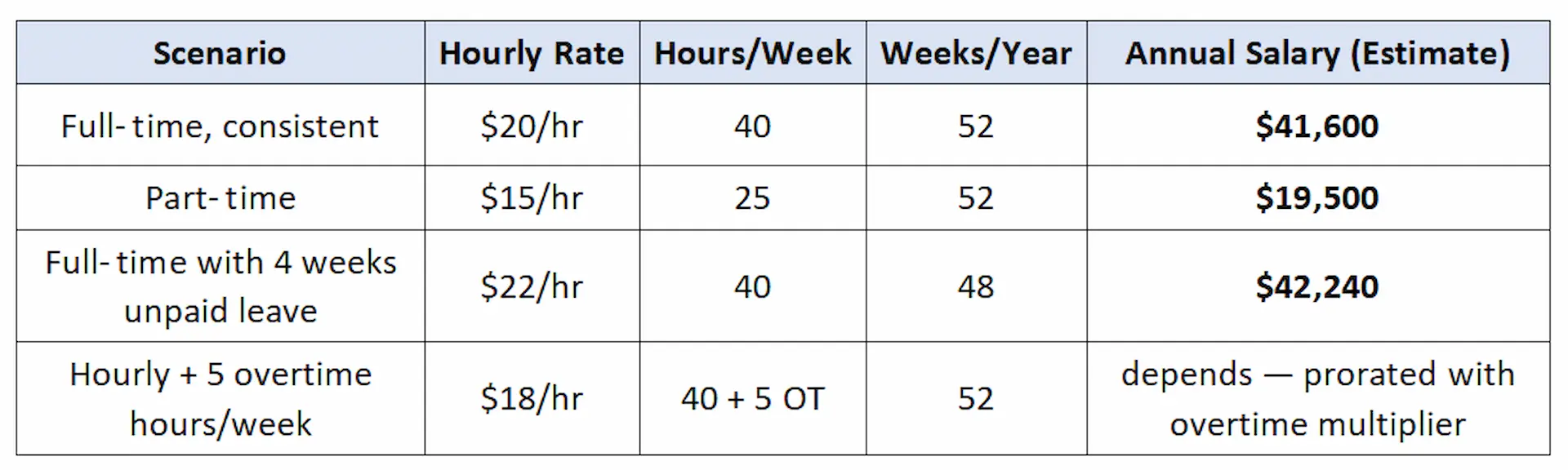
Take your hourly rate of $20 and multiply it by 40 hours per week. That gives you $800 per week in gross pay. Now multiply that $800 by 52 weeks in a year, and you arrive at $41,600 annually. This figure is based on the standard 2,080 working hours that employers and the Bureau of Labor Statistics use to define a full-time year. It assumes you work every scheduled week without unpaid time off, without overtime, and without missing any shifts.
Of course, real life rarely works that cleanly. Some weeks you might pick up extra shifts. Other weeks you might call in sick or take a vacation day without pay. But $41,600 is the baseline that answers the question of 20 an hour is how much a year for a full-time worker, and it is the number you should use when comparing job offers or planning your annual budget.
What If You Work More or Fewer Hours?
Not everyone works a perfect 40-hour week. If you are part-time at 20 hours a week, your annual gross income drops to $20,800. At 30 hours per week, you are looking at $31,200 per year. And if you regularly put in overtime, the numbers shift upward. Under the Fair Labor Standards Act, non-exempt employees earn time-and-a-half for every hour beyond 40 in a single workweek. That means your overtime rate jumps to $30 per hour. So a worker averaging 50 hours a week would earn $800 for the first 40 hours plus $300 for the extra 10 hours of overtime, totaling $1,100 per week or roughly $57,200 per year. Some states like California also require double-time pay at $40 per hour for shifts exceeding 12 hours, which pushes that ceiling even higher.
Breaking Down Your $20 Per Hour Paycheck
Knowing your annual gross income is helpful, but most people think in terms of what hits their bank account each pay period. Let us break $41,600 into the chunks you will actually see on your pay stubs.
Monthly Income
Divide $41,600 by 12 months and you get approximately $3,467 per month before any deductions. When people look up $20 an hour is how much a year, this monthly figure is often what they actually need for day-to-day planning. This is the number landlords and mortgage lenders look at when they evaluate your ability to pay rent or qualify for a home loan. Most financial advisors recommend keeping your housing costs at or below 30 percent of your gross monthly income, which means you should aim for rent or a mortgage payment no higher than about $1,040 per month on this salary.
Biweekly and Weekly Pay
If your employer pays you every two weeks, which is the most common payroll cycle in the United States, your gross paycheck will be $1,600 before taxes. That covers 80 hours of work across two weeks. On a weekly basis, you are earning $800 gross, and on a single eight-hour shift, you take home $160 before deductions. These numbers help when you are trying to figure out how much to set aside from each check for bills, groceries, and savings.
How Does $20 Per Hour Stack Up Nationally?
Here is some perspective. The Bureau of Labor Statistics reported that average hourly earnings for private-sector workers sat at roughly $35.93 as of early 2026. At $20 an hour, your wage falls about 44 percent below that national average. That sounds discouraging at first glance, but the average gets pulled up by high earners in finance, tech, and medicine. The national median hourly wage tells a more honest story, and that figure sits around $23.11 for all occupations. So earning $20 per hour puts you about 13 percent below the median, which is a much smaller gap than the average suggests. It is also worth noting that $20 an hour is roughly 2.76 times the federal minimum wage of $7.25, which has not budged since July 2009. In many parts of the country, this wage provides a solid foothold for building financial stability.
20 Dollars an Hour Is How Much a Year After Taxes?
Gross pay and take-home pay are two very different numbers, and the gap between them catches a lot of people off guard. When you look up 20 dollars an hour is how much a year, most calculators show you the gross figure. But federal income tax, Social Security, Medicare, and potentially state income tax all take their cut before your paycheck reaches your bank account. Understanding these deductions is essential if you want to budget accurately.
Federal Income Tax
For the 2025 tax year, the standard deduction for a single filer is $15,750, which was boosted by the One Big Beautiful Bill Act signed into law in mid-2025. If you earn $41,600 gross and take the standard deduction, your taxable income drops to roughly $25,850. Under the current seven-bracket system, here is how federal income tax breaks down for a single filer. The first $11,925 of taxable income is taxed at 10 percent, which comes to about $1,192. The remaining $13,925 falls into the 12 percent bracket, adding approximately $1,671. Your total estimated federal income tax bill lands around $2,863 for the year. Keep in mind that this is a simplified estimate. Your actual liability will vary based on your filing status, whether you itemize deductions, and any tax credits you qualify for. The Child Tax Credit alone is worth $2,200 per qualifying child in 2026, which can dramatically reduce what you owe.
FICA Taxes: Social Security and Medicare
On top of federal income tax, every worker pays FICA taxes. Social Security takes 6.2 percent of your gross earnings, which works out to $2,579 on a $41,600 salary. Medicare takes another 1.45 percent, or $603. Combined, your FICA contribution totals $3,182 per year. These withholdings are automatic and non-negotiable, regardless of your filing status or deductions.
Your Estimated Take-Home Pay
When you subtract federal income tax and FICA from your gross annual pay, you are left with approximately $35,555 per year in take-home pay at the federal level. That works out to about $2,963 per month or $1,367 every two weeks. But if you live in a state with income tax, expect your net pay to shrink further. States like California, New York, and Oregon charge income tax rates that can exceed 9 to 10 percent at higher brackets. On the other hand, states like Texas, Florida, Wyoming, and Nevada charge zero state income tax, letting you keep more of your earnings. When all is said and done, your effective hourly rate after federal taxes and FICA drops from $20 to roughly $17.09. That difference of nearly $3 per hour adds up to thousands of dollars over a full year, which is why understanding taxes matters so much when you ask $20 an hour is how much a year in real-world terms.
Can You Actually Live on $20 an Hour in 2026?
This is the question behind the question. People do not just want to know 20 per hour is how much per year as a math exercise. They want to know whether that number is enough to pay the bills, save for the future, and enjoy life without constant financial stress. The honest answer is that it depends almost entirely on where you live and how you spend.
Location Changes Everything
A $41,600 salary stretches much further in states where the cost of living falls below the national average. States like Mississippi, Arkansas, Kentucky, Ohio, and Oklahoma offer significantly lower housing, grocery, and transportation costs. A two-bedroom apartment in many Ohio cities rents for around $980 per month, which fits comfortably within the recommended 30 percent housing guideline for someone earning $20 an hour. On the other end of the spectrum, that same apartment costs well over $3,000 per month in San Francisco, $2,800 in New York City, and $2,500 or more in cities like Boston and Seattle. In those markets, $41,600 per year barely covers rent, let alone food, transportation, and insurance. So the answer to whether $20 per hour is how much per year that you can live on really comes down to your zip code.
Who Makes It Work and Who Struggles
A single person with no dependents living in a low-cost or mid-cost area can generally manage on $20 an hour. It is not luxury living, but it is stable. You can cover your essentials, put a little into savings each month, and still have some room for entertainment and personal spending. A young worker or recent college graduate living with roommates or family has an even easier time making this wage work, since shared housing costs can cut rent obligations in half. A single parent, however, faces a much tougher situation. Childcare alone can cost $800 to $1,500 per month depending on the state, eating up a massive chunk of take-home pay. And a mid-career professional in a major metro area will find this wage difficult to sustain as a sole income without a second earner or significant side income. The bottom line is that $20 an hour provides a workable foundation for many Americans, but it requires smart budgeting and thoughtful choices about how and where you live. The real answer to $20 an hour is how much a year is not just a number — it is a lifestyle shaped by your decisions.
Smart Budgeting When You Earn $20 an Hour
Knowing that 20 an hour is how much a year in gross and net terms is only useful if you have a plan for spending that money wisely. Without a budget, even a decent paycheck disappears fast. Here is how to structure your finances on this income so you cover your needs, enjoy your life, and still build a financial cushion.
A Realistic Monthly Budget Using the 50/30/20 Rule
Starting with your estimated monthly take-home of roughly $2,963, the 50/30/20 framework gives you a clear and simple structure. Fifty percent of your income, about $1,482, goes toward needs. This covers rent or mortgage, utilities, groceries, basic transportation, health insurance, and minimum debt payments. Thirty percent, roughly $889, goes toward wants. This includes dining out, streaming subscriptions, hobbies, non-essential shopping, gym memberships, and entertainment. The remaining twenty percent, approximately $593, goes toward savings and extra debt payments. This is money you funnel into an emergency fund, a retirement account like a 401(k) or IRA, or extra payments on high-interest debt.
This framework is a starting point, not a rigid rule. If your rent eats up more than 50 percent of your take-home pay, you will need to borrow from the wants category. If you have no debt at all, you might push more into savings. The point is to give every dollar a job instead of wondering where your paycheck went by the end of the month.
Practical Ways to Stretch Every Dollar
Housing is your biggest lever. If you can keep rent below $1,000 per month through roommates, a smaller apartment, or living in a more affordable part of town, you free up hundreds of dollars each month for everything else. Anyone earning $41,600 per year knows that keeping a roof over your head at a reasonable cost is what separates comfort from paycheck-to-paycheck stress. Transportation is the second biggest expense for most households. Avoid carrying multiple car payments on this income. A reliable used car that is fully paid off, public transit, or carpooling can save you $300 to $500 per month compared to financing a new vehicle. Food costs matter more than people realize. Cooking at home and meal planning can keep your grocery bill between $250 and $350 per month for one person. Eating out regularly, even at casual restaurants, can easily push that number past $600 or $700. The difference over a year is thousands of dollars. Take full advantage of employer benefits. If your company offers a 401(k) match, contribute at least enough to capture the full match. That is free money. Use employer-provided health insurance rather than buying your own on the marketplace, and look into health savings accounts or flexible spending accounts if they are available.
Paying Down Debt on a $41,600 Salary
If you are carrying debt, especially high-interest credit card balances, getting aggressive about repayment is one of the smartest financial moves you can make on this income. Start by listing your debts from highest interest rate to lowest. Focus extra payments on the highest-rate balance first while making minimum payments on everything else. This approach, known as the avalanche method, saves you the most money in interest over time. Even modest extra payments of $50 to $100 per month above the minimum can shave years off your repayment timeline and save you hundreds or thousands of dollars in interest charges. While you are paying down existing debt, avoid taking on new consumer debt. That means holding off on financing furniture, electronics, or vacations until your balances are under control.
Jobs That Pay Around $20 Per Hour Worth Exploring
If you are currently earning less than $20 per hour, or if you are just entering the workforce and targeting this wage, there are plenty of roles across different industries that consistently hit this pay range. Once you know that 20 per hour is how much per year, the next step is finding the right role to reach that income. Many of them do not require a four-year college degree, which makes them accessible to a wide range of workers.
In-Demand Roles at the $20 Per Hour Range
Administrative assistants earn around $20 per hour in many metropolitan areas, handling scheduling, correspondence, and office management. Customer service representatives, particularly those in specialized or senior-level positions, frequently reach the $20 mark. Warehouse and logistics associates, especially with companies like Amazon, UPS, and FedEx, often start at or near this rate, with opportunities for overtime. Licensed practical nurses and certified nursing assistants in certain regions can earn $20 an hour or more, particularly in states facing healthcare staffing shortages. Retail shift supervisors and store managers at mid-size chains regularly land in this pay range as well. On the skilled trade side, construction laborers, electrician apprentices, plumber apprentices, and HVAC trainees commonly start at $18 to $22 per hour, with wages climbing steeply as they complete certifications. Freelance graphic designers, virtual assistants, and bookkeepers working independently often set their own rates at $20 or above, even at the entry level. Delivery drivers who work for gig platforms can also hit $20 per hour or more after factoring in tips and bonuses, though income varies based on market and hours worked.
How to Move Beyond $20 an Hour
Earning $20 an hour is a solid starting point, but it does not have to be your ceiling. Now that you understand 20 dollars an hour is how much a year after taxes and deductions, you can set a clear target for what you want to earn next. Pursuing certifications or licenses in your field is one of the fastest ways to boost your pay. A certified medical assistant earns more than an uncertified one. A forklift-certified warehouse worker qualifies for higher-paying positions. A project management certification can open doors to supervisory roles with significantly better compensation. Take advantage of employer-sponsored education benefits if they are available. Many companies will pay for courses, certifications, or even partial tuition toward a degree. Building experience within a single company and negotiating raises during annual reviews is another reliable path upward. And if your primary job caps out, adding a side hustle like freelancing, tutoring, reselling, or part-time remote work can bring in an extra $500 to $1,500 per month, effectively raising your hourly rate well beyond $20.
Final Thoughts
So, $20 an hour is how much a year? It is $41,600 in gross income and roughly $35,555 after federal taxes for a single filer. Those numbers put you well above the federal minimum wage and within striking distance of the national median hourly pay. Whether that amount gives you a comfortable life depends entirely on your choices, your location, and how deliberately you manage your money.
For a single person in an affordable area, $20 per hour provides a stable income that covers essentials and leaves room for saving. For someone with dependents or living in an expensive city, it will require tighter budgeting, shared housing, or supplemental income to make things work. Either way, the key takeaway when asking $20 an hour is how much a year is to plan around your actual take-home pay rather than your gross earnings, because the gap between those two numbers is wider than most people expect.
Use this breakdown as a starting point. Map out your monthly expenses, figure out where your money goes, and set a savings goal, even if it starts small. A $20 per hour wage is a real foundation. Plenty of people have built solid financial lives on it, and with the right habits, you can too. The fact that you searched for the answer to $20 an hour is how much a year tells me you are already thinking about your money more carefully than most people do. That is the first step toward making it work for you.
FAQ 1: $20 an hour is how much a year before taxes?
If you work 40 hours per week for all 52 weeks in a year, $20 an hour equals $41,600 per year before any deductions. This calculation uses the standard 2,080 annual working hours that employers and the Bureau of Labor Statistics rely on for full-time positions. Keep in mind that this is gross income, and your actual take-home pay will be lower once federal and state taxes, Social Security, and Medicare are subtracted.
FAQ 2: How much is $20 an hour after taxes?
After federal income tax and FICA deductions, a single filer earning $20 an hour takes home roughly $35,500 per year, or about $2,960 per month. This estimate uses the 2025 standard deduction of $15,750 for a single filer and does not include state income tax. If you live in a state with no income tax like Texas or Florida, you keep the full amount. In higher-tax states like California or New York, your net pay will drop further.
FAQ 3: Is $20 an hour a good salary in 2026?
It depends on where you live and your personal financial obligations. The national median hourly wage sits around $23.11, which means $20 an hour falls roughly 13 percent below the middle. In affordable states like Mississippi, Ohio, or Kentucky, this wage offers a comfortable baseline for a single person. In expensive cities like San Francisco, New York, or Boston, it will likely fall short unless you have a second income, a roommate, or very tight spending discipline.
FAQ 4: How much is $20 an hour per month?
At 40 hours per week, $20 an hour works out to approximately $3,467 per month before taxes. After estimated federal income tax and FICA, your monthly take-home pay drops to around $2,960. This figure does not account for state taxes, health insurance premiums, or retirement contributions that may also be deducted from your paycheck.
FAQ 5: How much is $20 an hour biweekly?
Your gross biweekly paycheck at $20 an hour is $1,600, based on 80 hours worked across two weeks. Most employers in the United States use a biweekly pay schedule, which means you receive 26 paychecks per year. After taxes, your biweekly take-home pay will typically land somewhere between $1,250 and $1,400 depending on your tax bracket and state of residence.
FAQ 6: How much is $20 an hour per week?
Working a standard 40-hour week at $20 per hour gives you $800 per week in gross pay. If you work fewer hours, such as a 30-hour part-time schedule, your weekly gross drops to $600. On the flip side, overtime hours are paid at time-and-a-half ($30 per hour) under federal law, so a 50-hour week would bring in $1,100 gross.
FAQ 7: How much is $20 an hour per day?
An eight-hour workday at $20 per hour earns you $160 before taxes. If you work a shorter shift of six hours, your daily gross income would be $120. Knowing your daily rate is useful for tracking income on weeks where your hours vary or when comparing the day-to-day value of different job offers.
FAQ 8: What is time and a half for $20 an hour?
Time and a half for $20 an hour is $30 per hour. Under the Fair Labor Standards Act, non-exempt employees are entitled to this overtime rate for every hour worked beyond 40 in a single workweek. Some states, like California, also require double-time pay at $40 per hour for hours worked beyond 12 in a single shift. These overtime protections apply to hourly workers who are classified as non-exempt under federal law.
FAQ 9: How much rent can I afford making $20 an hour?
Financial experts recommend spending no more than 30 percent of your gross monthly income on housing. At $20 an hour with a 40-hour workweek, your gross monthly income is about $3,467, which means your rent should ideally stay at or below $1,040 per month. In many midsize and smaller cities across the United States, this is achievable with a one-bedroom or shared apartment. In major metro areas, you will likely need a roommate to stay within this guideline.
FAQ 10: Can I buy a house on $20 an hour?
It is possible in low-cost housing markets where homes are priced under $150,000, but it requires a solid credit score, a manageable debt-to-income ratio, and a saved down payment. On a $41,600 annual salary, most mortgage lenders would approve you for a home priced between $120,000 and $160,000 depending on your existing debts and down payment. In most suburban and urban markets, this wage alone will not qualify you for a mortgage without a co-borrower or supplemental income.
FAQ 11: Can you live on $20 an hour in 2026?
Yes, but where and how you live matters enormously. A single person with no dependents can live comfortably on $20 an hour in states with a below-average cost of living, such as Arkansas, Ohio, Oklahoma, or Kentucky. In high-cost cities, this income barely covers rent. The key factors are housing costs, whether you have dependents, outstanding debt, and how disciplined you are with budgeting.
FAQ 12: Is $20 an hour above the federal minimum wage?
Yes. The federal minimum wage has been $7.25 per hour since July 2009, which means $20 an hour is approximately 2.76 times higher. However, many states and cities have enacted their own minimum wage laws well above the federal floor. In states like Washington and California, the minimum wage already exceeds $16 per hour, which narrows the gap considerably.
FAQ 13: How does $20 an hour compare to the national average wage?
The Bureau of Labor Statistics reported average hourly earnings for private-sector workers at approximately $35.93 in early 2026. At $20 per hour, your wage sits about 44 percent below the national average. However, the national median hourly wage of roughly $23.11 is a fairer comparison point because averages are inflated by very high earners. At $20 per hour, you are about 13 percent below the median, which is a much narrower gap.
FAQ 14: How much tax do I pay on a $41,600 salary?
For a single filer using the 2025 standard deduction of $15,750, your taxable income is approximately $25,850. Federal income tax on that amount comes to roughly $2,860 using the 10 percent and 12 percent brackets. On top of that, you owe $2,579 in Social Security tax and $603 in Medicare tax, bringing your total federal tax burden to approximately $6,045. State income tax, if applicable, adds to this amount.
FAQ 15: What is $20 an hour salary for part-time workers?
Part-time earnings at $20 an hour depend on your weekly schedule. At 20 hours per week, you earn $20,800 per year. At 25 hours per week, that rises to $26,000. At 30 hours per week, your annual gross hits $31,200. Part-time workers should also keep in mind that their income is more sensitive to missed shifts or reduced hours since there is less margin in the paycheck to absorb lost time.
FAQ 16: What jobs pay $20 an hour without a college degree?
A wide range of roles pay $20 per hour or more without requiring a four-year degree. Common positions include warehouse and logistics associates, delivery drivers, licensed practical nurses, certified nursing assistants, administrative assistants, retail shift supervisors, construction laborers, plumber and electrician apprentices, solar panel installers, truck drivers, and freelance virtual assistants. Many of these roles rely on certifications, on-the-job training, or trade school credentials rather than traditional college education.
FAQ 17: How much should I save each month earning $20 an hour?
Using the 50/30/20 budgeting framework, you should aim to save at least 20 percent of your after-tax income. On a monthly take-home of roughly $2,960, that means setting aside about $590 per month for savings, which includes emergency fund contributions, retirement investing, and extra debt payments. Even if you cannot hit the full 20 percent right away, starting with $100 or $200 per month and gradually increasing it will make a meaningful difference over time.
FAQ 18: Can I contribute to a 401(k) on a $20 an hour salary?
Absolutely. If your employer offers a 401(k) plan with a company match, contributing at least enough to capture the full match should be a top priority because it is essentially free money. On a $41,600 salary, even a modest contribution of 5 to 6 percent adds up to $2,080 to $2,496 per year going toward retirement. Over decades, that investment compounds significantly and can be the difference between retiring comfortably or falling short.
FAQ 19: How much is $20 an hour annually with two weeks of unpaid vacation?
If you take two weeks of unpaid time off per year, you work 50 weeks instead of 52. At $20 an hour and 40 hours per week, that brings your annual gross income to $40,000 instead of $41,600. The $1,600 difference may seem small, but it can impact your monthly budget by about $133 per month. This is a common scenario for hourly workers who do not receive paid vacation time.
FAQ 20: Is $20 an hour enough to raise a family?
For most families, $20 an hour as the sole household income will be very tight. A family of four typically needs a combined household income of $50,000 to $70,000 or more depending on location. Childcare alone can cost $800 to $1,500 per month in many states. Dual-income households where both partners earn around $20 per hour are in a much stronger position, with a combined gross of $83,200 per year before taxes.
FAQ 21: How much is $20 an hour compared to the poverty line?
A single person working full-time at $20 an hour earns $41,600 per year, which is well above the 2025 federal poverty guideline of $15,650 for a one-person household. For a family of four, the poverty threshold is $32,470, meaning a single earner at $20 per hour still clears the line by about $9,000. However, clearing the poverty threshold does not necessarily mean living comfortably, especially in higher-cost regions of the country.
FAQ 22: How many hours do I need to work at $20 an hour to make $50,000 a year?
To earn $50,000 per year at $20 an hour, you would need to work approximately 2,500 hours, which breaks down to about 48 hours per week for all 52 weeks. If your employer pays overtime at time-and-a-half for hours beyond 40, you would only need to work about 46.5 hours per week because those extra hours are paid at $30 per hour instead of $20. Alternatively, adding a side income of roughly $160 per week would close the gap without requiring overtime.
FAQ 23: What is the difference between $20 an hour and $25 an hour annually?
At 40 hours per week for 52 weeks, $20 an hour equals $41,600 per year and $25 an hour equals $52,000 per year. The difference is $10,400 annually, or roughly $867 per month before taxes. That gap is significant enough to cover a car payment, boost your savings by over $500 a month, or meaningfully improve your quality of life. Pursuing certifications, switching employers, or negotiating raises are common ways to bridge that $5-per-hour gap.
FAQ 24: Is $20 an hour enough to live alone in 2026?
For a single person without dependents, $20 an hour is generally enough to live alone in cities and towns where the cost of living falls at or below the national average. You will need to find housing that stays under $1,040 per month, keep transportation costs manageable, and cook most meals at home. In expensive metro areas, living alone on this wage is extremely difficult without earning additional income from a side hustle, freelance work, or a second job.